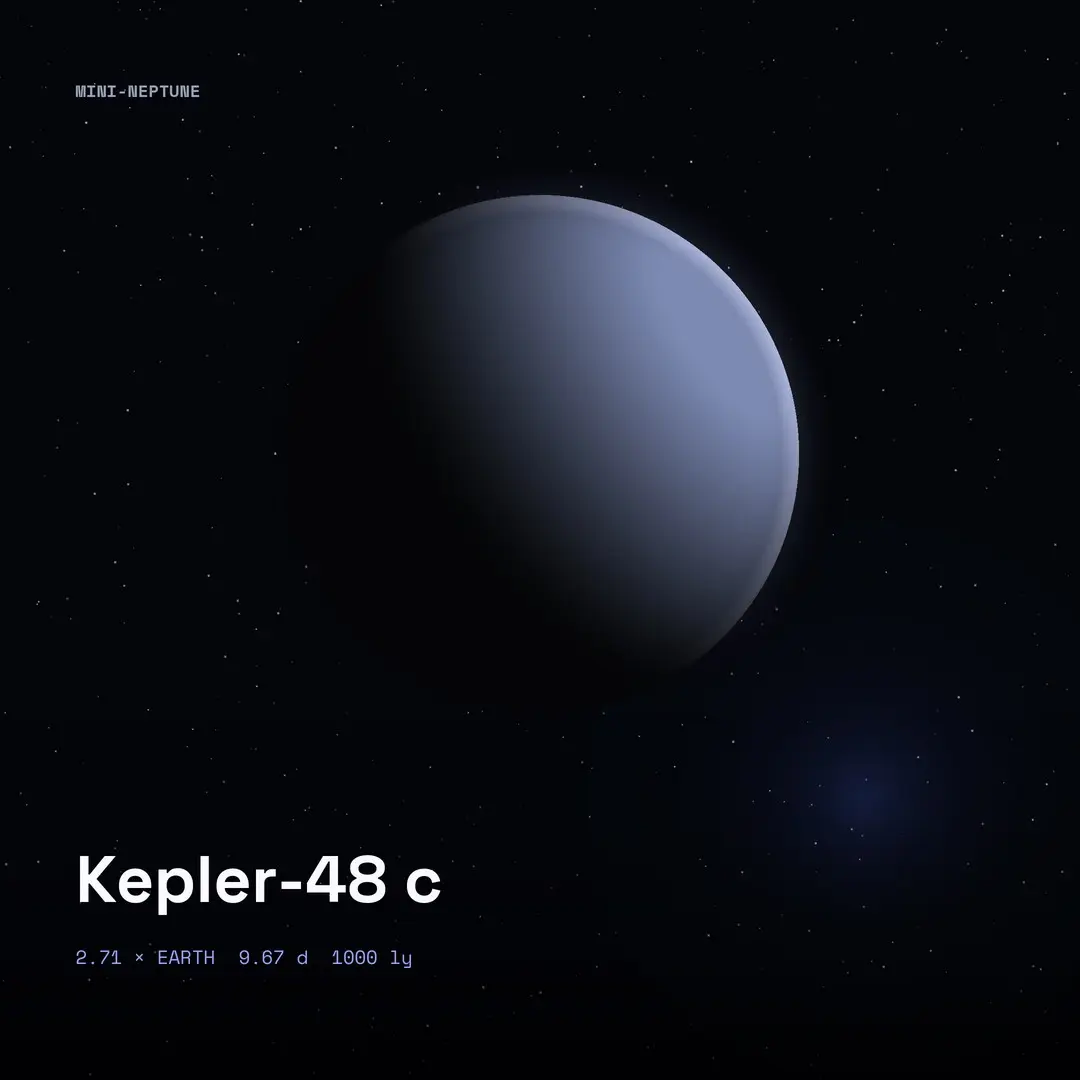
Kepler-48 c: 14.6 Earth Masses
Mini-neptune around Kepler-48
It is 2.71 times Earth's radius, closest in size to Neptune, and 14.6 times Earth's mass, at 4.01 g/cm3, less dense than Earth. A year there lasts 9.67 days. The host star Kepler-48 runs at 5194 K with 0.88 times the Sun's mass.
Radius
2.71 Earth radii
Mass
14.6 Earth masses
One year
9.67 days
Host star
Kepler-48 at 5194 K
Distance
1000 light-years
Starlight blocked
0.078% at each transit
What the archive holds on this planet
A radius from transit photometry. Yes.
A weight, not just a width. Yes.
A density, which decides rock or gas. Yes.
A semi-major axis. No.
A measured temperature rather than a derived one. No.
An eccentricity, so we know if the orbit is a circle. No.
What the transit gives
The depth of the dip is the ratio of the two discs, so the radius follows.
Found by Kepler in 2012. Kepler watched a single field continuously, so it found the planets that come round often. A world with a long year simply never repeated within the mission.
Size from the shadow, mass from elsewhere. Most transiting planets never get the second half, and without it composition stays a guess.
Kepler-48 has 5 known planets. Planets in company tug on each other, and those tugs are measurable, which is how masses get pinned down without a wobble.
