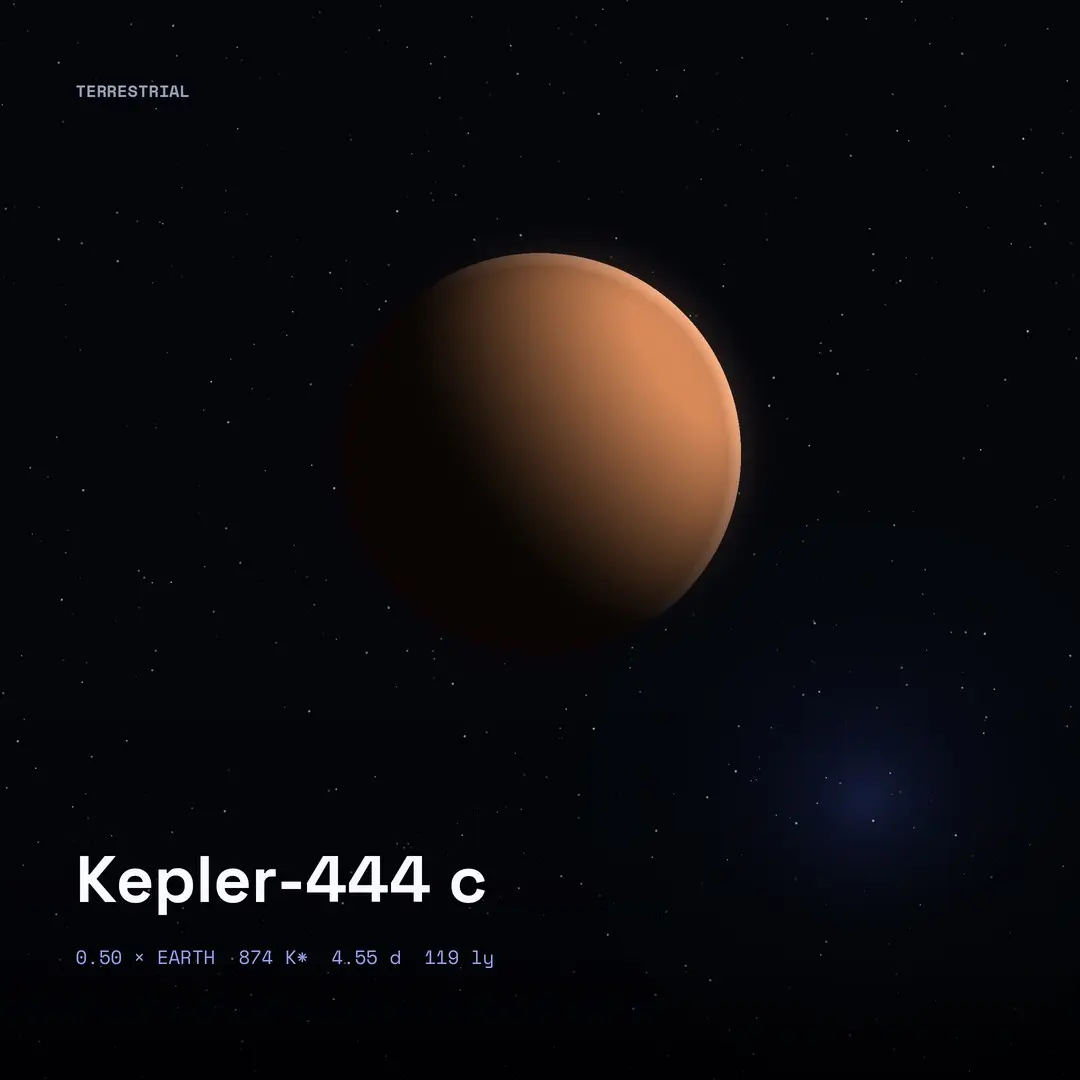
Kepler-444 c: 0.50 Times Earth
Terrestrial around Kepler-444
It is 0.50 times Earth's radius, closest in size to Mars. A year there lasts 4.55 days, on an orbit 8 times closer to its star than Mercury is to the Sun. Its equilibrium temperature is 874 K (derived from the star rather than measured), hot enough to melt lead. The host star Kepler-444 runs at 5046 K with 0.76 times the Sun's mass.
Kepler-444 from the inside out
Orbit
/
Planet
Radius
0.50 Earth radii
Equilibrium temperature
874 K (derived)
One year
4.55 days
Orbit radius
0.0488 AU
Host star
Kepler-444 at 5046 K
Distance
119 light-years
Starlight blocked
0.004% at each transit
What you get from the shadow
How deep the star dims fixes the planet's size relative to it.
0.50xEarth: smaller than Venus
What has been measured here and what has not
A measured radius. Yes.
A mass. No.
A density, the one clue to composition. No.
How far out it orbits. Yes.
An observed temperature. No.
An eccentricity, so we know if the orbit is a circle. Yes.
The archive lists no measured equilibrium temperature for this planet. The 874 K quoted here is derived from the star's output and the orbital distance, assuming a third of the light is reflected. It is an estimate from two numbers, not an observation.
Found by Kepler in 2015. The mission traded sky coverage for depth, holding one view for years. That bias runs through its whole catalogue and through this planet's discovery.
Found by watching its star dim as it crossed in front. That measures size and not weight, which is why there is a radius here and no mass.
Kepler-444 has 5 known planets. Systems like this are the ones where architecture can be studied instead of guessed at.
Half the temperatures quoted for exoplanets are calculated from the star, not \
measured at the planet. Should a page like this show them at all, or leave the field blank?