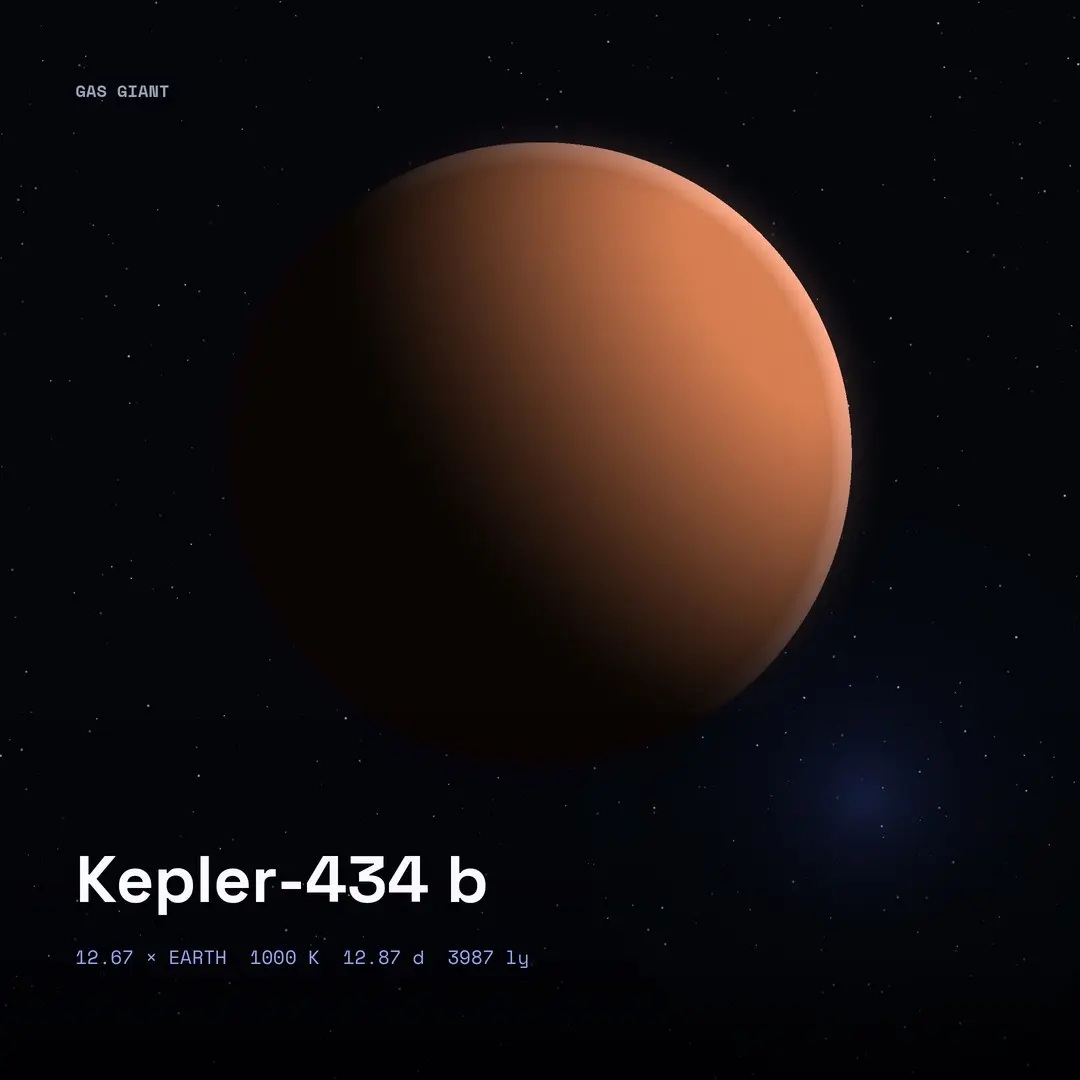
Kepler-434 b: 909.0 Earth Masses
Gas giant around Kepler-434
It is 1.13 times Jupiter's radius, closest in size to Jupiter, and 909.0 times Earth's mass, at 2.40 g/cm3, less dense than Earth. A year there lasts 12.87 days, on an orbit 3 times closer to its star than Mercury is to the Sun. Its equilibrium temperature is 1000 K, hot enough to melt lead. The host star Kepler-434 runs at 5977 K with 1.20 times the Sun's mass.
Radius
12.67 Earth radii
Mass
909.0 Earth masses
Equilibrium temperature
1000 K (measured)
One year
12.87 days
Orbit radius
0.1143 AU
Host star
Kepler-434 at 5977 K
Distance
3987 light-years
Starlight blocked
0.707% at each transit
What a crossing measures
How deep the star dims fixes the planet's size relative to it.
Found by Kepler in 2015. Kepler stared at one patch of sky for four years, which is why so many of its planets have short periods: a planet only counts once you have seen it cross several times.
Two independent measurements sit behind this page: a dip in starlight for the size, and something else entirely for the mass. Together they make a density.
