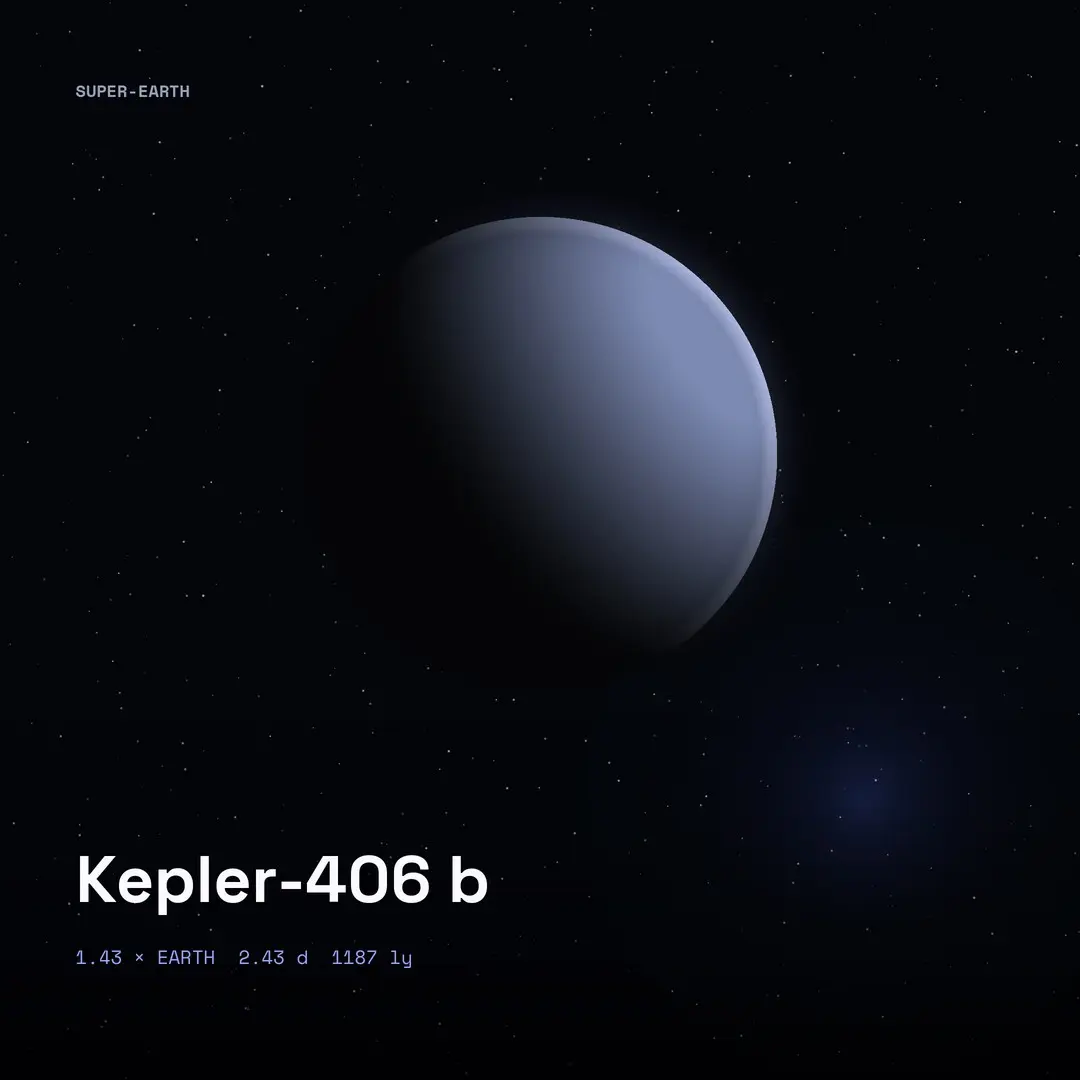
Kepler-406 b: 11.8 Grams Per Cubic Centimetre
Super-earth around Kepler-406
It is 1.43 times Earth's radius, closest in size to Earth, and 6.3 times Earth's mass, at 11.82 g/cm3, denser than Earth. A year there lasts 2.43 days. The host star Kepler-406 runs at 5538 K with 1.07 times the Sun's mass.
11.8g/cm3: denser than iron at Earth surface pressure
Radius
1.43 Earth radii
Mass
6.3 Earth masses
One year
2.43 days
Host star
Kepler-406 at 5538 K
Distance
1187 light-years
Starlight blocked
0.015% at each transit
Known and unknown, as the archive has it
A size. Yes.
A mass. Yes.
A density, so rock and gas can be told apart. Yes.
A semi-major axis. No.
An observed temperature. No.
An eccentricity, so we know if the orbit is a circle. No.
What the transit gives
How deep the star dims fixes the planet's size relative to it.
A transit gives the radius and a separate measurement gives the mass. Having both is what makes a density, and a density is the only clue to composition at this range.
Found by Kepler in 2014. Kepler stared at one patch of sky for four years, which is why so many of its planets have short periods: a planet only counts once you have seen it cross several times.
Kepler-406 has 2 known planets. Systems like this are the ones where architecture can be studied instead of guessed at.
