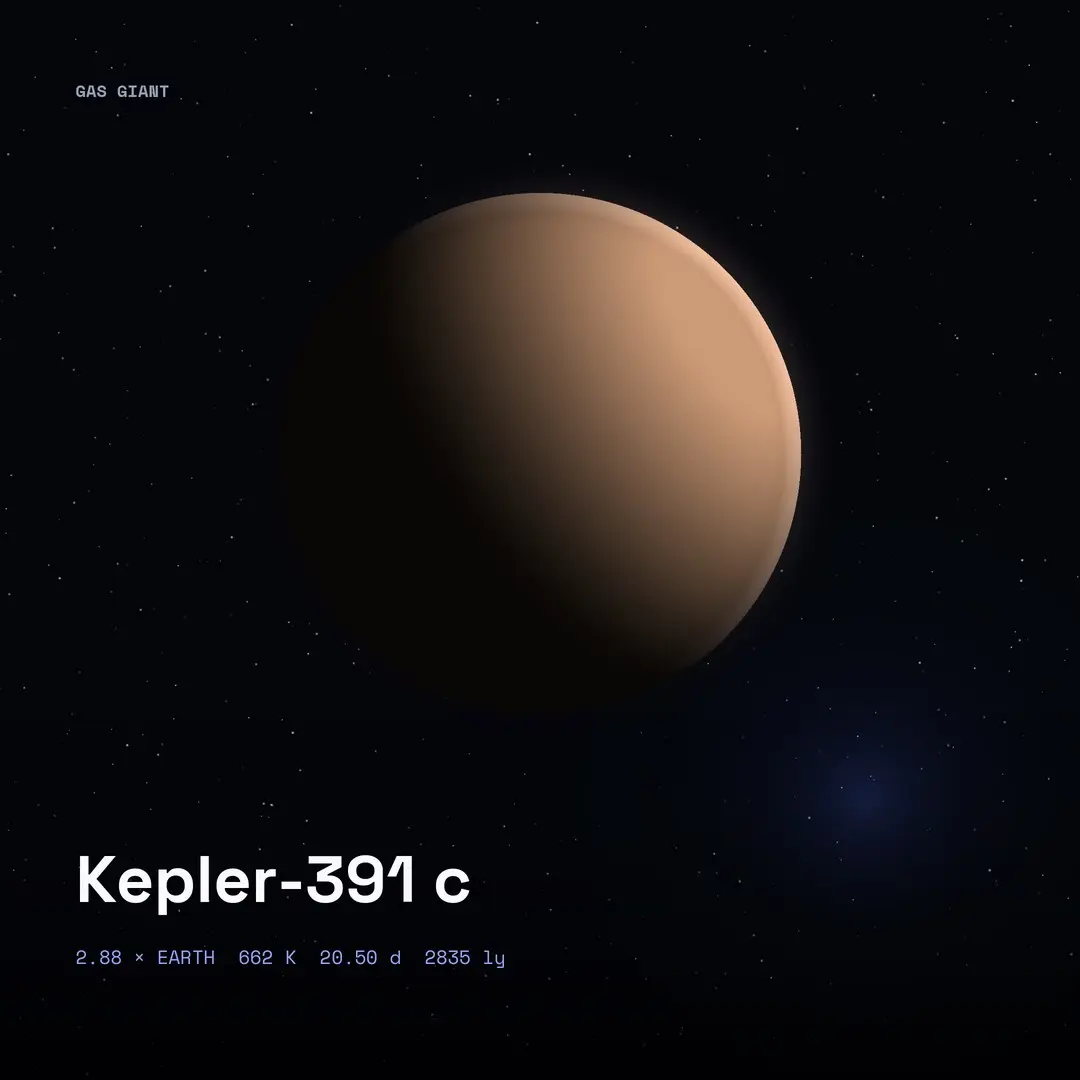
Kepler-391 c: 400.0 Grams Per Cubic Centimetre
Gas giant around Kepler-391
It is 2.88 times Earth's radius, closest in size to Neptune, and 450.0 times Earth's mass, at 400.00 g/cm3, denser than Earth. A year there lasts 20.50 days, on an orbit 2 times closer to its star than Mercury is to the Sun. Its equilibrium temperature is 662 K, hotter than any desert. The host star Kepler-391 runs at 5038 K with 1.27 times the Sun's mass.
400.0g/cm3: denser than iron at Earth surface pressure
Radius
2.88 Earth radii
Mass
450.0 Earth masses
Equilibrium temperature
662 K (measured)
One year
20.50 days
Orbit radius
0.1640 AU
Host star
Kepler-391 at 5038 K
Distance
2835 light-years
Starlight blocked
0.008% at each transit
What you get from the shadow
Block a known fraction of a known star and you have measured a width.
A transit gives the radius and a separate measurement gives the mass. Having both is what makes a density, and a density is the only clue to composition at this range.
Found by Kepler in 2014. Kepler's method needed repetition, not brightness. It could find small planets around faint stars, provided they came round quickly enough to be seen twice.
Kepler-391 has 2 known planets. Systems like this are the ones where architecture can be studied instead of guessed at.
Its orbit is noticeably elliptical, eccentricity 0.27, so the starlight it receives changes substantially over one year.
