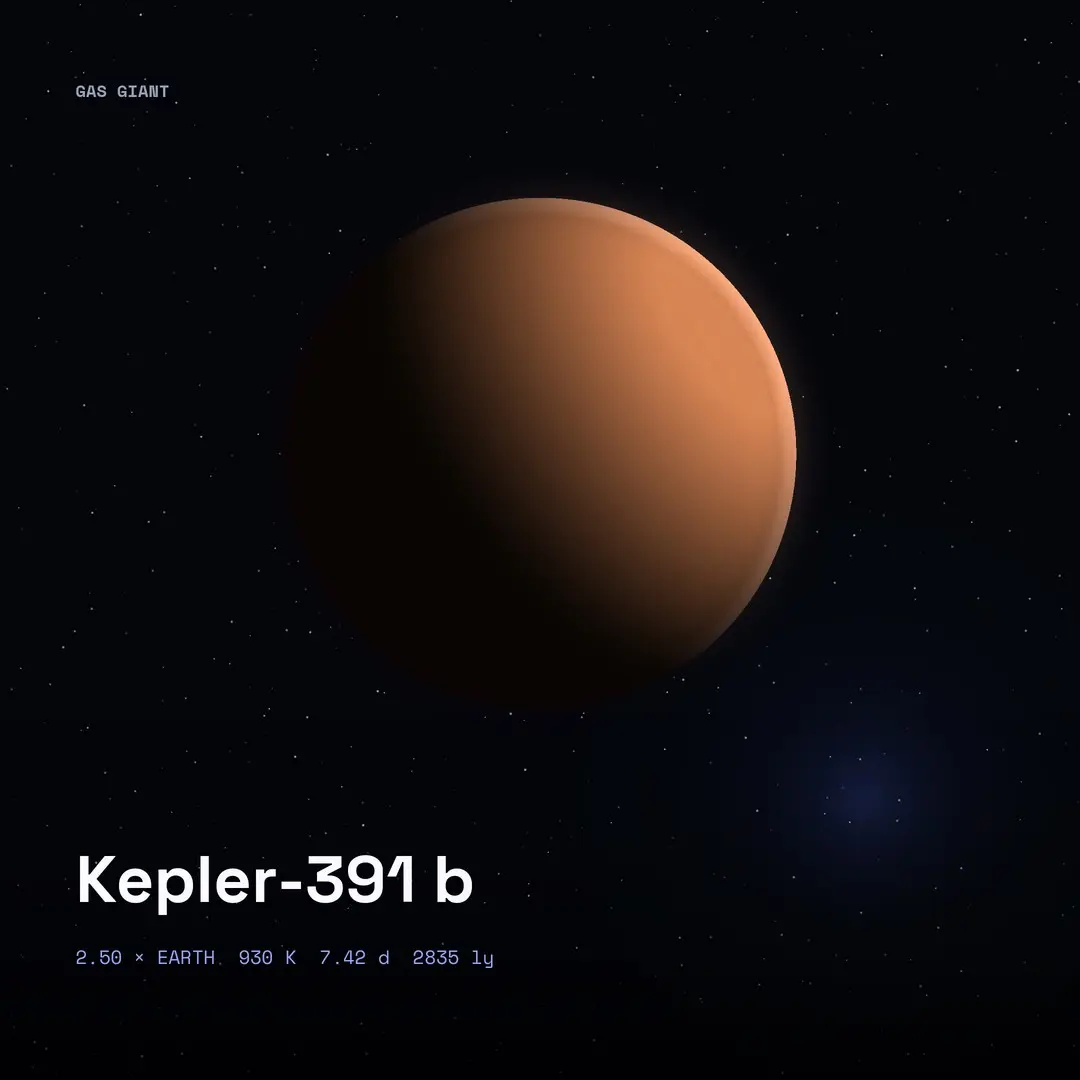
Kepler-391 b: 380.0 Grams Per Cubic Centimetre
Gas giant around Kepler-391
It is 2.50 times Earth's radius, closest in size to Neptune, and 1100.0 times Earth's mass, at 380.00 g/cm3, denser than Earth. A year there lasts 7.42 days, on an orbit 5 times closer to its star than Mercury is to the Sun. Its equilibrium temperature is 930 K, hot enough to melt lead. The host star Kepler-391 runs at 5038 K with 1.27 times the Sun's mass.
380.0g/cm3: denser than iron at Earth surface pressure
Radius
2.50 Earth radii
Mass
1100.0 Earth masses
Equilibrium temperature
930 K (measured)
One year
7.42 days
Orbit radius
0.0830 AU
Host star
Kepler-391 at 5038 K
Distance
2835 light-years
Starlight blocked
0.006% at each transit
What the transit gives
The depth of the dip is the ratio of the two discs, so the radius follows.
Size from the shadow, mass from elsewhere. Most transiting planets never get the second half, and without it composition stays a guess.
Found by Kepler in 2014. Kepler watched a single field continuously, so it found the planets that come round often. A world with a long year simply never repeated within the mission.
Kepler-391 has 2 known planets. Multi-planet systems are where orbital dynamics can be measured rather than assumed.
Its orbit is noticeably elliptical, eccentricity 0.46, so the starlight it receives changes substantially over one year.
