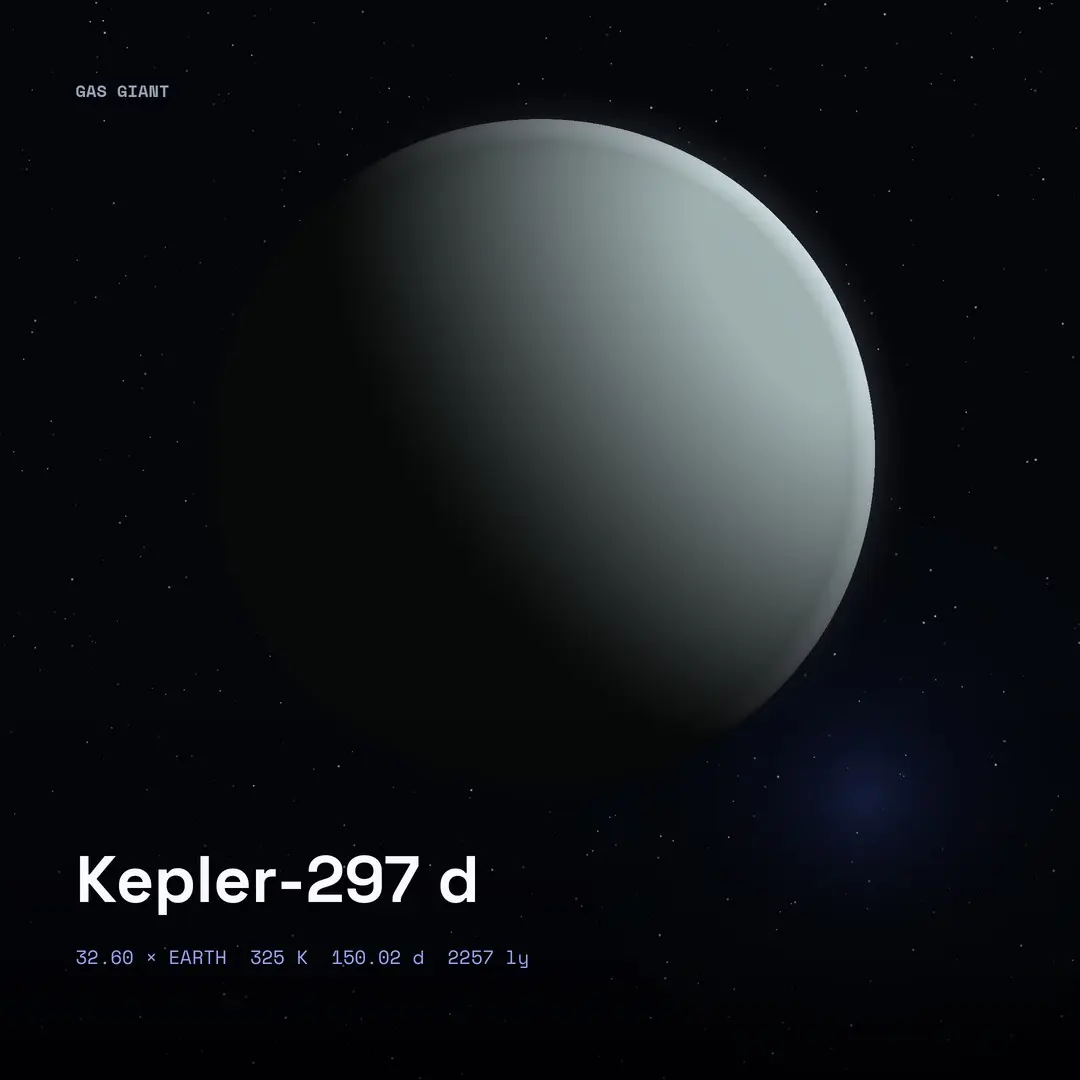
Kepler-297 d: 2.9 Times Jupiter
Gas giant around Kepler-297
It is 2.91 times Jupiter's radius, closest in size to Jupiter. A year there lasts 150.02 days, on an orbit 1.4 times Mercury's distance from the Sun. Its equilibrium temperature is 325 K, hotter than any desert. The host star Kepler-297 runs at 5618 K with 0.85 times the Sun's mass.
Kepler-297 from the inside out
Orbit
/
Planet
Radius
32.60 Earth radii
Equilibrium temperature
325 K (measured)
One year
150.02 days
Orbit radius
0.5230 AU
Host star
Kepler-297 at 5618 K
Distance
2257 light-years
Starlight blocked
11.077% at each transit
What the dip tells you
How deep the star dims fixes the planet's size relative to it.
2.9xJupiter: among the largest planets measured
The habitability checklist, honestly scored
Orbits inside the computed habitable zone. No.
A measured mass, not just a radius. No.
A measured temperature rather than one derived from the star. Yes.
Any detection of an atmosphere. Not recorded in the archive.
Kepler-297 has 3 known planets. A crowded system is worth more than the sum of its planets: the timing of each transit constrains the others.
Everything known here comes from how much light went missing. That fixes the size and leaves the mass entirely open.
Found by Kepler in 2023. Kepler stared at one patch of sky for four years, which is why so many of its planets have short periods: a planet only counts once you have seen it cross several times.
