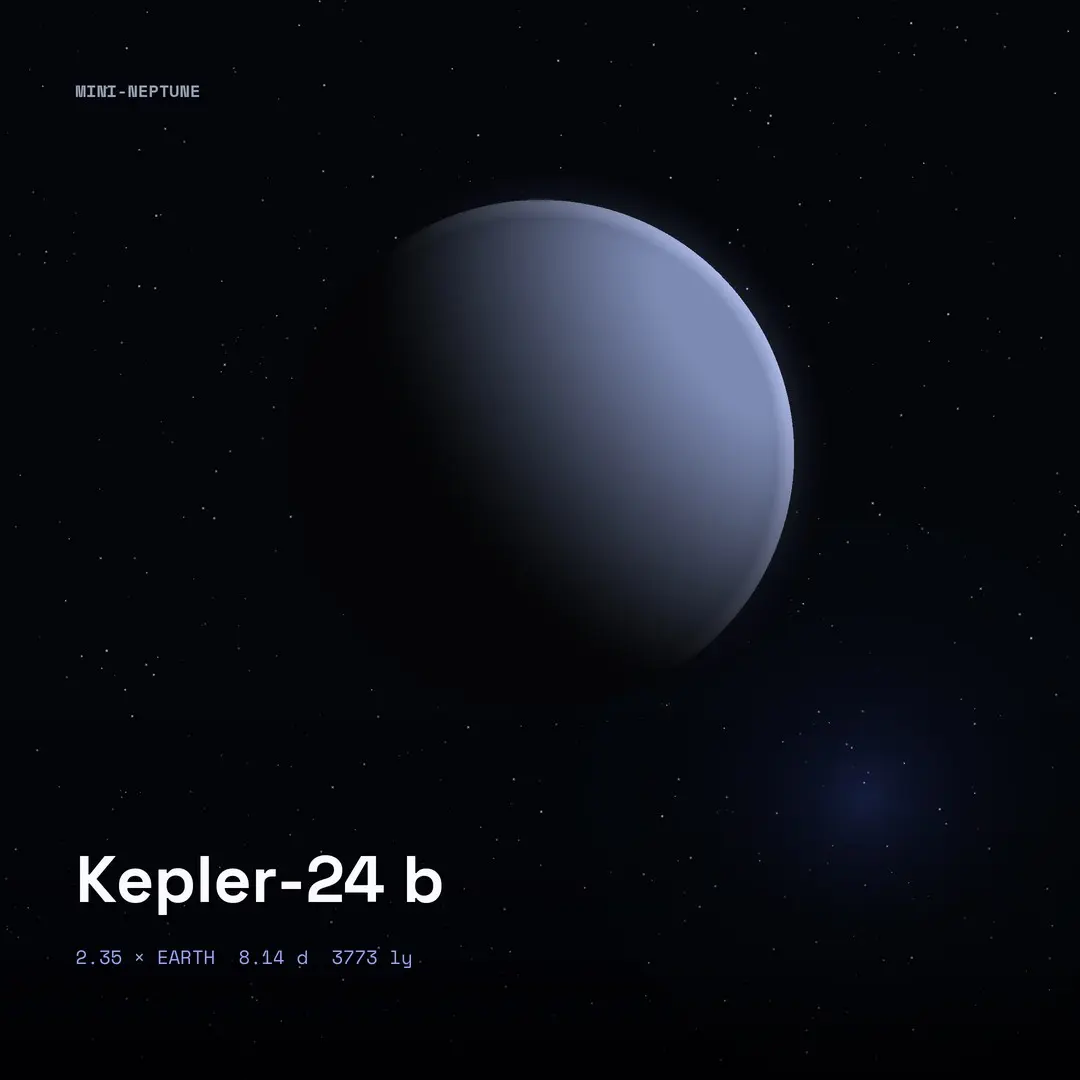
Kepler-24 b: 11.1 Earth Masses
Mini-neptune around Kepler-24
It is 2.35 times Earth's radius, closest in size to Neptune, and 11.1 times Earth's mass, at 4.69 g/cm3, less dense than Earth. A year there lasts 8.14 days. The host star Kepler-24 runs at 6028 K with 1.06 times the Sun's mass.
Radius
2.35 Earth radii
Mass
11.1 Earth masses
One year
8.14 days
Host star
Kepler-24 at 6028 K
Distance
3773 light-years
Starlight blocked
0.038% at each transit
The state of the record for this planet
A radius from transit photometry. Yes.
A weight, not just a width. Yes.
A density, so rock and gas can be told apart. Yes.
How far out it orbits. No.
A measured temperature rather than a derived one. No.
An eccentricity, so the orbit shape is known. Yes.
What you get from the shadow
The fraction of starlight blocked sets the radius against the star's.
Kepler-24 has 4 known planets. Systems like this are the ones where architecture can be studied instead of guessed at.
Two independent measurements sit behind this page: a dip in starlight for the size, and something else entirely for the mass. Together they make a density.
Found by Kepler in 2011. Kepler watched a single field continuously, so it found the planets that come round often. A world with a long year simply never repeated within the mission.
