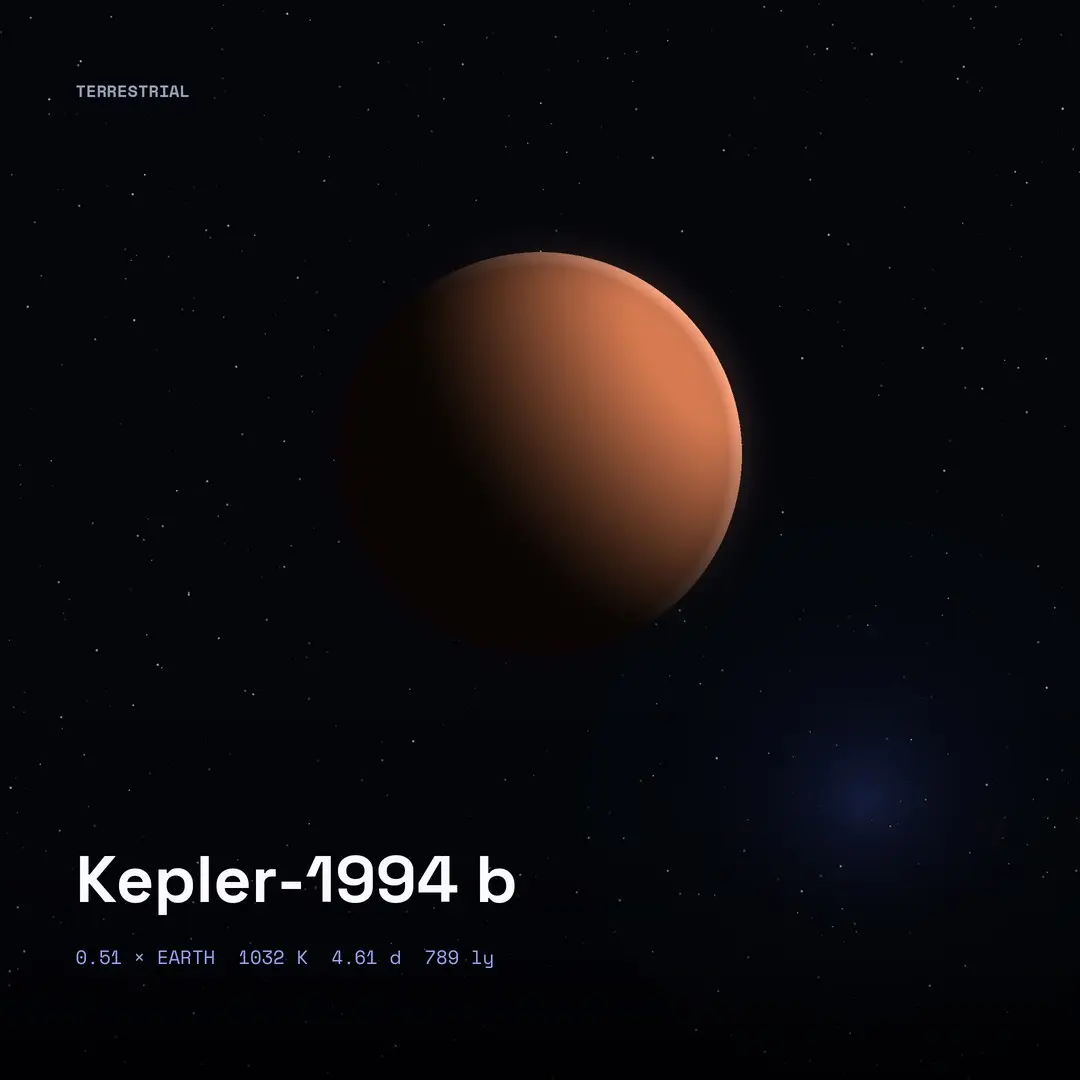
Kepler-1994 b: 0.51 Times Earth
Terrestrial around Kepler-1994
It is 0.51 times Earth's radius, closest in size to Mars. A year there lasts 4.61 days, on an orbit 7 times closer to its star than Mercury is to the Sun. Its equilibrium temperature is 1032 K, hot enough to melt lead. The host star Kepler-1994 runs at 5495 K with 0.93 times the Sun's mass.
Radius
0.51 Earth radii
Equilibrium temperature
1032 K (measured)
One year
4.61 days
Orbit radius
0.0530 AU
Host star
Kepler-1994 at 5495 K
Distance
789 light-years
Starlight blocked
0.002% at each transit
What the transit gives
The fraction of starlight blocked sets the radius against the star's.
0.51xEarth: smaller than Venus
The state of the record for this planet
A size. Yes.
A mass. No.
A density, the one clue to composition. No.
How far out it orbits. Yes.
An observed temperature. Yes.
An eccentricity, so the orbit shape is known. Yes.
Found by Kepler in 2023. Kepler stared at one patch of sky for four years, which is why so many of its planets have short periods: a planet only counts once you have seen it cross several times.
Everything known here comes from how much light went missing. That fixes the size and leaves the mass entirely open.
