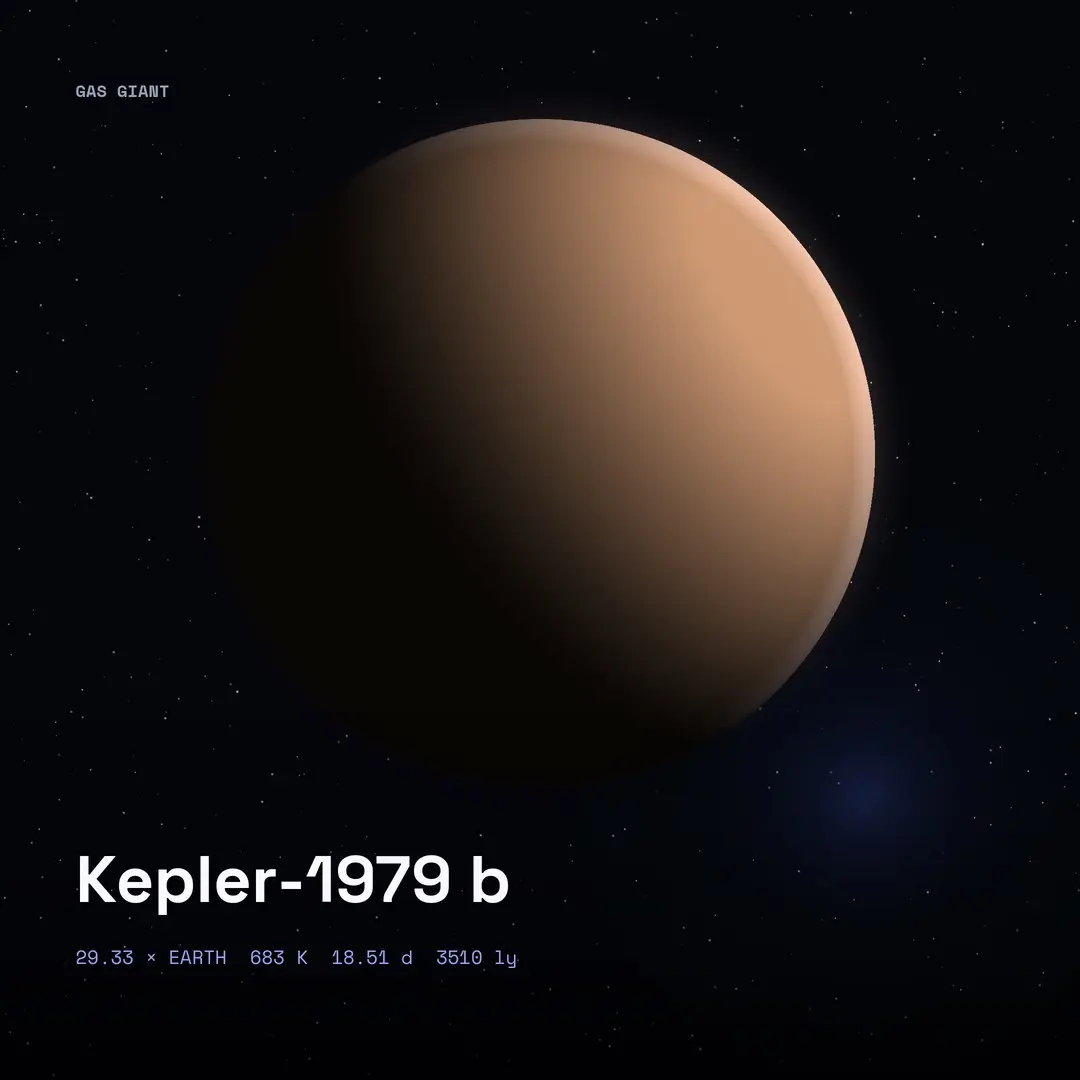
Kepler-1979 b: 2.6 Times Jupiter
Gas giant around Kepler-1979
It is 2.62 times Jupiter's radius, closest in size to Jupiter. A year there lasts 18.51 days, on an orbit 3 times closer to its star than Mercury is to the Sun. Its equilibrium temperature is 683 K, hotter than any desert. The host star Kepler-1979 runs at 5942 K with 1.03 times the Sun's mass.
Radius
29.33 Earth radii
Equilibrium temperature
683 K (measured)
One year
18.51 days
Orbit radius
0.1383 AU
Host star
Kepler-1979 at 5942 K
Distance
3510 light-years
Starlight blocked
8.200% at each transit
What a crossing measures
The fraction of starlight blocked sets the radius against the star's.
2.6xJupiter: among the largest planets measured
Known and unknown, as the archive has it
A measured radius. Yes.
A measured mass. No.
A density, so rock and gas can be told apart. No.
An orbital distance. Yes.
A temperature someone observed rather than calculated. Yes.
The shape of the orbit. Yes.
The detection is a shadow crossing a disc. Shadows have no weight, which is the whole reason the mass column is empty.
Found by Kepler in 2023. Kepler's method needed repetition, not brightness. It could find small planets around faint stars, provided they came round quickly enough to be seen twice.
