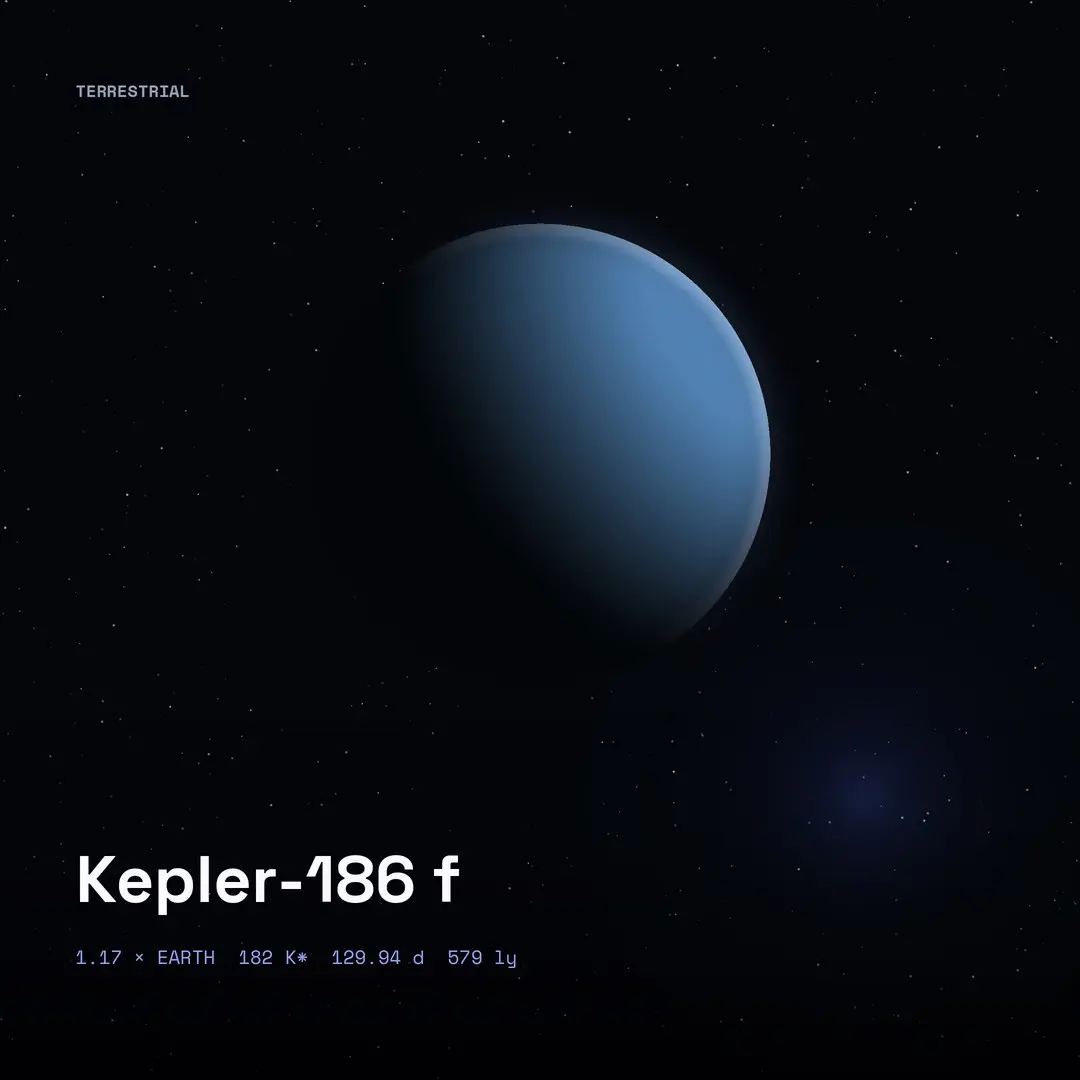
Kepler-186 f: 5-Planet System, 0.432 AU Out
Terrestrial around Kepler-186
It is 1.17 times Earth's radius, closest in size to Earth. A year there lasts 129.94 days, on an orbit 1.1 times Mercury's distance from the Sun. Its equilibrium temperature is 182 K (derived from the star rather than measured), colder than anywhere on Earth. The host star Kepler-186 runs at 3755 K with 0.54 times the Sun's mass.
Kepler-186 from the inside out
Orbit
/
Planet
The habitability checklist, honestly scored
On the edge of the habitable zone. Borderline.
A measured mass, not just a radius. No.
A measured temperature rather than one derived from the star. No.
Any detection of an atmosphere. Not recorded in the archive.
Radius
1.17 Earth radii
Equilibrium temperature
182 K (derived)
One year
129.94 days
Orbit radius
0.4320 AU
Host star
Kepler-186 at 3755 K
Distance
579 light-years
Starlight blocked
0.042% at each transit
What a crossing measures
Block a known fraction of a known star and you have measured a width.
The archive lists no measured equilibrium temperature for this planet. The 182 K quoted here is derived from the star's output and the orbital distance, assuming a third of the light is reflected. It is an estimate from two numbers, not an observation.
Found by Kepler in 2014. Kepler watched a single field continuously, so it found the planets that come round often. A world with a long year simply never repeated within the mission.
The detection is a shadow crossing a disc. Shadows have no weight, which is the whole reason the mass column is empty.
Kepler-186 has 5 known planets. Multi-planet systems are where orbital dynamics can be measured rather than assumed.
Half the temperatures quoted for exoplanets are calculated from the star, not \
measured at the planet. Should a page like this show them at all, or leave the field blank?
