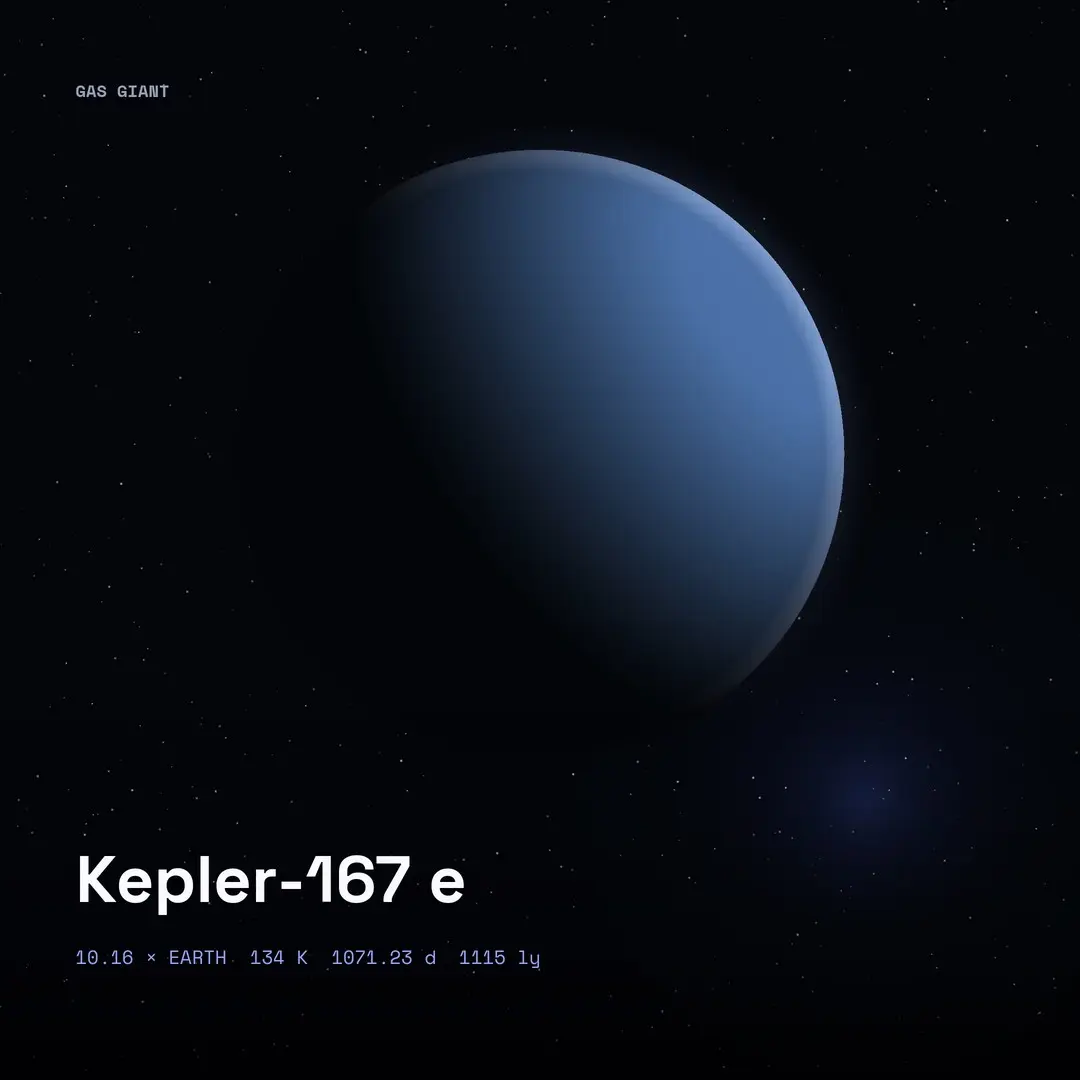
Kepler-167 e: 134 K, Colder Than Pluto
Gas giant around Kepler-167
It is 0.91 times Jupiter's radius, closest in size to Saturn, and 321.0 times Earth's mass, at 1.68 g/cm3, less dense than Earth. A year there lasts 2.9 years, on an orbit 4.9 times Mercury's distance from the Sun. Its equilibrium temperature is 134 K, colder than anywhere on Earth. The host star Kepler-167 runs at 4884 K with 0.78 times the Sun's mass.
Kepler-167 from the inside out
Orbit
/
Planet
Radius
10.16 Earth radii
Mass
321.0 Earth masses
Equilibrium temperature
134 K (measured)
One year
2.9 years
Orbit radius
1.8830 AU
Host star
Kepler-167 at 4884 K
Distance
1115 light-years
Starlight blocked
1.543% at each transit
What this planet has and has not got
Orbits inside the computed habitable zone. No.
Dense enough to be rock rather than gas, at 1.68 g/cm3. No.
A measured mass, not just a radius. Yes.
A measured temperature rather than one derived from the star. Yes.
Any detection of an atmosphere. Not recorded in the archive.
What the transit gives
Block a known fraction of a known star and you have measured a width.
Found by Kepler in 2016. The mission traded sky coverage for depth, holding one view for years. That bias runs through its whole catalogue and through this planet's discovery.
Kepler-167 has 4 known planets. Planets in company tug on each other, and those tugs are measurable, which is how masses get pinned down without a wobble.
Its orbit is noticeably elliptical, eccentricity 0.29, so the starlight it receives changes substantially over one year.
Size from the shadow, mass from elsewhere. Most transiting planets never get the second half, and without it composition stays a guess.