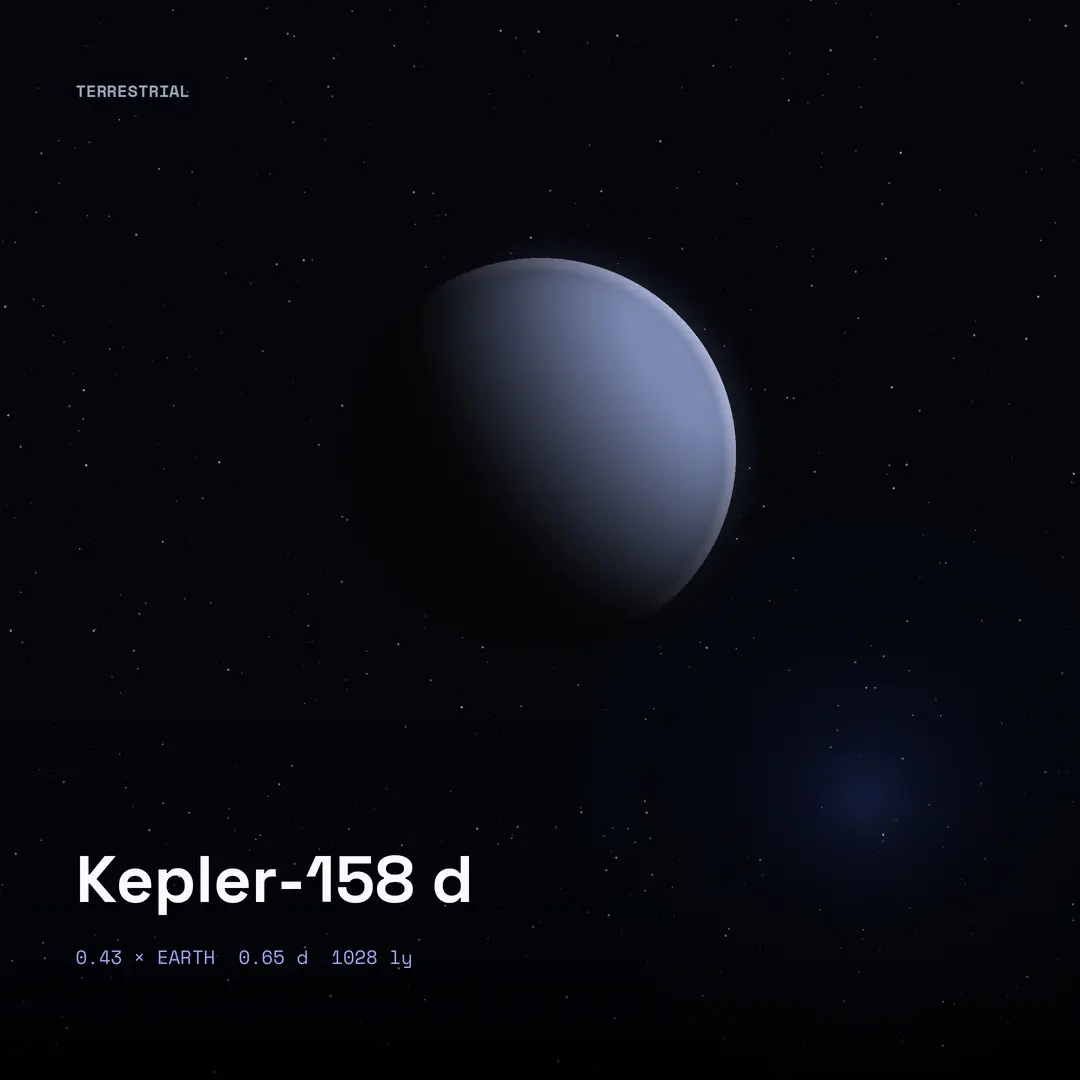
Kepler-158 d: A Year In 15.5 Hours
Terrestrial around Kepler-158
It is 0.43 times Earth's radius, closest in size to Mars. A year there lasts 15.5 hours. The host star Kepler-158 runs at 4896 K with 0.66 times the Sun's mass.
Radius
0.43 Earth radii
One year
15.5 hours
Host star
Kepler-158 at 4896 K
Distance
1028 light-years
Starlight blocked
0.003% at each transit
What a crossing measures
The depth of the dip is the ratio of the two discs, so the radius follows.
15.5hours: one full year, start to finish
What the archive holds on this planet
A measured radius. Yes.
A measured mass. No.
A density, so rock and gas can be told apart. No.
A semi-major axis. No.
A temperature someone observed rather than calculated. No.
The shape of the orbit. No.
Found by Kepler in 2024. The mission traded sky coverage for depth, holding one view for years. That bias runs through its whole catalogue and through this planet's discovery.
Kepler-158 has 3 known planets. Planets in company tug on each other, and those tugs are measurable, which is how masses get pinned down without a wobble.
Everything known here comes from how much light went missing. That fixes the size and leaves the mass entirely open.
