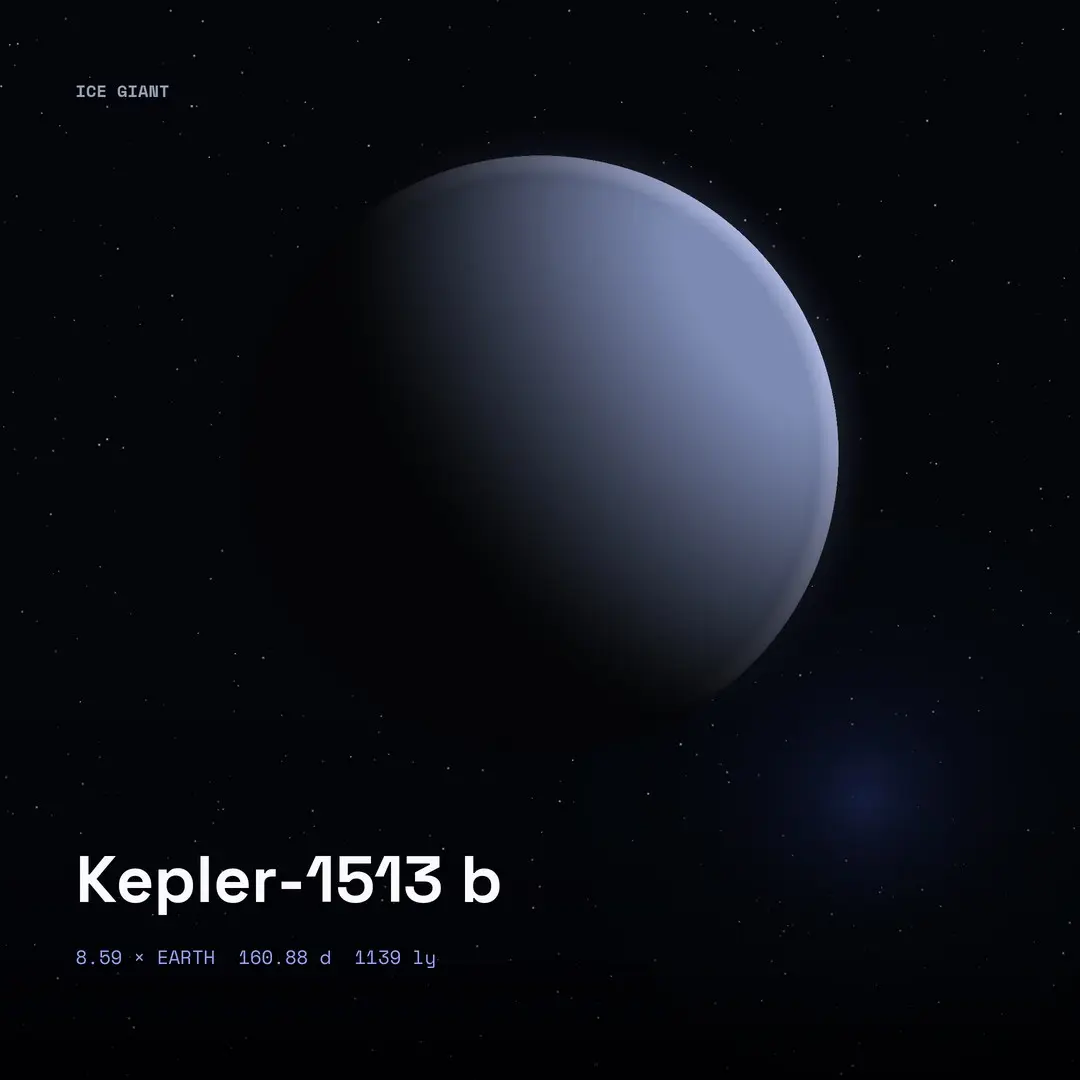
Kepler-1513 b: 48.3 Earth Masses
Ice giant around Kepler-1513
It is 0.77 times Jupiter's radius, closest in size to Saturn, and 48.3 times Earth's mass, at 1.30 g/cm3, less dense than Earth. A year there lasts 160.88 days. The host star Kepler-1513 runs at 5491 K with 0.94 times the Sun's mass.
Radius
8.59 Earth radii
Mass
48.3 Earth masses
One year
160.88 days
Host star
Kepler-1513 at 5491 K
Distance
1139 light-years
Starlight blocked
0.686% at each transit
What has been measured here and what has not
A radius from transit photometry. Yes.
A weight, not just a width. Yes.
A density, the one clue to composition. Yes.
An orbital distance. No.
A measured temperature rather than a derived one. No.
An eccentricity, so we know if the orbit is a circle. Yes.
What a crossing measures
Block a known fraction of a known star and you have measured a width.
Two independent measurements sit behind this page: a dip in starlight for the size, and something else entirely for the mass. Together they make a density.
Found by Kepler in 2016. Kepler stared at one patch of sky for four years, which is why so many of its planets have short periods: a planet only counts once you have seen it cross several times.
Kepler-1513 has 2 known planets. Multi-planet systems are where orbital dynamics can be measured rather than assumed.
Its orbit is noticeably elliptical, eccentricity 0.31, so the starlight it receives changes substantially over one year.
