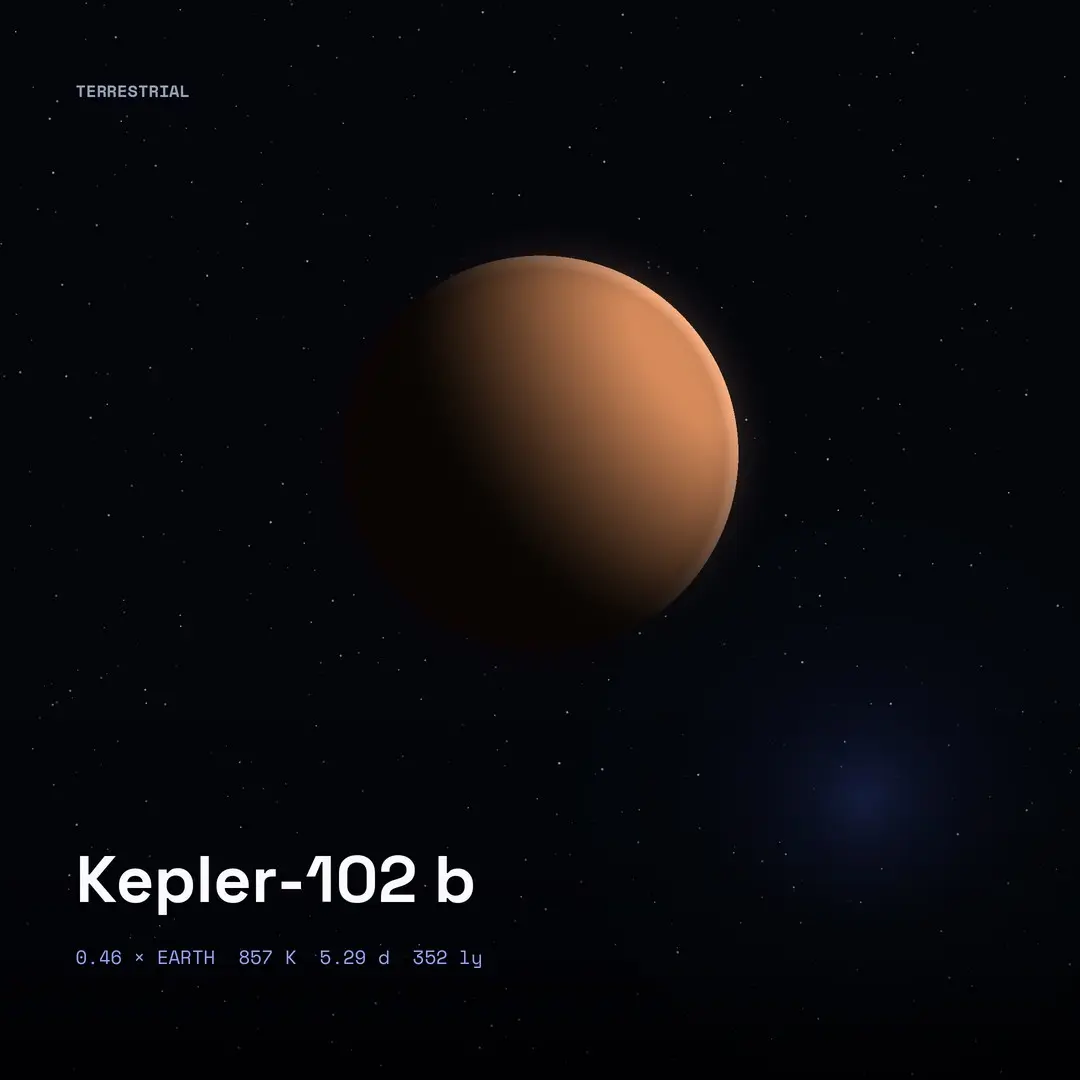
Kepler-102 b: 0.46 Times Earth
Terrestrial around Kepler-102
It is 0.46 times Earth's radius, closest in size to Mars, and 1.1 times Earth's mass, at 62.00 g/cm3, denser than Earth. A year there lasts 5.29 days, on an orbit 7 times closer to its star than Mercury is to the Sun. Its equilibrium temperature is 857 K, hot enough to melt lead. The host star Kepler-102 runs at 4909 K with 0.80 times the Sun's mass.
Kepler-102 from the inside out
Orbit
/
Planet
62.0g/cm3: denser than iron at Earth surface pressure
Radius
0.46 Earth radii
Mass
1.1 Earth masses
Equilibrium temperature
857 K (measured)
One year
5.29 days
Orbit radius
0.0552 AU
Host star
Kepler-102 at 4909 K
Distance
352 light-years
Starlight blocked
0.003% at each transit
What you get from the shadow
Block a known fraction of a known star and you have measured a width.
Found by Kepler in 2014. Kepler's method needed repetition, not brightness. It could find small planets around faint stars, provided they came round quickly enough to be seen twice.
Kepler-102 has 5 known planets. A crowded system is worth more than the sum of its planets: the timing of each transit constrains the others.
Two independent measurements sit behind this page: a dip in starlight for the size, and something else entirely for the mass. Together they make a density.
