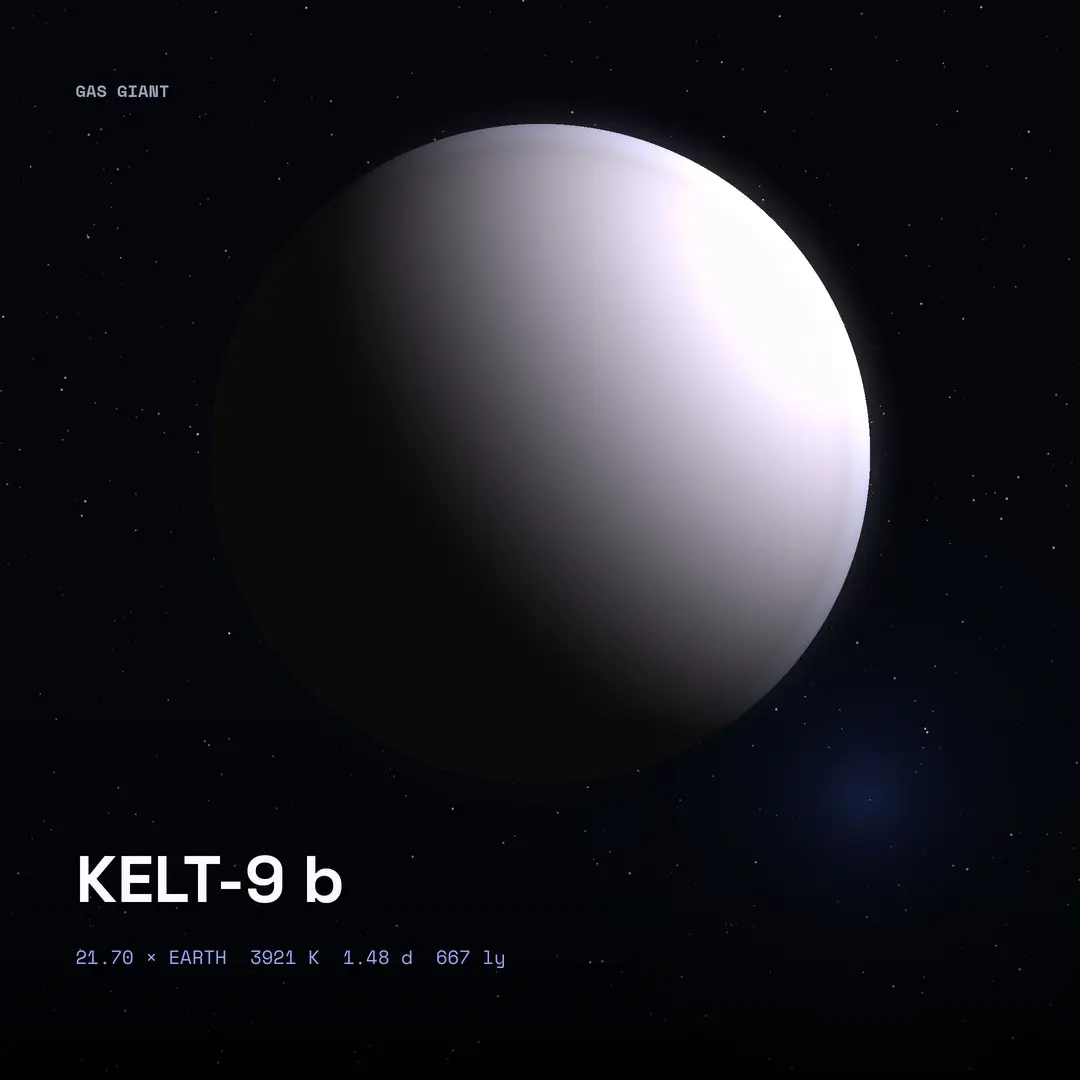
KELT-9 b: The Planet That Tears Its Own Air Apart
Hotter than most of the stars in the sky
KELT-9 b holds the temperature record among known planets. Its equilibrium temperature is 3921 K and the dayside runs hotter still, which puts it above the surface of a typical red dwarf. That is not a figure of speech: this planet is hotter than most stars in the galaxy. It orbits a blue A-type star of 9270 K, more than twice the Sun's mass, and it does so in 35 hours at a distance of 0.034 AU. At those temperatures chemistry stops working the way it does anywhere else.
Equilibrium temperature
3921 K, measured not derived
Radius
21.7 Earth radii, about 1.9 Jupiters
Mass and density
915 Earth masses at 0.491 g/cm3
One year
1.481 Earth days
Host star
KELT-9 at 9270 K, an A-type blue star
Distance
about 667 light-years
What heat does to matter, step by step
Severity
/
Stage
The temperature here is the rare case where the archive has a measured value rather than one derived from the star, so the 3921 K on the cover carries no asterisk. The dayside figure often quoted at around 4600 K is a different quantity: equilibrium temperature averages the whole planet, while the dayside of a world that never rotates relative to its star runs hotter than the average.