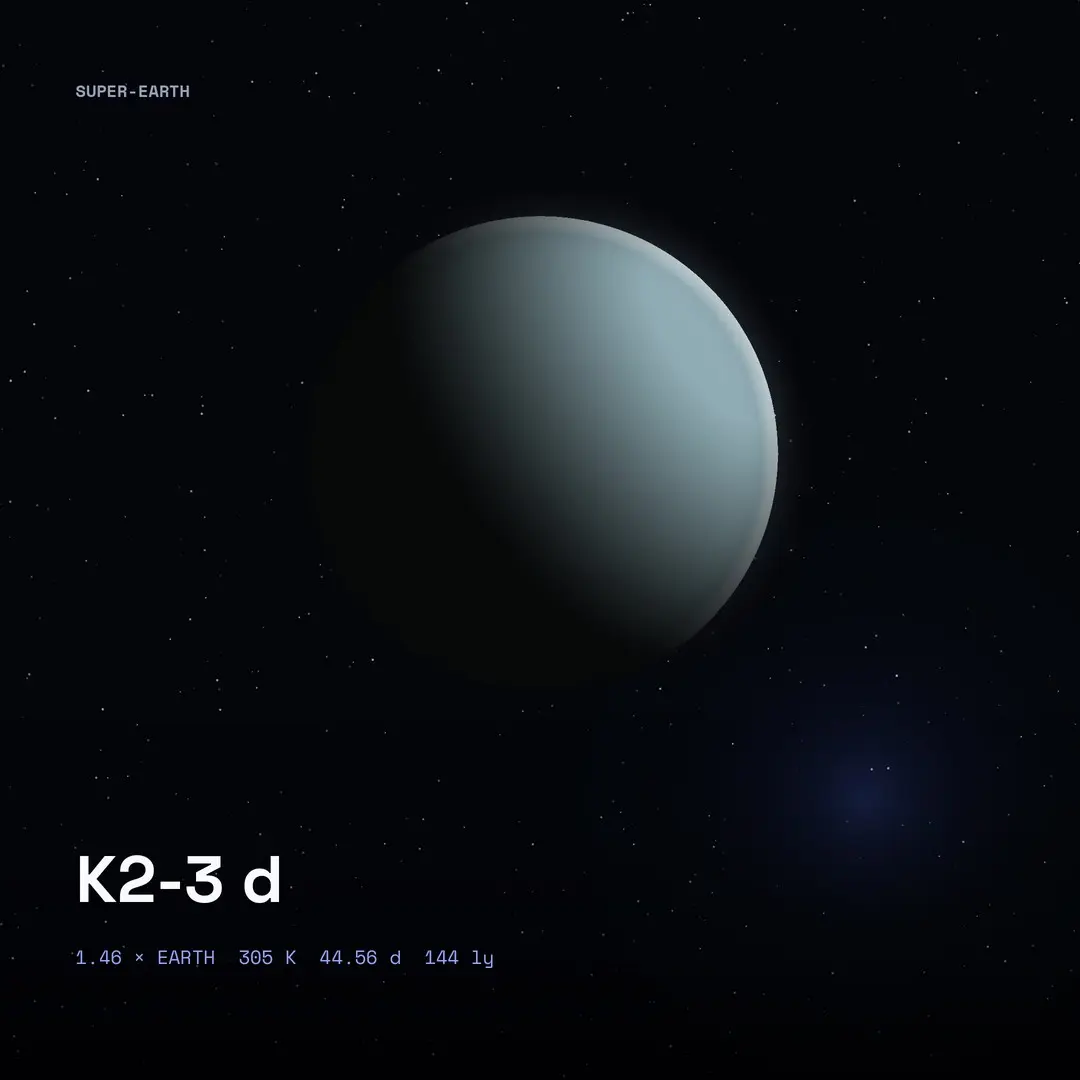
K2-3 d: Habitable Zone, 45-Day Year
Super-earth around K2-3
It is 1.46 times Earth's radius, closest in size to Earth, and 2.2 times Earth's mass. A year there lasts 44.56 days, on an orbit 2 times closer to its star than Mercury is to the Sun. Its equilibrium temperature is 305 K, in the range where liquid water is possible. The host star K2-3 runs at 3844 K with 0.55 times the Sun's mass.
What this planet has and has not got
Inside the habitable zone, computed from the star's luminosity. Yes.
A measured mass, not just a radius. Yes.
A measured temperature rather than one derived from the star. Yes.
Any detection of an atmosphere. Not recorded in the archive.
K2-3 from the inside out
Orbit
/
Planet
Radius
1.46 Earth radii
Mass
2.2 Earth masses
Equilibrium temperature
305 K (measured)
One year
44.56 days
Orbit radius
0.2014 AU
Host star
K2-3 at 3844 K
Distance
144 light-years
Starlight blocked
0.060% at each transit
What you get from the shadow
The depth of the dip is the ratio of the two discs, so the radius follows.
K2-3 has 3 known planets. Planets in company tug on each other, and those tugs are measurable, which is how masses get pinned down without a wobble.
Found by K2 in 2015, the second life of the Kepler spacecraft after two of its reaction wheels failed and it could no longer hold a fixed stare.
Size from the shadow, mass from elsewhere. Most transiting planets never get the second half, and without it composition stays a guess.
K2-3 d sits in the habitable zone on the arithmetic alone. That says where it \
orbits, not what it is like. What would you want measured next before calling it promising?
