K2-216 b: 8.2 Grams Per Cubic Centimetre
Super-earth around K2-216
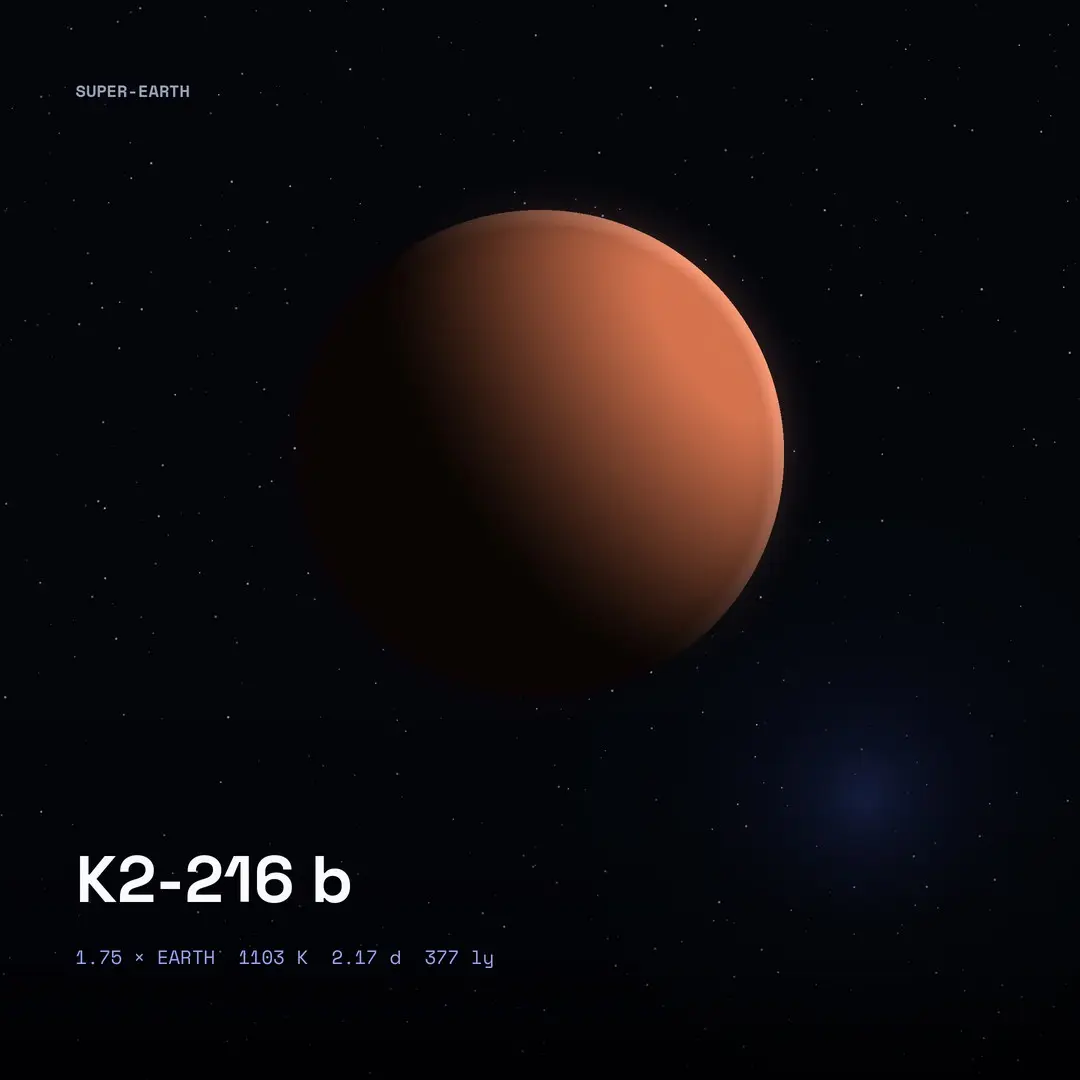
It is 1.75 times Earth's radius, closest in size to Earth, and 8.0 times Earth's mass, at 8.20 g/cm3, denser than Earth. A year there lasts 2.17 days, on an orbit 14 times closer to its star than Mercury is to the Sun. Its equilibrium temperature is 1103 K, hot enough to melt lead. The host star K2-216 runs at 4503 K with 0.70 times the Sun's mass.
Radius
1.75 Earth radii
Mass
8.0 Earth masses
Equilibrium temperature
1103 K (measured)
One year
2.17 days
Orbit radius
0.0280 AU
Host star
K2-216 at 4503 K
Distance
377 light-years
Starlight blocked
0.050% at each transit
8.2g/cm3: denser than iron at Earth surface pressure
What the dip tells you
The depth of the dip is the ratio of the two discs, so the radius follows.
Found by K2 in 2018, the second life of the Kepler spacecraft after two of its reaction wheels failed and it could no longer hold a fixed stare.
The size came from a crossing, the mass did not. That pairing is uncommon and it is what lets anyone say whether this is rock or gas.
