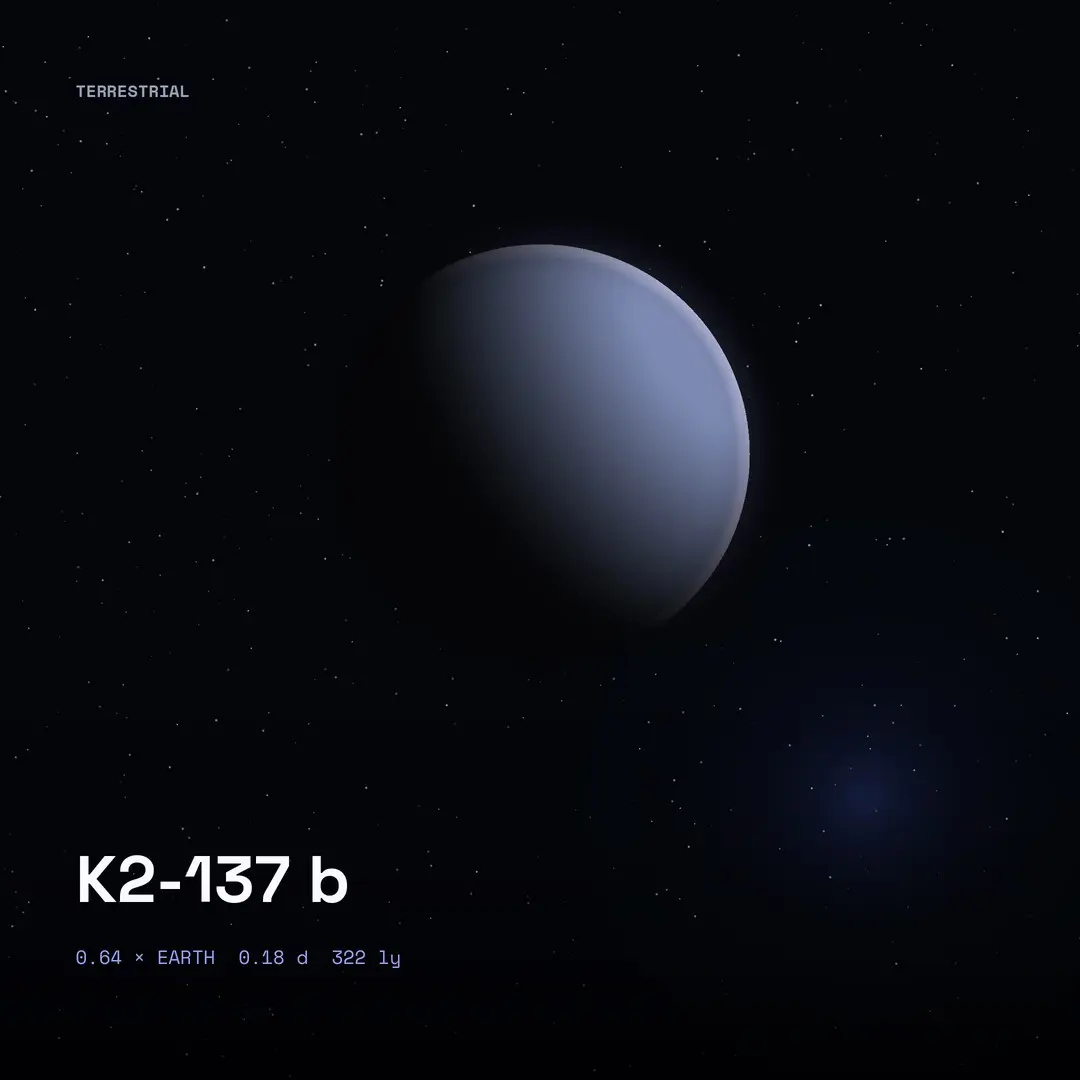
K2-137 b: A Year In 4.3 Hours
Terrestrial around K2-137
It is 0.64 times Earth's radius, closest in size to Mars. A year there lasts 4.3 hours.
4.3hours: one full year, start to finish
Radius
0.64 Earth radii
One year
4.3 hours
Host star
K2-137 at 3697 K
Distance
322 light-years
Starlight blocked
0.041% at each transit
What the dip tells you
How deep the star dims fixes the planet's size relative to it.
Known and unknown, as the archive has it
A measured radius. Yes.
A measured mass. No.
A density, the one clue to composition. No.
An orbital distance. No.
An observed temperature. No.
An eccentricity, so the orbit shape is known. No.
The detection is a shadow crossing a disc. Shadows have no weight, which is the whole reason the mass column is empty.
Found by K2 in 2017, the second life of the Kepler spacecraft after two of its reaction wheels failed and it could no longer hold a fixed stare.