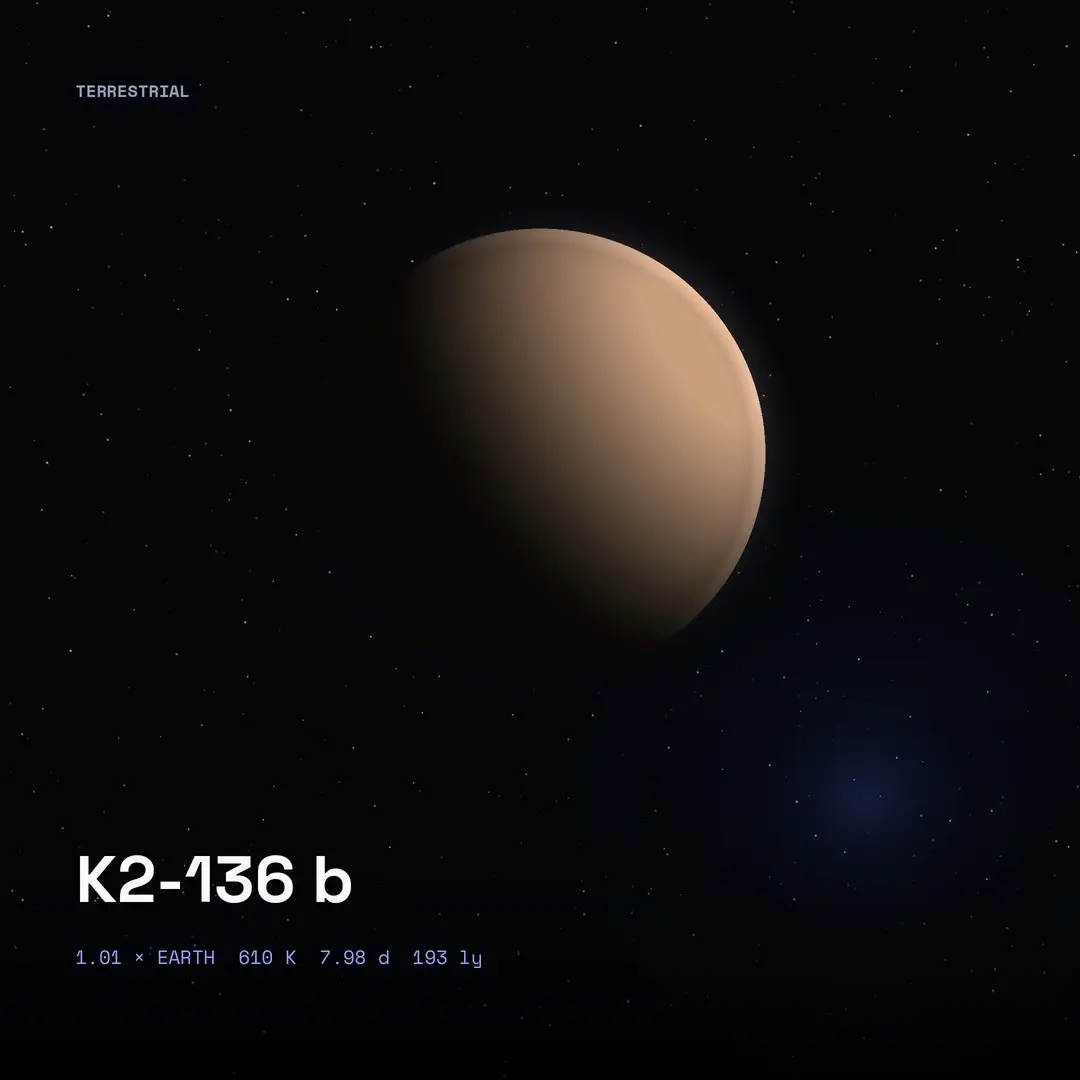
K2-136 b: 24.0 Grams Per Cubic Centimetre
Terrestrial around K2-136
It is 1.01 times Earth's radius, closest in size to Earth, and 4.3 times Earth's mass, at 24.00 g/cm3, denser than Earth. A year there lasts 7.98 days, on an orbit 5 times closer to its star than Mercury is to the Sun. Its equilibrium temperature is 610 K, hotter than any desert. The host star K2-136 runs at 4500 K with 0.74 times the Sun's mass.
24.0g/cm3: denser than iron at Earth surface pressure
K2-136 from the inside out
Orbit
/
Planet
Radius
1.01 Earth radii
Mass
4.3 Earth masses
Equilibrium temperature
610 K (measured)
One year
7.98 days
Orbit radius
0.0707 AU
Host star
K2-136 at 4500 K
Distance
193 light-years
Starlight blocked
0.019% at each transit
What you get from the shadow
The depth of the dip is the ratio of the two discs, so the radius follows.
A transit gives the radius and a separate measurement gives the mass. Having both is what makes a density, and a density is the only clue to composition at this range.
Found by K2 in 2017, the second life of the Kepler spacecraft after two of its reaction wheels failed and it could no longer hold a fixed stare.
K2-136 has 3 known planets. Systems like this are the ones where architecture can be studied instead of guessed at.