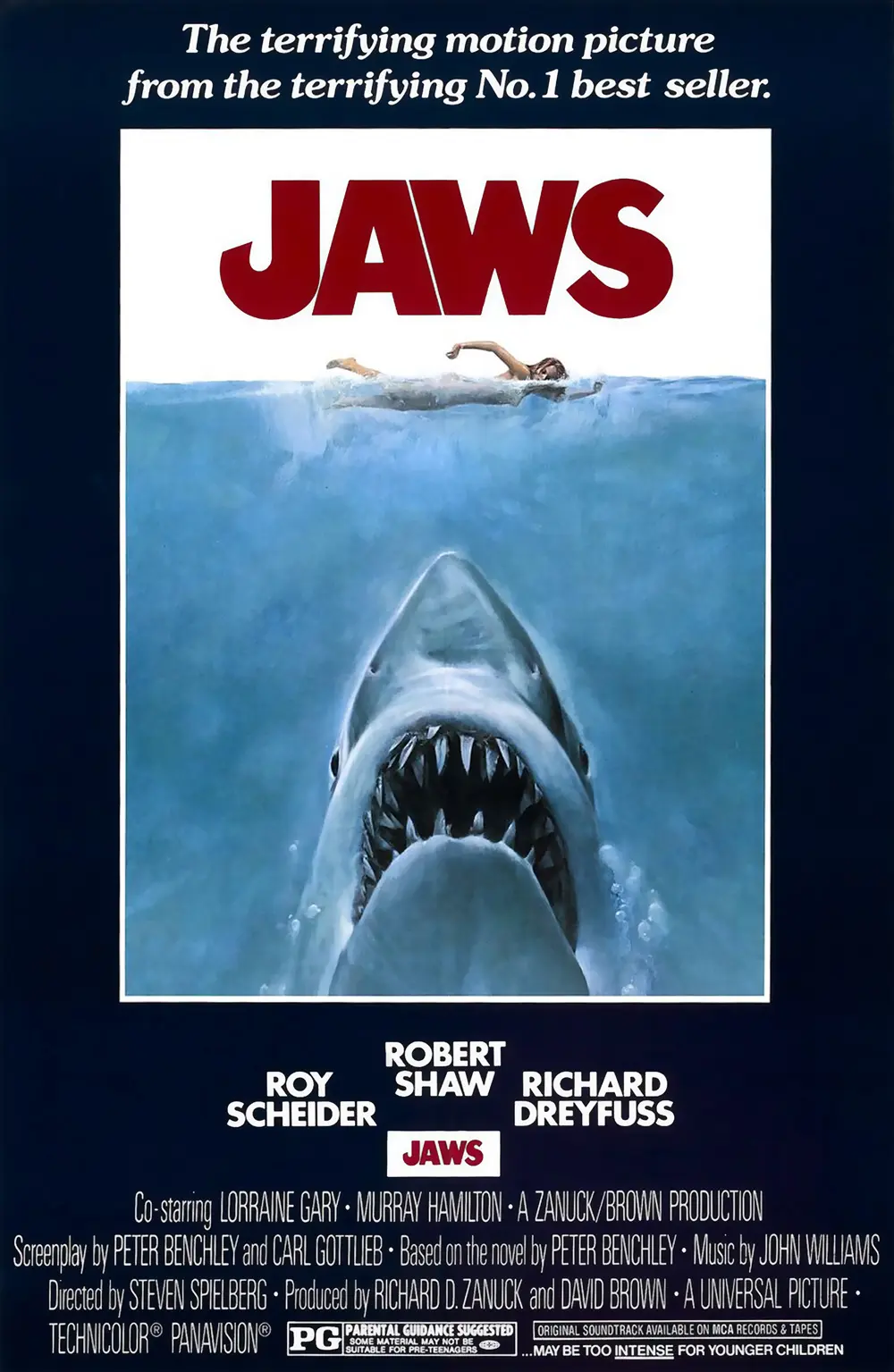
Jaws: The Shark Kept Breaking So You Never See It
Jaws (1975)
Three malfunctioning mechanical sharks turned a monster movie into a suspense film and invented the summer blockbuster.
Runtime
124 minutes
Director
Steven Spielberg
Budget
$9 million
Box office
$497 million worldwide
Score
John Williams
A Failure That Became The Method
The mechanical shark did not work in salt water. It sank, it corroded, its skin swelled, and a fifty five day shoot became a hundred and fifty nine. Spielberg's response was to shoot around it: a yellow barrel moving against the tide, a camera at water level, a severed leg dropping through green murk, and two notes from John Williams doing the work of a creature. The shark appears properly about eighty minutes in, by which point the audience has built something worse. The first half of the film is a municipal politics story about a town that cannot afford to close its beaches, and the second is three men on a boat that is too small, which is why the picture holds up as drama rather than spectacle.
Watching Jaws
Momentum
/
Section
"You're gonna need a bigger boat.
"Chief Brody · Jaws · 1975
Universal opened it on over four hundred screens with a national television campaign, a strategy nobody had used for a serious release, and created the wide release summer model.
The Indianapolis speech was rewritten by Howard Sackler, expanded by John Milius and cut down by Robert Shaw himself the night before shooting.
The commercial consequence was enormous and not entirely good: the film's success taught the industry to bet on a small number of wide summer releases, which is still the structure of the business. The craft consequence was the opposite lesson, and the one Spielberg took forward. The film works because the threat is mostly implied, and every effective monster film since, from Alien to A Quiet Place, has been reverse engineering a broken rubber shark.