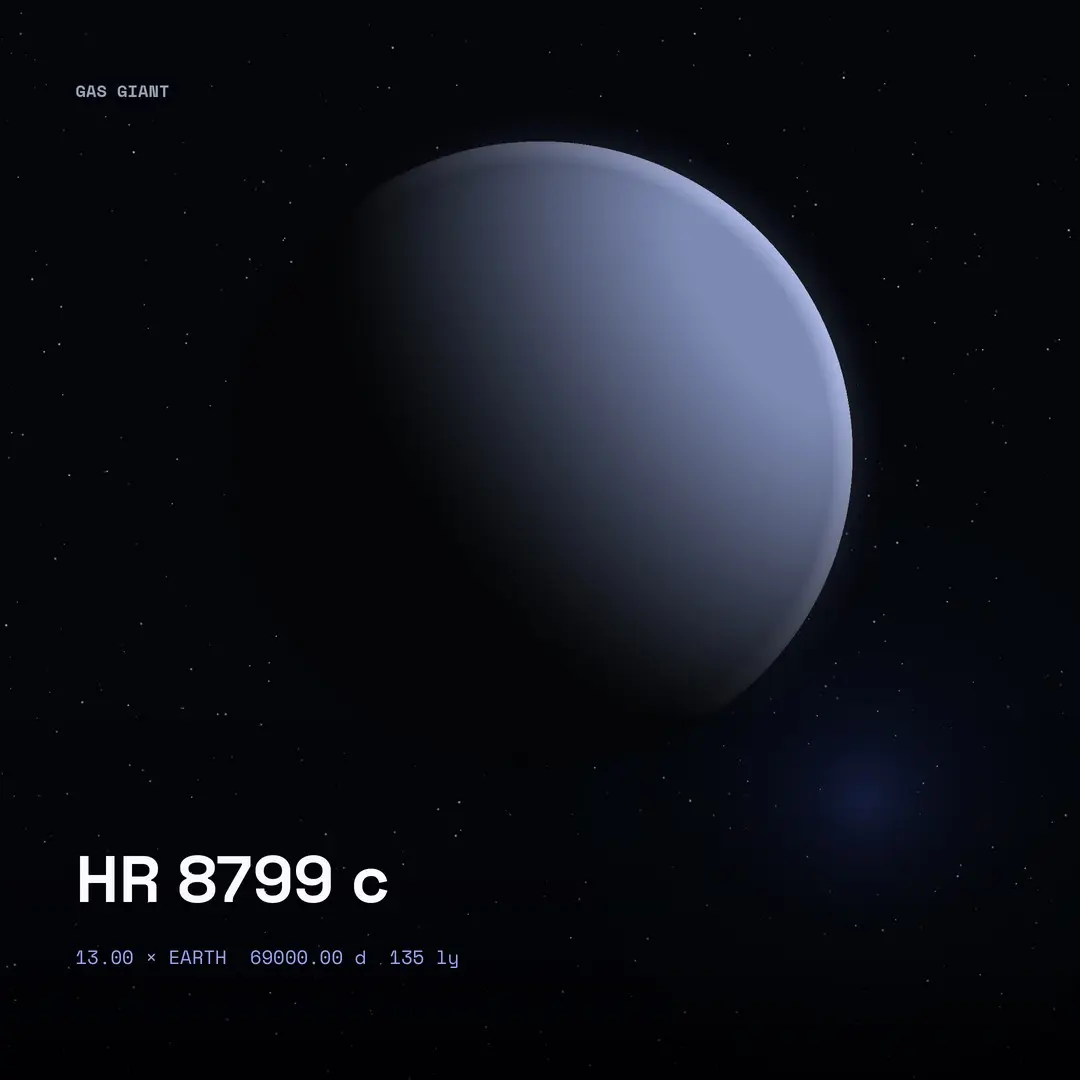
HR 8799 c: Photographed, Not Inferred
Gas giant around HR 8799
It is 1.16 times Jupiter's radius, closest in size to Jupiter, and 3000.0 times Earth's mass. A year there lasts 188.9 years, on an orbit 98.2 times Mercury's distance from the Sun.
HR 8799 from the inside out
Orbit
/
Planet
Radius
13.00 Earth radii
Mass
3000.0 Earth masses
One year
188.9 years
Orbit radius
38.0000 AU
Distance
135 light-years
What the archive holds on this planet
A radius from transit photometry. Yes.
A measured mass. Yes.
A density, which decides rock or gas. No.
How far out it orbits. Yes.
A temperature someone observed rather than calculated. No.
An eccentricity, so the orbit shape is known. No.
What seeing it actually provides
Where it is, how bright it is, and a spectrum taken from the planet directly.
Found by Gemini Observatory in 2008.
This is one of the rare planets that has actually been photographed. Fewer than a hundred of the thousands known were found this way, and they are mostly young giants far from their stars.
HR 8799 has 4 known planets. Systems like this are the ones where architecture can be studied instead of guessed at.
Fewer than a hundred planets have been photographed rather than inferred. Does \
seeing one directly change how real it feels to you?
