How to buy a second-hand road bicycle
How to buy a second-hand road bicycle: the full inspection guide
A 2021 carbon bike with Shimano Ultegra that retailed for $3,500 routinely sells secondhand for $1,200 to $1,800. But the used market has real pitfalls: crash-damaged frames, worn-out drivetrains, incompatible groupset generations, and stolen bikes. This guide covers everything in the order you need it, from sizing yourself before you go, to the red flags that mean you should walk away. As of November 2026.
Entry tier (used)
$500 to $1,300
Mid tier (used)
$1,400 to $3,000
High end (used)
$3,000 to $8,000+
Time to inspect properly
30 to 45 minutes
Chain wear tool cost
$10 to $20 (Park Tool CC-4.2)
Typical discount vs. retail
Around 45% below original price
Part 1. Frame sizing: how to know if it fits before you see it
Road bikes are sized in centimetres, from roughly 47 cm to 63 cm, or in S/M/L labels that vary by brand. The seat tube length is the traditional measurement, but two bikes with the same seat tube can feel completely different. The numbers that actually tell you how a bike fits are stack, reach, and standover. Stack is the vertical distance from the centre of the bottom bracket to the top of the head tube. Reach is the horizontal equivalent. Together they define whether you will ride upright or stretched out. Standover is the height of the top tube from the ground; you need at least 2 to 5 cm of clearance when standing flat-footed over the bike.
The four geometry numbers that matter
| Measurement | What it is | Typical range | Why it matters |
|---|---|---|---|
| Stack | Vertical: BB centre to head tube top | 500 to 600 mm | Controls upright vs. aerodynamic position |
| Reach | Horizontal: BB centre to head tube top | 360 to 420 mm | Controls stretched vs. compact position |
| Standover | Height of top tube from ground | Varies by frame | Must give 2 to 5 cm clearance when straddling |
| Seat tube length | The traditional frame "size" | 47 to 63 cm | Starting point only; stack and reach matter more |
Stack/reach ratio: the fastest filter
Divide stack by reach to get the stack/reach ratio. A ratio below 1.35 is race geometry, aggressive and aerodynamic. Between 1.35 and 1.43 is performance-endurance, the most common used-market sweet spot. Above 1.43 is comfort geometry, more upright. You cannot change head tube height or seat tube angle with a stem swap, so check this ratio before you go to see the bike.
Height-to-frame-size starting guide (road bike)
| Rider height | Frame size | Label |
|---|---|---|
| 4'10" to 5'0" (148 to 152 cm) | 47 to 48 cm | XXS |
| 5'0" to 5'3" (152 to 160 cm) | 49 to 50 cm | XS |
| 5'3" to 5'6" (160 to 168 cm) | 51 to 53 cm | S |
| 5'6" to 5'9" (168 to 175 cm) | 54 to 55 cm | M |
| 5'9" to 6'0" (175 to 183 cm) | 56 to 57 cm | M/L |
| 6'0" to 6'3" (183 to 191 cm) | 58 to 60 cm | XL |
| 6'3" to 6'6" (191 to 198 cm) | 61 to 63 cm | XXL |
How to measure yourself at home
Stand barefoot with your back against a wall. Press a hardcover book up between your legs as if it were a saddle. Mark where the spine meets the wall and measure from that mark to the floor. That is your cycling inseam. For saddle height, multiply that inseam by 0.883. For a rough frame size estimate, multiply by 0.67. These are starting points; use the brand's actual geometry table to confirm stack and reach before making the trip. BikeInsights.com lets you compare geometry across brands and years for free.
Part 2. Frame materials: what each one means in practice
The four materials you will encounter on the used market are aluminium, carbon fibre, steel, and titanium.
Aluminium (1.0 to 1.3 kg frame): stiff, efficient, and the material on most entry and mid-range bikes. It transfers power well but can feel harsh. Cracks appear at welds under impact and are visible to the eye.
Carbon (0.7 to 1.1 kg frame): lighter and more tuneable than any metal. Frame engineers can make specific tubes stiff in one direction and compliant in another. The risk is impact damage: carbon can fail without visible external warning if the internal laminate has delaminated.
Steel (1.5 to 2.0 kg frame): heavier but lively and compliant. The easiest material to repair. Rusts from the inside; check around cable entry points and under the bottom bracket for bubbling paint.
Titanium (1.2 to 1.5 kg frame): steel compliance at near-aluminium weight, no rust, often lifetime-warranted. Rarely appears below $1,500 as a frameset on the used market.
Frame material comparison
| Material | Weight | Ride feel | Main risk | Repairability |
|---|---|---|---|---|
| Aluminium | 1.0 to 1.3 kg | Stiff, efficient, can be harsh | Fatigue cracks at welds | Difficult; specialist needed |
| Carbon | 0.7 to 1.1 kg | Smooth, tuneable | Impact delamination without warning | Expensive; specialist only |
| Steel | 1.5 to 2.0 kg | Lively, compliant | Rusts from inside | Easy; any frame builder |
| Titanium | 1.2 to 1.5 kg | Steel compliance, lighter | Essentially no fatigue limit | Specialist TIG welding |
Checking an aluminium frame for cracks
On an aluminium frame, cracks occur at or near the welds. Look at every weld junction under bright light: head tube, bottom bracket, seat tube cluster, chainstay dropouts. Hairline cracks are still cracks. Dents on aluminium tubes are a serious red flag; aluminium does not bend back. Sight down the bike from behind; if the rear wheel does not track directly behind the front, the rear triangle is bent from crash damage.
Checking a carbon frame for cracks
Carbon can fail without visible external warning. Work through all four checks:
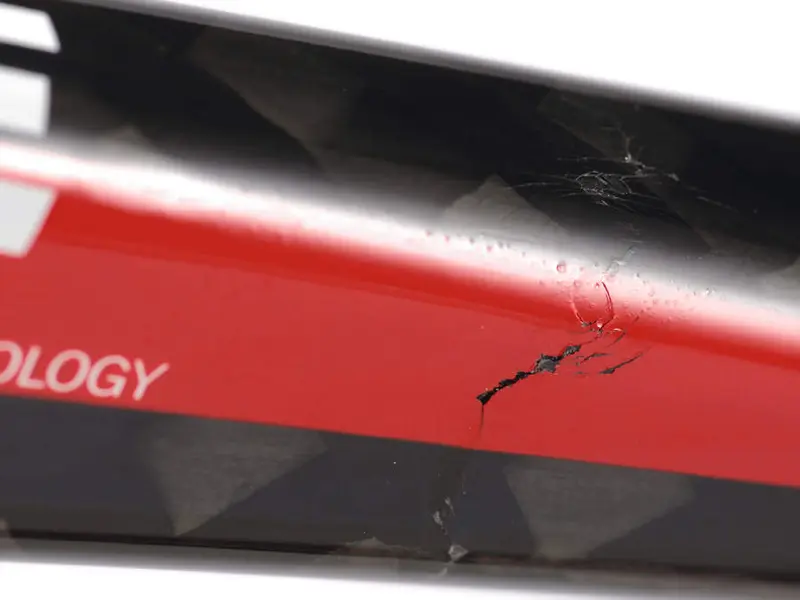
Visual: look for white stress marks, spiderweb paint cracking, bubbling paint, ripples in the surface, or any areas that look touched up. Focus on the head tube, bottom bracket area, top tube, down tube, and fork crown.
Coin tap test: tap a coin along every tube in a grid pattern, about 2 cm apart. A healthy carbon tube rings sharply and consistently. A dull thud indicates delamination.
Acetone test: wipe acetone across a suspected area and watch it evaporate. Acetone stays wet longer inside a crack, revealing its extent as a wet line.
Flex test: apply light hand pressure at the seat stays or fork legs. Watch whether any suspected crack widens under load.
Carbon frame damage can cause sudden, catastrophic failure at speed. If any inspection raises doubt, require a professional check by a carbon-specialist shop before riding. Do not accept a seller's assurance that it is "just a paint chip."
Part 3. Groupset generations: what is on the bike and what it means
The groupset is the family of components handling shifting and braking: shifters, derailleurs, crankset, cassette, chain, and brakes. On a road bike, Shimano dominates the used market. The critical split right now is 11-speed versus 12-speed. Shimano moved to 12-speed across all three performance tiers in 2022 and 2023. The two generations are not interchangeable: you cannot swap a 12-speed cassette onto an 11-speed drivetrain or use their chains across the gap.
Shimano road groupset generations on the used market
| Tier | Generation | Speeds | Di2 option | Status (Nov 2026) |
|---|---|---|---|---|
| 105 | R7000 | 11-speed | No | End of life; shifters becoming scarce |
| 105 | R7100 | 12-speed | Yes (R7150) | Current generation; active parts supply |
| Ultegra | R8000 | 11-speed | Yes (R8050) | Used-market sweet spot; parts plentiful |
| Ultegra | R8100 | 12-speed | Yes (R8150) | Current generation; active parts supply |
| Dura-Ace | R9100 | 11-speed | Yes | Superseded; parts available but declining |
| Dura-Ace | R9200 | 12-speed | Yes | Current top tier; active supply |
| Tiagra | 4700 | 10-speed | No | Still in production; disc version available |
What the generation means for a used-bike purchase
If you buy a bike with Shimano 105 R7000 (11-speed), you are on an end-of-life platform. Complete R7000 groupsets were discontinued at most major retailers in 2026. Shifter assemblies are becoming difficult to source; if one cracks, replacing like-for-like requires either a lucky eBay find or switching the entire drivetrain to 12-speed. Ultegra R8000 (11-speed) is the used-market sweet spot right now: parts are plentiful, it is a better groupset than R7000 in every measurable way, and prices reflect its age. The 105 R7100 and Ultegra R8100 (both 12-speed) are the current platforms with long parts futures. One more consideration: Shimano 12-speed cassettes require a Micro Spline freehub body on some wheel configurations, while 11-speed uses the standard HG freehub. If you plan to buy different wheels later, check the freehub standard before you commit.

Part 4. The physical inspection: what to check and how
Arrive with a chain wear tool (Park Tool CC-4.2, about $14), a small flashlight, and a rag. Bring cycling shoes so you can check standover height accurately. Do this in daylight or under a bright lamp. Give yourself 30 to 45 minutes. Frame and fork: under bright light, examine every tube junction. On aluminium, look at every weld. On carbon, run your fingers across the surface and apply the coin tap test. Sight down the bike from behind: if the rear wheel does not track directly behind the front, the rear triangle is bent. Headset: grip the front brake, rock the bike forward and backward. Any knock or click means play in the headset bearings. Turn the bars slowly through a full arc; roughness or a centred notch means pitted bearings. Bottom bracket: rock a crank arm side-to-side. Any lateral play means the BB is worn or loose. Spin the cranks and listen; grinding is a worn BB. A creak that only appears under hard pedalling is often the same problem.
Wheels and brakes
Wheels: lift each end and spin both wheels. Side-to-side wobble greater than 2 mm means the wheel needs re-trueing. Rock the rim at 3 and 9 o'clock to check hub bearing play; there should be none. On rim brake bikes, look at the rim sidewall: a concave or deeply grooved braking surface means the rim is near the end of its life. Many rims have a wear-indicator hole that disappears when the rim needs replacing. Rim brakes: check that pads align with the rim (not the tyre) and that grooves are still visible on the pad surface. Lever pull should feel firm and progressive. Disc brakes: spin the wheel and confirm the rotor stays parallel to the caliper. Most rotors have minimum thickness stamped on the side. Deep grooves, blue heat-staining, or a reading below that minimum are all walk-aways.
Drivetrain
Insert both ends of the CC-4.2 chain wear tool. If it drops at 0.5%, the chain needs replacing ($30 to $60). If it drops at 0.75%, the cassette is likely worn too ($80 to $200 combined). Without a tool, push a link away from the chainring at 3 o'clock; more than 3 mm of movement means the chain is stretched. Look at the cassette teeth from the side: shark-fin or hooked teeth mean the cassette is done. Shift through every gear both up and down; hesitation or skipping under load is a red flag. Cables and bar tape that are kinked, frayed, or worn through signal a bike that has not been serviced in a while; budget $20 to $40 for new bar tape and $30 to $60 for a cable set.
Inspection checklist at a glance
| Component | Pass | Concern | Walk away |
|---|---|---|---|
| Frame (alloy) | Clean welds, no marks | Surface scratches | Any crack at or near a weld |
| Frame (carbon) | Sharp tap tone throughout | Single dull spot on tap test | Multiple dull spots or visible damage |
| Headset | Smooth, no play | Very slight roughness | Knock or click; centred notch |
| Bottom bracket | Silent, no lateral play | Minor creak under load | Lateral play; grinding |
| Wheels | Under 2 mm wobble; no hub play | 2 to 3 mm wobble | Over 3 mm; hub play; cracked rim |
| Rim surfaces | Flat braking surface | Slight grooving | Concave; wear indicator hole gone |
| Disc rotors | Flat, no scoring | Light surface rust | Deep grooves; blue heat marks; below min thickness |
| Chain | Does not drop at 0.5% | Drops at 0.5%: replace chain | Drops at 0.75%: cassette worn too |
| Cassette | Symmetrical teeth | Slight wear | Shark-fin or hooked teeth |
| Shifting | Clean, no hesitation | Slight delay | Skipping or chain jumping under load |
Worn consumables (tyres, bar tape, cables, brake pads, chain) are normal and cheap. Use them to negotiate the price down. Do not walk away over a worn chain alone; walk away over a worn chain plus a worn cassette plus a cracked shifter hood plus a delaminated carbon frame.
Part 5. Price ranges by quality tier
Used road bike prices have settled after the pandemic surge. Buycycle, the largest used-bike marketplace in Europe, reports that used bikes currently sell at a median of around 45 percent below their original retail price.
Entry tier ($500 to $1,300 used): aluminium frames with Shimano Tiagra or 105 R7000, typically rim brakes, bikes from around 2016 to 2020. Budget an extra $80 to $150 for new tyres, cables, and bar tape before riding well.
Mid tier ($1,400 to $3,000 used): carbon or quality aluminium, 105 R7000 or Ultegra R8000, disc or rim brakes, bikes from 2019 to 2023. This is where most value lies. A 2021 Specialized Allez Sprint, a Canyon Endurace CF with 105, or a Trek Domane SL5 with Ultegra all fall here secondhand.
High end ($3,000 to $8,000+ used): full carbon, Ultegra R8100 or Dura-Ace, often with carbon wheels. Expect bikes in near-new condition with low mileage.
Part 6. Red flags that mean you should walk away
Some problems are negotiating points. A worn chain ($30 to $50), old tyres ($40 to $80), or scuffed bar tape ($20 to $40) are normal. The following are not.
Any crack on a carbon frame, including cracks called "just paint." Carbon can fail suddenly. Delamination found via the coin tap test falls in the same category. Frame replacement starts at $800.
Any crack at a weld on an aluminium frame. Aluminium cannot be easily re-welded; a cracked weld on a chainstay or head tube is a write-off.
Frame misalignment: if the rear wheel does not track behind the front when sighted from behind, the rear triangle is bent from a crash.
A tampered or missing serial number. The serial is stamped under the bottom bracket on nearly every bike. A filed or punched-over serial almost always means stolen. Check it against BikeRegister or the National Bike Registry.
More red flags
A seized seatpost: try to turn the saddle with the clamp bolt loosened. An aluminium seatpost seized inside a carbon frame often requires frame destruction to remove. Walk away.
Spongy disc brake levers with no firm point, combined with scored rotors and worn pads: a brake system neglected end to end.
Mismatched crash-fresh parts on an otherwise aged bike: new brake levers, a new fork, or a new stem on a bike where everything else is scuffed and worn. Ask directly what happened.
A seller who cannot say where or when they bought the bike, or who refuses a test ride.
Always test ride before buying. A static inspection catches visible damage and wear. The test ride catches what inspection misses: a rough bottom bracket that only grinds under load, a creak that appears only on hard pedalling, gear skipping under sprint effort, and brake pulsation from a warped rotor. If the seller will not allow a test ride, that is itself a red flag.