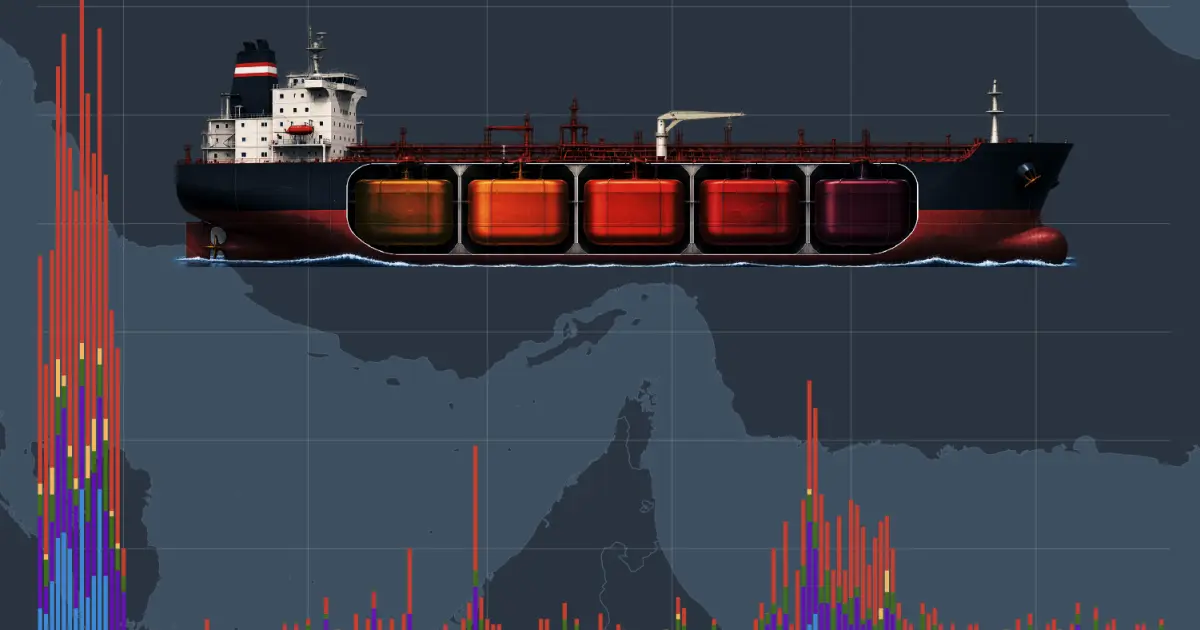
Hormuz: The 33-Kilometre Chokepoint That Shut Down
Barrels of oil through Hormuz per day (pre-war)
20 million
Drop in daily vessel transits since February
95%
Ships per day through the strait now
5 (from 100+)
Peak oil price reached in April 2026
$130 per barrel
Gulf crude exports cut since the war began
47%
Commercial vessels escorted by US Navy
1,500+
20 Million Barrels a Day, Through 33 Kilometres
The Strait of Hormuz is a narrow channel between the southern tip of Iran and the Omani enclave of Musandam. At its narrowest it is only 33 kilometres wide; the shipping lanes are two corridors, each 3.2 kilometres across. About 20 million barrels of oil passed through those lanes every day in 2024: roughly 20 percent of all global petroleum consumption, and more than a quarter of total seaborne oil trade. Qatar's LNG flows through it. Saudi Arabia, Iraq, Kuwait, and the UAE all ship their oil through it. About 84 percent of everything transiting Hormuz goes to Asia: China, India, Japan, and South Korea together account for 69 percent of all crude that passes that way. Before February 28, 2026, more than 100 vessels transited the strait each day. That baseline is now gone.
Six Months of War, One Lane of Oil
On February 28, 2026, US and Israeli forces struck Iran. Within 48 hours the strait was functionally closed. Maersk, MSC, CMA CGM, and Hapag-Lloyd all suspended transits. More than 150 tankers anchored offshore rather than risk attack. Iran's IRGC declared the lane off-limits, boarded merchant ships, and laid sea mines in the navigation corridor. By April, mines had forced the US Navy to deploy minesweepers and special operations divers. A June 17 ceasefire briefly restored around 20 transits per day, but it collapsed in July after renewed IRGC attacks. By late August 2026 the count was back to roughly 5 vessels per day. Gulf crude exports had fallen from 17 million barrels per day to approximately 9 million bpd. Iran's oil exports were at effectively zero under the US naval blockade.
"Over the past few months, our forces meticulously and quietly cleared sea mine threats using Navy divers, Navy SEALs, and US air power. Today, international shipping lanes are open and momentum is building.
"Admiral Brad Cooper. US Central Command. August 28 2026
Mines Cleared on Thursday. Re-Mining Attempted on Sunday.
On August 28, Admiral Cooper announced the completion of a months-long mine-clearing operation. US Navy divers, SEALs, and aircraft from all four service branches had worked, in Cooper's words, "meticulously and quietly" through a minefield in one of the world's busiest shipping lanes. Nearly 1,500 commercial vessels were escorted through during the conflict. Trump declared on Truth Social: "All mines have been removed and/or detonated from within the International Waters of the Strait of Hormuz." Seventy-two hours later, US forces struck two IRGC rocket launchers on Larak Island at the strait's eastern entrance. CENTCOM spokesperson Navy Captain Tim Hawkins confirmed the launchers were "preparing to launch rockets with sea mines into the Strait of Hormuz." Iran retaliated overnight, firing at US-linked bases in Jordan. Jordan intercepted eight missiles. Brent crude rose 3 percent, to more than $90 per barrel.
A World That Cannot Easily Reroute
The US imports under 2 percent of its consumption from the Persian Gulf, so the pain falls elsewhere. Japan and South Korea have almost no alternative supply routes. India built its refining capacity partly around Gulf crude grades. Saudi Arabia's East-West pipeline can carry around 5 million barrels per day westward to the Red Sea, but that route faces its own risks and does not cover the full gap. The Dallas Fed and IMF estimate that a full-year Hormuz closure would cut global GDP growth by 1.3 percentage points. The US is currently running 20-plus warships and hundreds of aircraft to enforce the blockade. It has turned around 75 ships and disabled three. What happens next in 33 kilometres of open water will set energy prices, shipping rates, and the economic pace for Asia through the end of 2026.