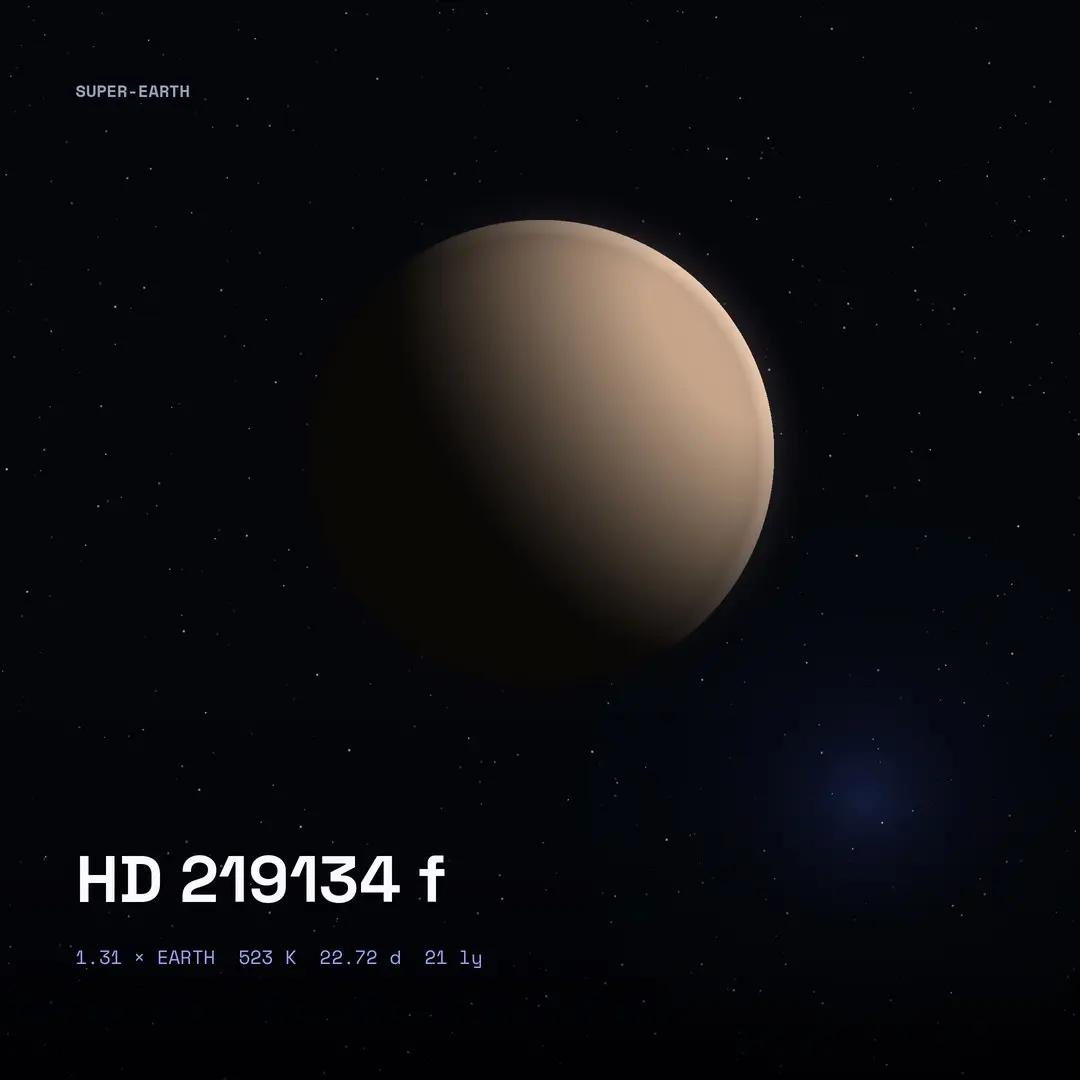
HD 219134 f: 21 Light-Years Away
Super-earth around HD 219134
It is 1.31 times Earth's radius, closest in size to Earth, and 7.3 times Earth's mass. A year there lasts 22.72 days, on an orbit 3 times closer to its star than Mercury is to the Sun. Its equilibrium temperature is 523 K, hotter than any desert. The host star HD 219134 runs at 4699 K with 0.81 times the Sun's mass.
HD 219134 from the inside out
Orbit
/
Planet
Radius
1.31 Earth radii
Mass
7.3 Earth masses
Equilibrium temperature
523 K (measured)
One year
22.72 days
Orbit radius
0.1463 AU
Host star
HD 219134 at 4699 K
Distance
21 light-years
21.3light-years: close enough to be a follow-up target
What the archive holds on this planet
A measured radius. Yes.
A measured mass. Yes.
A density, the one clue to composition. No.
A semi-major axis. Yes.
An observed temperature. Yes.
An eccentricity, so the orbit shape is known. Yes.
What the wobble gives
A minimum mass, from how fast the star moves toward and away from us.
HD 219134 has 6 known planets. Systems like this are the ones where architecture can be studied instead of guessed at.
This planet was found by the wobble it induces in its star, which measures mass rather than size. A radius quoted for such a planet usually comes from a later transit or from a model.
