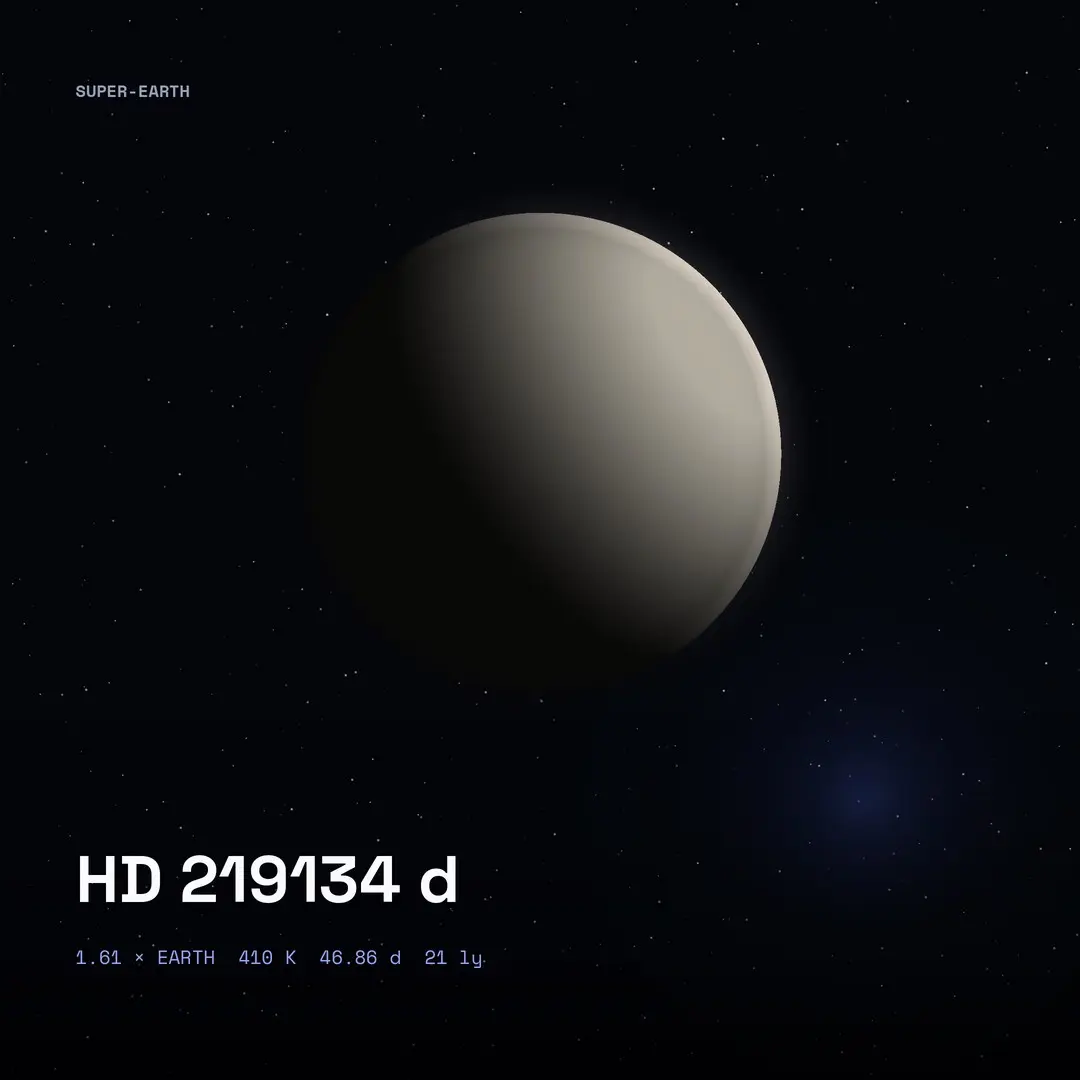
HD 219134 d: 21 Light-Years Away
Super-earth around HD 219134
It is 1.61 times Earth's radius, closest in size to Earth, and 16.2 times Earth's mass. A year there lasts 46.86 days, on an orbit 2 times closer to its star than Mercury is to the Sun. Its equilibrium temperature is 410 K, hotter than any desert. The host star HD 219134 runs at 4699 K with 0.81 times the Sun's mass.
HD 219134 from the inside out
Orbit
/
Planet
Radius
1.61 Earth radii
Mass
16.2 Earth masses
Equilibrium temperature
410 K (measured)
One year
46.86 days
Orbit radius
0.2370 AU
Host star
HD 219134 at 4699 K
Distance
21 light-years
21.3light-years: close enough to be a follow-up target
The state of the record for this planet
A radius from transit photometry. Yes.
A mass. Yes.
A density, the one clue to composition. No.
An orbital distance. Yes.
A temperature someone observed rather than calculated. Yes.
The shape of the orbit. Yes.
What the wobble gives
The pull of the planet on its star, which is a lower bound on its mass.
HD 219134 has 6 known planets. A crowded system is worth more than the sum of its planets: the timing of each transit constrains the others.
This planet was found by the wobble it induces in its star, which measures mass rather than size. A radius quoted for such a planet usually comes from a later transit or from a model.
Found by Roque de los Muchachos Observatory in 2015.
