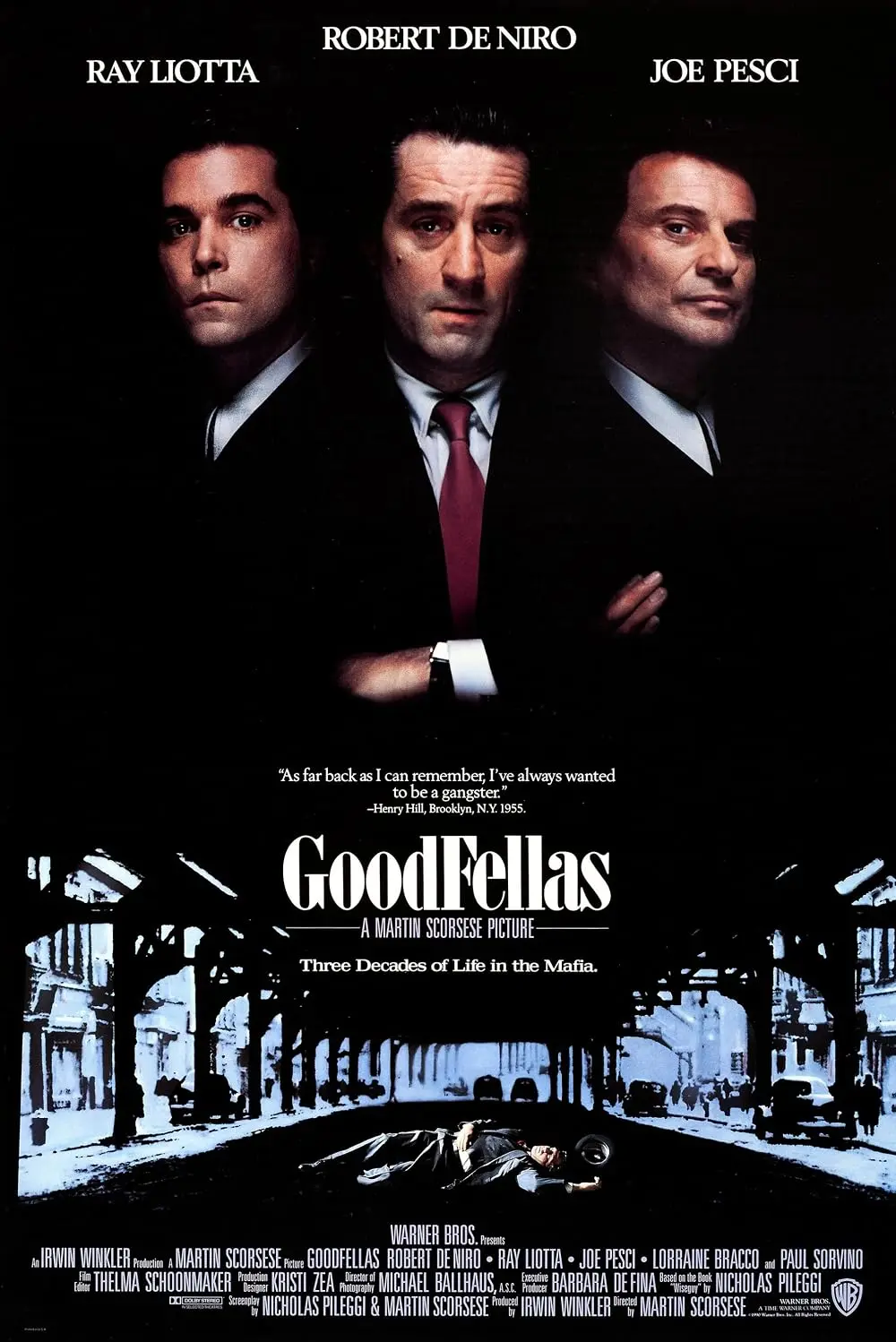
GoodFellas: A Gangster Film Told As A Job
GoodFellas (1990)
Scorsese strips out the honour, the family and the opera, and leaves the wages, the paranoia and the cocaine.
Runtime
146 minutes
Director
Martin Scorsese
Budget
$25 million
Box office
$47 million worldwide
Editing
Thelma Schoonmaker
Narration As Seduction
Where The Godfather is about a dynasty, this is about employment. Henry Hill narrates his own career the way people describe a good job they once had, with enthusiasm for the perks and no interest in the ethics, and Scorsese matches that tone with freeze frames, jump cuts, needle drops and a camera that never stops moving. The Copacabana shot, three minutes unbroken from a car through a kitchen to a table placed at the front, exists to make the audience feel what Henry is selling. Then the film's second half withdraws it all: the same energy applied to a single paranoid day in 1980, helicopters overhead, sauce on the stove, a narration that has become a man talking too fast. It ends with the worst punishment the film can imagine, which is having to live like everybody else.
Watching GoodFellas
Register
/
Reel
"As far back as I can remember, I always wanted to be a gangster.
"Henry Hill · GoodFellas · 1990
What to watch for
Freeze frames marking the moments Henry stops to justify himself
The Copacabana Steadicam shot as an argument rather than a flourish
Two narrators, and what changes when Karen takes over
Needle drops dated to the exact year of each sequence
The final shot breaking the fourth wall and the film's whole promise
Joe Pesci's funny how am I funny scene came from an incident he had witnessed in a restaurant as a young man, and was worked out with Ray Liotta in rehearsal rather than written.
Thelma Schoonmaker cut roughly a third of the film's shots to music chosen in advance, so the editing rhythm is set by records that existed in the year each scene takes place.