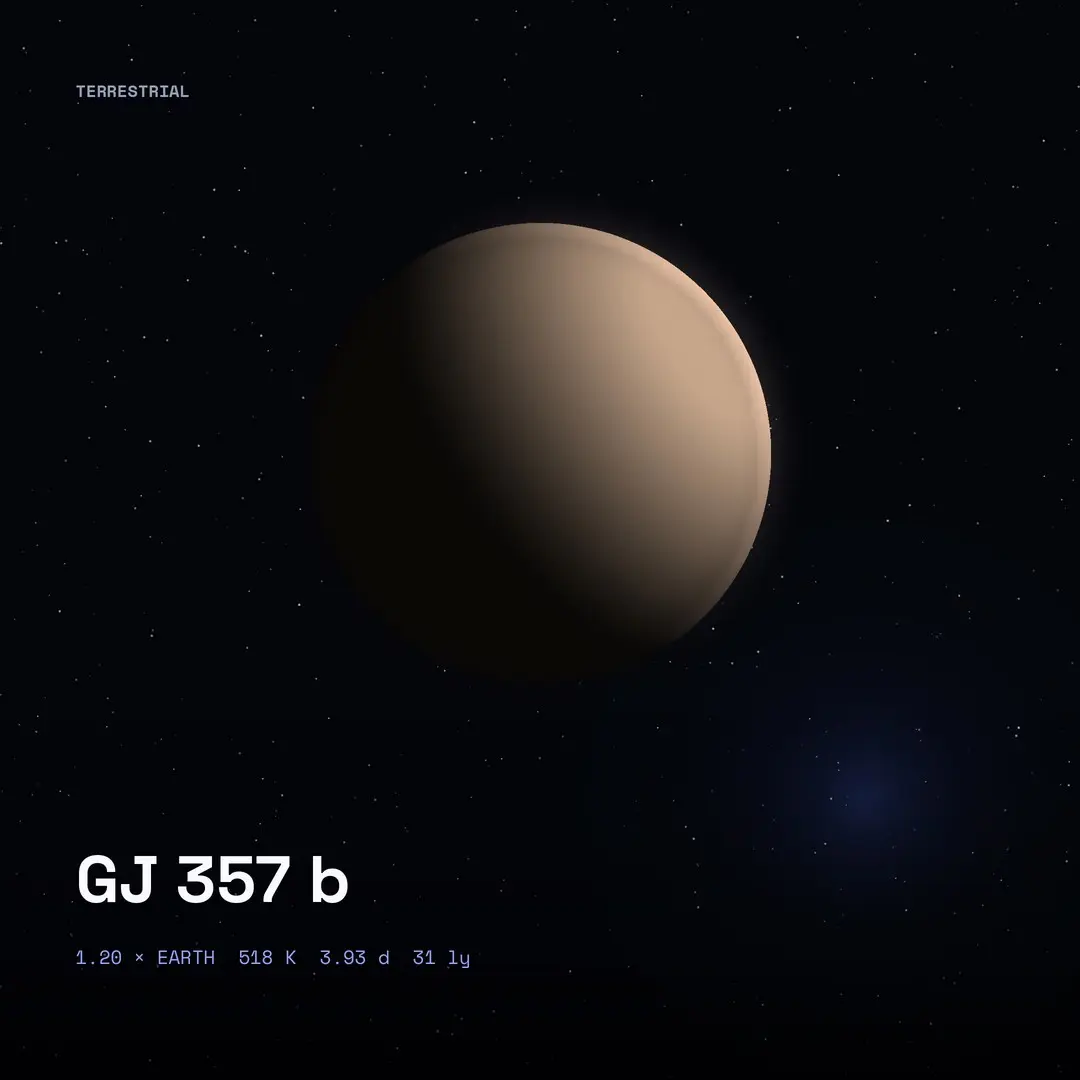
GJ 357 b: 3-Planet System, 0.036 AU Out
Terrestrial around GJ 357
It is 1.20 times Earth's radius, closest in size to Earth. A year there lasts 3.93 days, on an orbit 11 times closer to its star than Mercury is to the Sun. Its equilibrium temperature is 518 K, hotter than any desert. The host star GJ 357 runs at 3505 K with 0.34 times the Sun's mass.
Radius
1.20 Earth radii
Equilibrium temperature
518 K (measured)
One year
3.93 days
Orbit radius
0.0360 AU
Host star
GJ 357 at 3505 K
Distance
31 light-years
Starlight blocked
0.106% at each transit
What you get from the shadow
How deep the star dims fixes the planet's size relative to it.
Known and unknown, as the archive has it
A radius from transit photometry. Yes.
A weight, not just a width. No.
A density, so rock and gas can be told apart. No.
How far out it orbits. Yes.
A temperature someone observed rather than calculated. Yes.
An eccentricity, so the orbit shape is known. No.
Found by Transiting Exoplanet Survey Satellite (TESS) in 2019. TESS scans most of the sky in 27-day stretches, so it favours bright nearby stars and short orbits over the faint distant ones Kepler specialised in.
The detection is a shadow crossing a disc. Shadows have no weight, which is the whole reason the mass column is empty.
GJ 357 has 3 known planets. A crowded system is worth more than the sum of its planets: the timing of each transit constrains the others.
