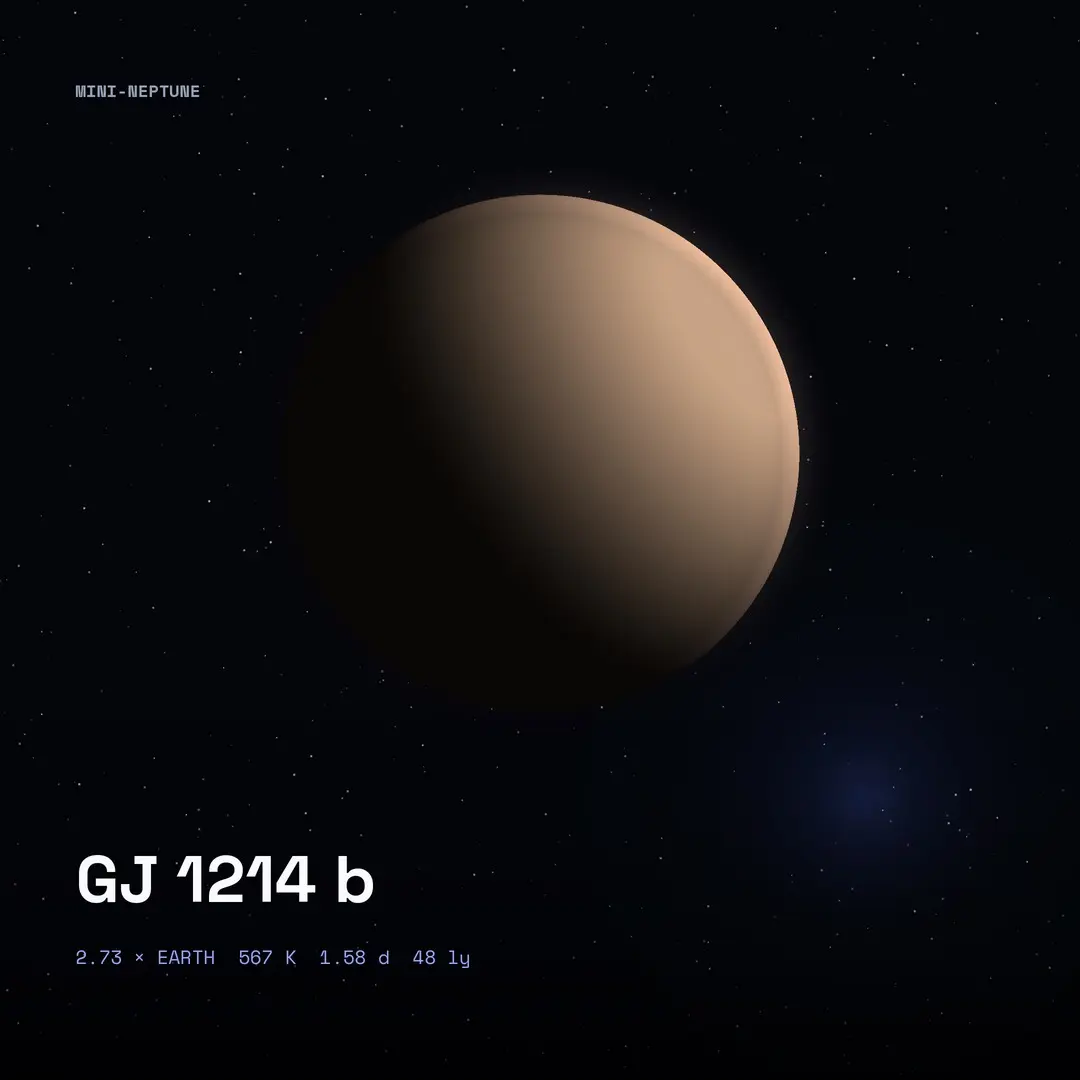
GJ 1214 b: The Planet Hiding Behind Its Own Haze
The planet that refused to answer for thirteen years
Every telescope aimed at GJ 1214 b between 2009 and 2022 came back with the same thing: a flat line. A transmission spectrum works by watching starlight filter through a planet's air, and each gas leaves a fingerprint. This one had no fingerprints at all, just a featureless curve, which meant a cloud or haze deck high enough to block the view of everything below it. In 2023 JWST attacked it from a different angle, measuring a full phase curve as the planet went round instead of just the moment it crossed.
Radius
2.733 Earth radii, a mini-Neptune
Mass and density
8.41 Earth masses at 2.26 g/cm3
Equilibrium temperature
567 K, measured
One year
1.58 Earth days
Host star
GJ 1214 at 3101 K, a cool red dwarf
Distance
about 48 light-years
Thirteen years of getting nowhere, and why it was not wasted
What it bought
/
Attempt
The measured dayside came in colder than the planet's own equilibrium temperature. That sounds impossible and is not: equilibrium temperature assumes the planet absorbs everything that falls on it. Measure it colder and you have learned that a great deal of the starlight is being reflected straight back out, which is how the haze got characterised without ever being seen through.
High metallicity means the air is dominated by things heavier than hydrogen and helium. At 100 times solar or more this is not a scaled-down Neptune, it is a different kind of object, and the category is the most common one in the galaxy while having no example in our own solar system.
Thirteen years of flat spectra were not wasted effort. They ruled out a clear hydrogen atmosphere early and forced the haze interpretation, and the phase curve that finally worked was designed around exactly that problem. A null result that narrows the options is still a measurement.