Five Dead: Amazon Cargo Plane Crashes at Miami
People killed
5
People injured
5 (3 critical)
Speed when leaving runway
112 knots
Distance overrun beyond pavement
~2,000 ft
Time of crash
1:58 p.m. EDT, September 6, 2026
Emergency responders on scene
~200
112 Knots, Halfway Down the Runway, and No Sign of Spoilers
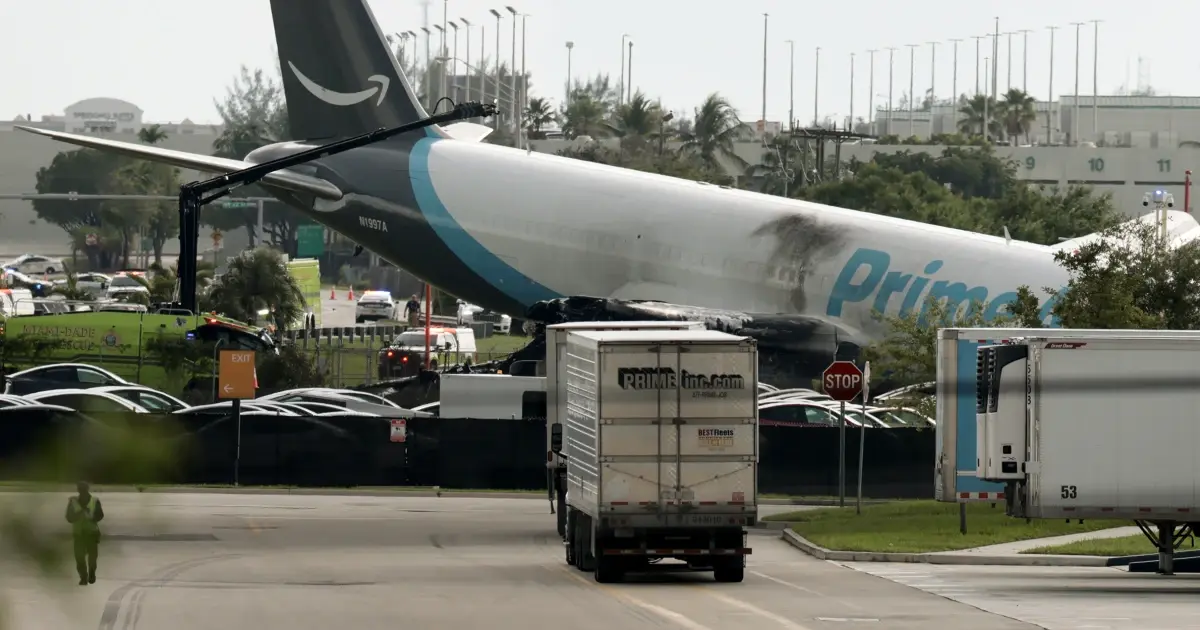
At approximately 1:58 p.m. on Sunday, September 6, 2026, Amazon Air Flight 7598 touched down at Miami International Airport and did not stop. The Boeing 767-300 freighter, operated by 21 Air on behalf of Amazon Air, was arriving from San Juan, Puerto Rico, when it overran the full length of Runway 30, crossed the airport perimeter road on NW 67th Avenue at 112 knots (roughly 130 mph), and struck multiple vehicles before coming to rest approximately 2,000 feet beyond the end of the usable pavement. Five people were killed. Five more were injured, three of them critically. Miami-Dade Fire Rescue Chief Ray Jadallah said crews arrived to find heavy flames and smoke from a complex engine compartment fire, with the pilot and copilot trapped inside the cockpit and victims trapped in struck vehicles on the road. About 200 firefighters were on scene.
No Spoilers, No Reverse Thrust
Video circulating on social media appears to show the aircraft remaining airborne well into the 9,360-foot runway before finally touching down, with the right main gear on the pavement and the left still in the air. Critically, the footage does not appear to show the wing spoilers rising or the thrust reverser sleeves opening. Those two systems are the primary means of stopping a widebody jet once it is on the ground. Flightradar24 ADS-B data shows the aircraft was still travelling at 112 knots when it crossed the end of the runway surface. The last received speed was 69 knots, meaning it was still doing roughly 80 mph as it crossed the road where five people died. The NTSB will need to confirm the spoiler and reverser question from the flight data recorder, but if the video evidence holds, it puts the landing sequence at the centre of the inquiry.
A 32-Year-Old Airframe with Seven Owners
The aircraft, registered N1997A, is a Boeing 767-33A(ER) with serial number 27310, built in 1994. It was originally delivered to Belgian carrier Sobelair, then passed through Vietnam Airlines, Air Europa, Kenya Airways, Russian carrier Nordwind Airlines, and Atlas Air before being converted from a passenger jet to a freighter in 2015. 21 Air began operating it in January 2025, just 20 months before the crash. The registered owner is Andromeda Leasing II LLC, an entity at the same Purchase, New York address as Atlas Air Worldwide. Three companies sit in the chain between the airframe and the flight crew: the Atlas-affiliated lessor that owns the aircraft, Amazon which controls the 767 fleet, and 21 Air which holds the FAA operating certificate and employs the pilots.
This Was Not the First Amazon 767 Runway Overrun
On November 19, 2024, a CargoJet Boeing 767 operating for Amazon overran the runway at Vancouver International Airport. That aircraft had flap problems, informed ATC it would make a faster-than-normal approach, and crossed the runway threshold at 173 knots before stopping approximately one-third of a mile beyond the pavement. There were no injuries. Before that, on February 23, 2019, Atlas Air Flight 3591, a Boeing 767 operating for Amazon Prime Air, crashed into Trinity Bay near Houston after a loss of control in flight. All three crew members were killed. The NTSB's final report cited "inappropriate crew response" and found systemic problems with how contracted cargo carriers trained pilots. Miami is now the third serious runway or flight control event involving a Boeing 767 in Amazon's contracted cargo network in seven years. Two of the three resulted in fatalities.
NTSB Chairwoman Jennifer Homendy Is on the Ground
NTSB Chairwoman Jennifer Homendy led the Go Team dispatched to Miami on the day of the crash. A formal briefing was scheduled for 4:00 p.m. EDT on Monday, September 7. Investigators are expected to focus on four areas: where the aircraft first contacted the runway (the touchdown point), whether the braking and thrust reversers deployed, the mechanical condition of the spoiler system, and crew decision-making in the final approach. Former NTSB official Mary Schiavo noted investigators will also examine the aircraft's maintenance history, including its years under Russian ownership. The flight data recorder and cockpit voice recorder, if recoverable, will be the primary evidence.
The Contracted Cargo Model Is Back Under the Microscope
The Boeing 767 has two hull losses from accidents in 44 years of service, one of the best records of any widebody jet. But the pattern of serious incidents within Amazon's contracted network has drawn scrutiny since the 2019 Atlas Air crash. Amazon does not operate aircraft itself. It contracts with carriers like 21 Air, CargoJet, and ATSG, who hold the FAA operating certificates and employ the crews. That structure gives Amazon operational influence over routes, scheduling, and fleet composition without direct FAA certification responsibility. After 2019, the NTSB recommended the FAA examine oversight of this model. The Miami crash will renew that pressure. Miami International saw more than 160 flights cancelled and 325 delayed on Sunday as crews worked the scene. Some flights were diverted 200 miles north to Orlando.