Every Code on Your Tyre Sidewall, Decoded
Five groups, one sidewall.
Pick up any tyre and you see a wall of moulded text: P215/65R17 94H, then UTQG 600 A A, then a DOT code, then a scatter of letters like XL, ZP, or MO. Every character means something specific and standardised. This reference decodes all five groups in order, with tables for the two that matter most (load index and speed rating), so you can read any tyre without a search engine.
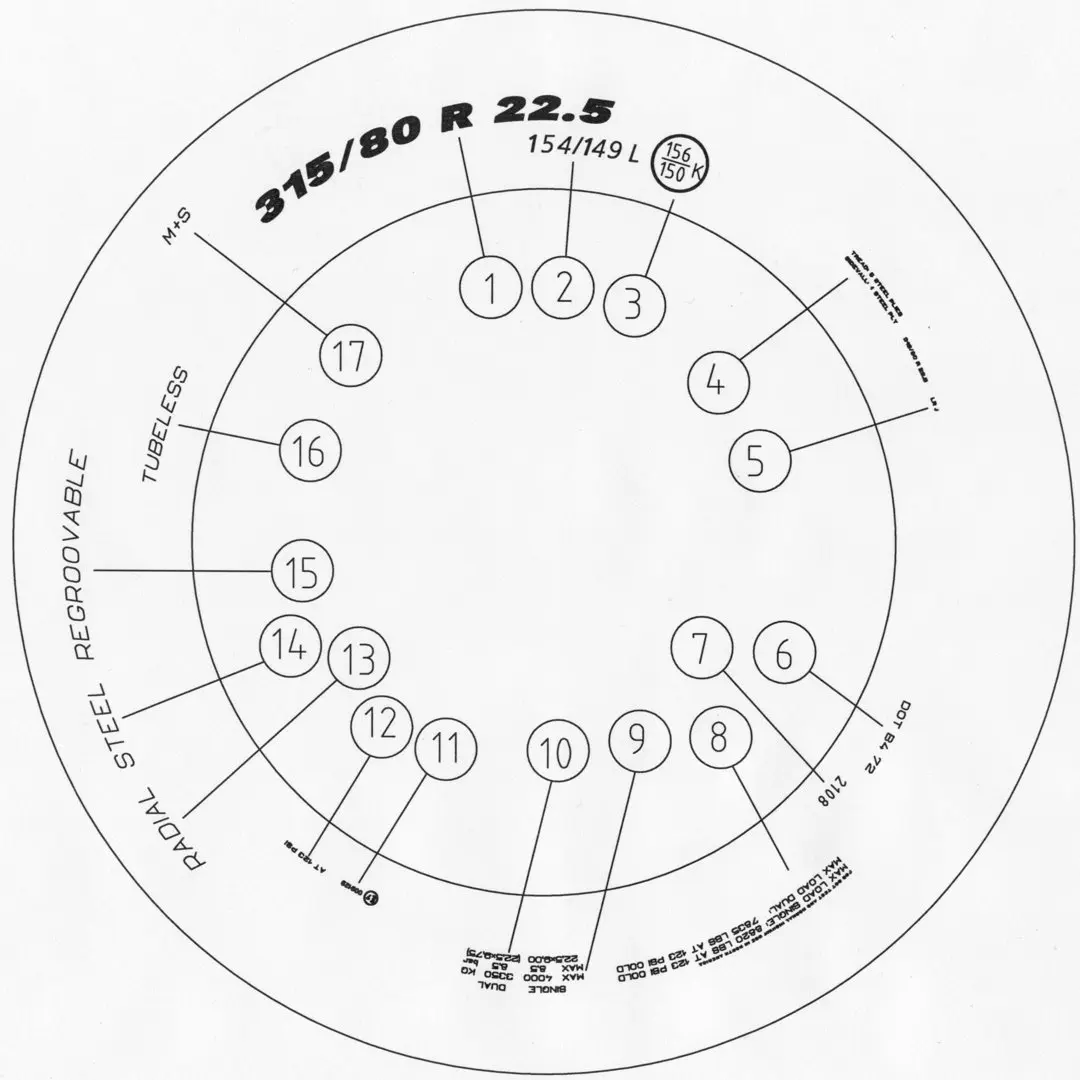
Group 1: the size code (example: P215/65R17)
The size code has five parts, always in the same order. The optional prefix letter (P, LT, ST) tells you the service category. The three-digit number is the section width in millimetres from sidewall to sidewall. The two-digit aspect ratio is the sidewall height expressed as a percentage of the width: a 65-series tyre on a 215mm wide tyre has a sidewall height of 215 x 0.65 = 139.75mm. The construction letter (R for radial, B for bias-belt, D for diagonal) tells you how the casing plies are laid. The final two digits are the rim diameter in inches: this must match your wheel exactly.
Part
Example | Meaning
Service prefix
P | P = Passenger, LT = Light Truck, ST = Trailer, blank = Euro-metric
Section width
215 | Width in mm from sidewall to sidewall
Aspect ratio
65 | Sidewall height as % of section width (65% of 215 = 139.75mm)
Construction
R | R = Radial (standard), B = Bias-belt, D = Diagonal/bias-ply
Rim diameter
17 | Wheel diameter in inches. Must match wheel exactly.
Group 2: load index (the two or three digits after the construction letter)
The load index (LI) is a standardised number that maps to a maximum load per tyre at correct inflation. It is NOT a weight in kg printed directly; you look it up in the ETRTO table. The most common passenger-car range is 71 to 110. Fitting tyres with a lower LI than your vehicle requires is illegal and dangerous: the tyre can fail under load. Fitting a higher LI is safe. Your door-jamb sticker shows the minimum LI for your vehicle.
Group 3: speed rating (the letter after the load index)
The speed rating is the maximum sustained speed at which the tyre is tested to carry its rated load. It is km/h-based. The scale jumps from T (190 km/h) to H (210 km/h), skipping the alphabetical gap: H was historically the highest rating and carries a premium sports connotation even though V, W, and Y surpassed it later. The letters I and O are unused to avoid confusion with 1 and 0. Fitting tyres rated below your vehicle's minimum speed rating is illegal in most countries. The door-jamb sticker or owner's manual lists the minimum speed rating.
Symbol
km/h | mph | Typical use
Q
160 | 99 | Winter and studded tyres
S
180 | 112 | Family sedans, minivans
T
190 | 118 | Family sedans, SUVs
H
210 | 130 | Sport sedans, crossovers
V
240 | 149 | Sports cars
W
270 | 168 | Exotic sports cars
Y
300 | 186 | Supercars
ZR
240+ | 149+ | Appears in size code, not service description
(W)
270+ | 168+ | Exceeds W threshold, see manufacturer
(Y)
300+ | 186+ | Exceeds Y threshold, see manufacturer
Group 4: UTQG grades (three characters, e.g. 600 A A)
UTQG stands for Uniform Tire Quality Grading, mandated by NHTSA under 49 CFR 575.104 for all US passenger-car tyres since 1979. It is NOT required on light truck tyres, winter tyres, temporary spares, or trailer tyres. The three characters are always in the same order: treadwear, traction, temperature. Treadwear is a relative index: 100 is the baseline government test tyre. A tyre rated 400 should last four times as long on the government test course. Real-world range is roughly 100 (track-day tyres) to 800 (premium all-season). Traction grades measure only wet straight-line braking, not cornering or dry grip. Temperature grades show the sustained speed at which the tyre dissipates heat safely. C is the legal minimum.
Grade
Traction (wet asphalt) | Traction (wet concrete) | Temperature (sustained)
AA
above 0.54g | above 0.38g | (not applicable)
A
above 0.47g | above 0.35g | above 115 mph
B
above 0.38g | above 0.26g | 100 to 115 mph
C
below 0.38g | below 0.26g | 85 to 100 mph
The DOT date code Every tyre is required to print a DOT code. The last four digits are the manufacture date: the first two are the week (01 to 52), the last two are the year. "4723" = week 47 of 2023. Only one sidewall carries the complete date code; the other may show only the partial plant code. Most manufacturers recommend replacing tyres after six to ten years from the manufacture date regardless of visible tread depth.
Marking
Meaning
XL or EXTRA LOAD
Higher load capacity at same size. Requires higher inflation to realise the extra rating.
M+S (or M/S, M&S)
Mud and Snow. Self-declared by the manufacturer, no performance test required.
3PMSF snowflake
Three-Peak Mountain Snowflake. Must pass a wet-snow braking test (UN/ECE Reg. 117).
RFT, ROF, EMT
Bridgestone or Firestone run-flat (RFT), Goodyear/Dunlop (ROF or EMT)
SSR, DSST
Continental/Uniroyal self-supporting runflat (SSR), Dunlop (DSST)
ZP, ZPS
Michelin Zero Pressure (ZP), Yokohama Zero Pressure System (ZPS)
RSC
BMW/MINI original equipment run-flat component
MO, AO, N0, N1...
OE homologation: MO = Mercedes, AO = Audi, N0-N4 = Porsche models
* (star)
BMW/MINI OE approval. Compound and noise tuned for that vehicle.
T0, T1, T2
Tesla OE homologation (reinforced lower sidewall for EV torque loads)
M+S is not a winter tyre M+S is a self-declared label with no independent test. A tyre can carry M+S with no meaningful advantage over a summer tyre in snow. The 3PMSF snowflake is the mark that requires a verified performance result. Several Canadian provinces and some European regions legally require the 3PMSF symbol for winter driving; M+S alone does not qualify.