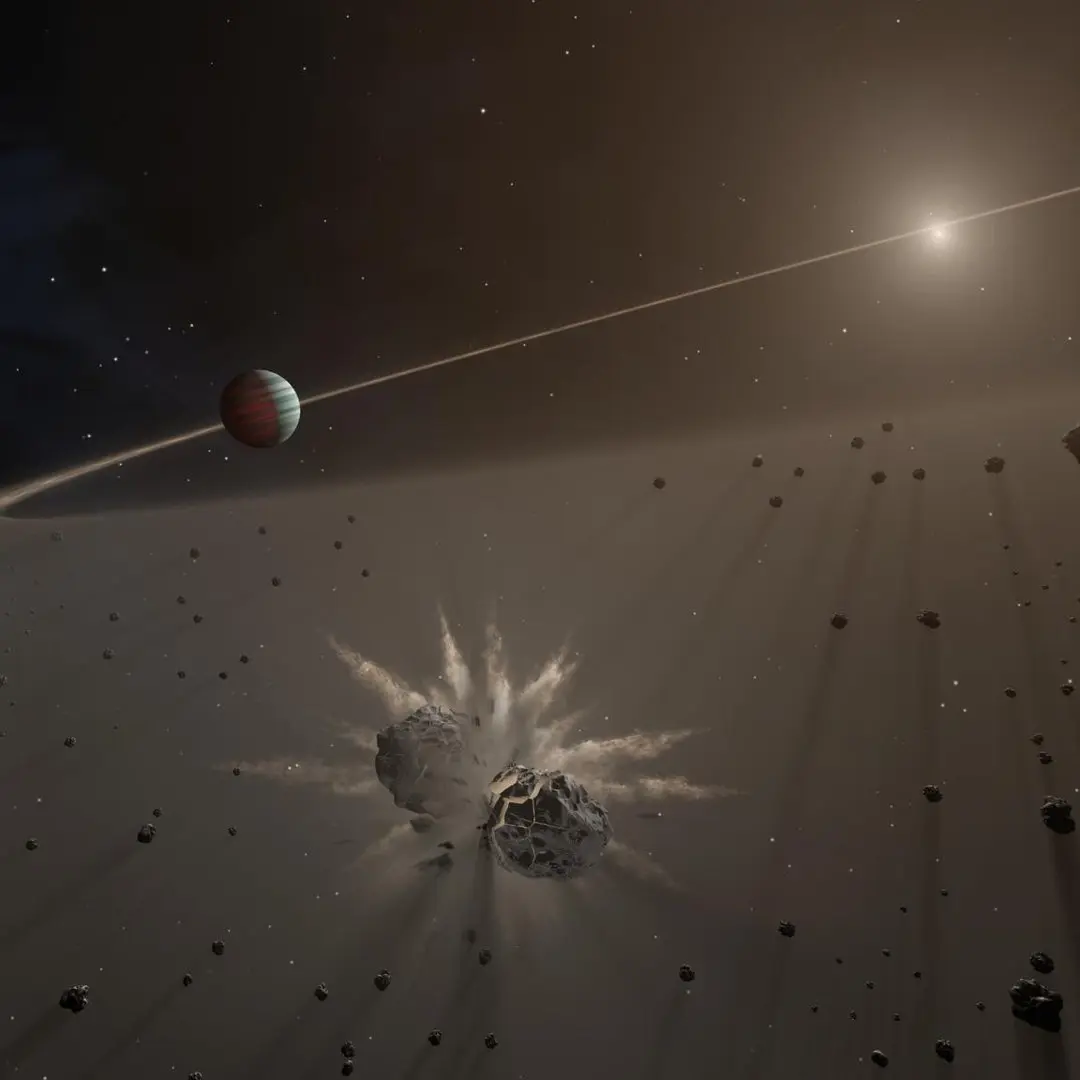
Elias 2-24 b: The Baby Planet That Broke the Clock
A planet less than 1 million years old, forming five times faster than \
science said was possible. Before this week, the youngest confirmed planets in the universe were all over 5 million years old. That figure was not just a record, it was a theoretical lower bound: the leading model of giant planet formation predicts that a Jupiter-mass world takes roughly 5 million years to build at the distances we see in our own solar system. It takes longer, not shorter, the farther from the star you go. Then Andrea Bernardi, a doctoral candidate at Universidad Diego Portales in Chile, pulled open a decade of archived telescope data and found Elias 2-24 b.
A Jupiter-sized planet orbiting 55 times farther from its star than Earth \
orbits the Sun, inside a system less than 1 million years old. The study was published Wednesday September 16, 2026, in The Astrophysical Journal Letters. Elias 2-24 b is not just a new record. It is an anomaly the models cannot yet explain.
Credit: NASA/JPL-Caltech. Artist concept of a giant exoplanet orbiting \
inside a debris disk, with the host star visible at upper right. The gap carved by a forming planet is the signature Bernardi's team searched for in the Elias 2-24 disk.
The Gaps Were the Clue
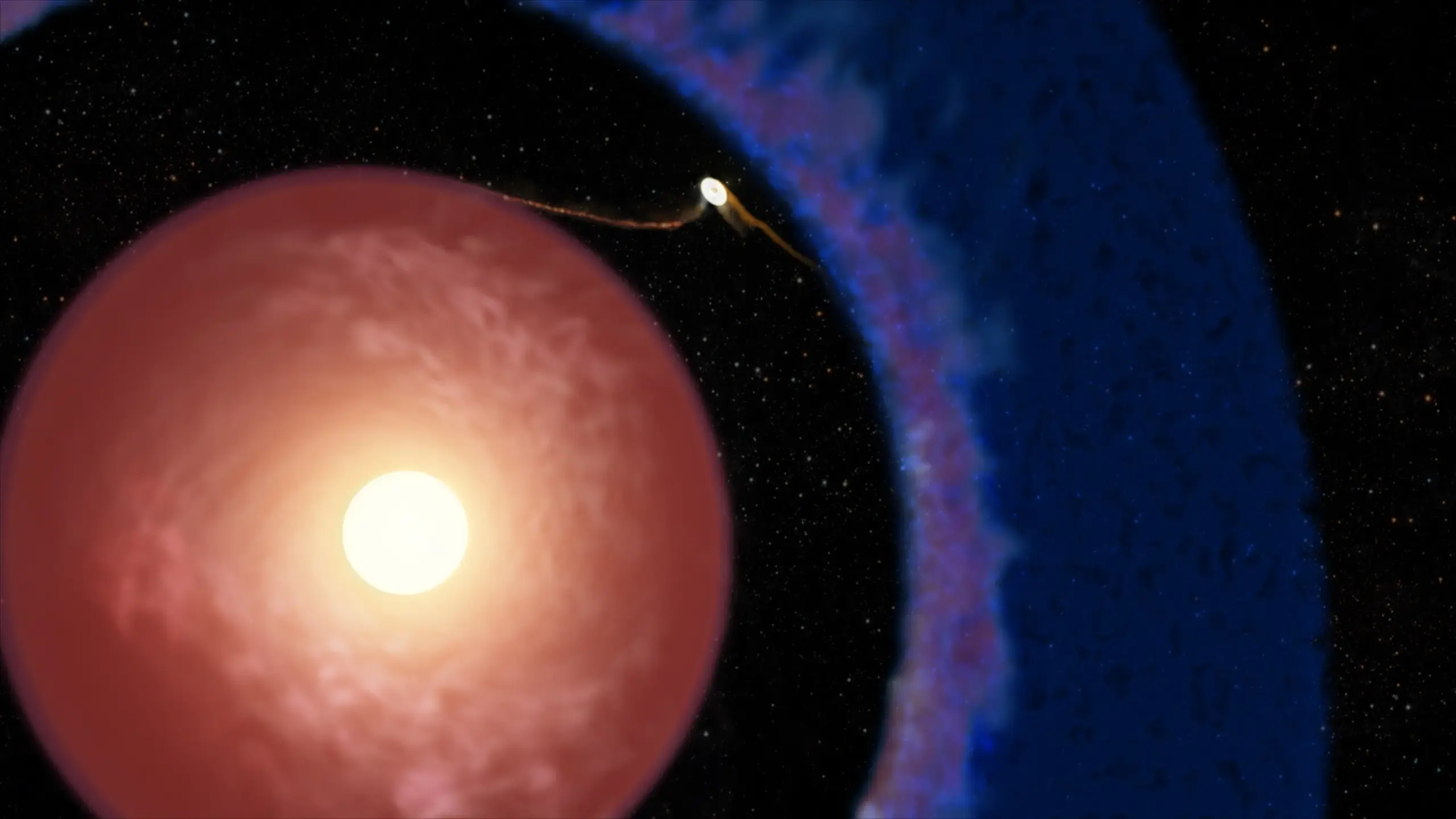
The star Elias 2-24 sits about 450 light-years from Earth in the rho Ophiuchi cloud, a stellar nursery where new stars and planetary systems are still assembling. Like many young stars, it is wrapped in a protoplanetary disk: a flat ring of gas and dust left over from the star's formation, the raw material from which planets are made. ALMA, the radio telescope array in Chile, had imaged that disk years earlier and found something telling: three concentric gaps cut into the dust, at roughly 20, 52, and 87 astronomical units from the star. "The planets should be found within the gaps, since they are carving them. And that's exactly where we found Elias 2-24 b," Bernardi said.
A gap alone is not a planet. To confirm the object, Bernardi turned to \
archived data from the W. M. Keck Observatory in Hawaii, using its NIRC2 coronagraph, a device that blocks a star's glare to reveal faint objects orbiting nearby. She found a signal in observations from 2018, and again in 2020. Two years apart, two data sets, one moving object. Its motion matched a planet on a stable orbit, not a background star drifting behind the disk by coincidence.
Five Times Younger Than the Previous Record
The previous record was a four-way tie: two planets around the star PDS 70 and two around WISPIT 2, all clocking in at just over 5 million years. Those planets were already challenging the models. At under 1 million years, the timeline is not merely tight. It is broken. Lucas Cieza, professor at the Instituto de Estudios Astrofisicos in Chile and a co-author of the study, was direct: "Our planet-formation models already struggled to explain the previous record holders. Elias 2-24 b shows us that even our best models are still missing some important processes."
The core accretion model works in two stages. First, dust grains collide \
and stick to form a solid core. Then the core, once massive enough, pulls in gas from the disk to become a gas giant. That sequence takes time. At the distance of Jupiter from our Sun, the model requires at least 5 million years. At 55 AU, even farther out, where the disk is colder and material more spread out, it should take longer still. Elias 2-24 b formed at less than one-fifth that timescale, at a greater distance. The numbers do not work.
Planet name
Elias 2-24 b
Age
Less than 1 million years old
Previous record
Over 5 million years (PDS 70, WISPIT 2)
How many times younger
5x younger than any prior confirmation
Distance from its star
55 AU (55x the Earth-Sun distance)
Distance from Earth
~450 light-years, rho Ophiuchi region
Mass
Jupiter-sized, confirmed by coronagraphic imaging
Discovery data
Keck/NIRC2 archival observations, 2018 and 2020
"Our planet-formation models already struggled to explain the previous record holders. Elias 2-24 b shows us that even our best models are still missing some important processes.
"Lucas Cieza · Professor · Instituto de Estudios Astrofisicos · co-author
What Comes Next: Roman Is Already in Orbit
Detecting a faint planet next to a blinding young star inside a thick disk of gas and dust requires a coronagraph of exceptional sensitivity. The Keck data worked because Bernardi had two epochs of archival observations. Most young stars have only one, or none. NASA's Nancy Grace Roman Space Telescope, launched August 30, 2026, carries an advanced coronagraph designed to push past this limit. It can detect planets in tighter orbits and targets several times harder to see than Keck's NIRC2 can resolve. Cieza noted that "such detections should become easier" once Roman turns toward nurseries like rho Ophiuchi. Elias 2-24 b may soon look less like an anomaly and more like the first entry in a catalogue. The models will need to catch up.