Earth's Core Just Reversed: What That Means
What Is Down There
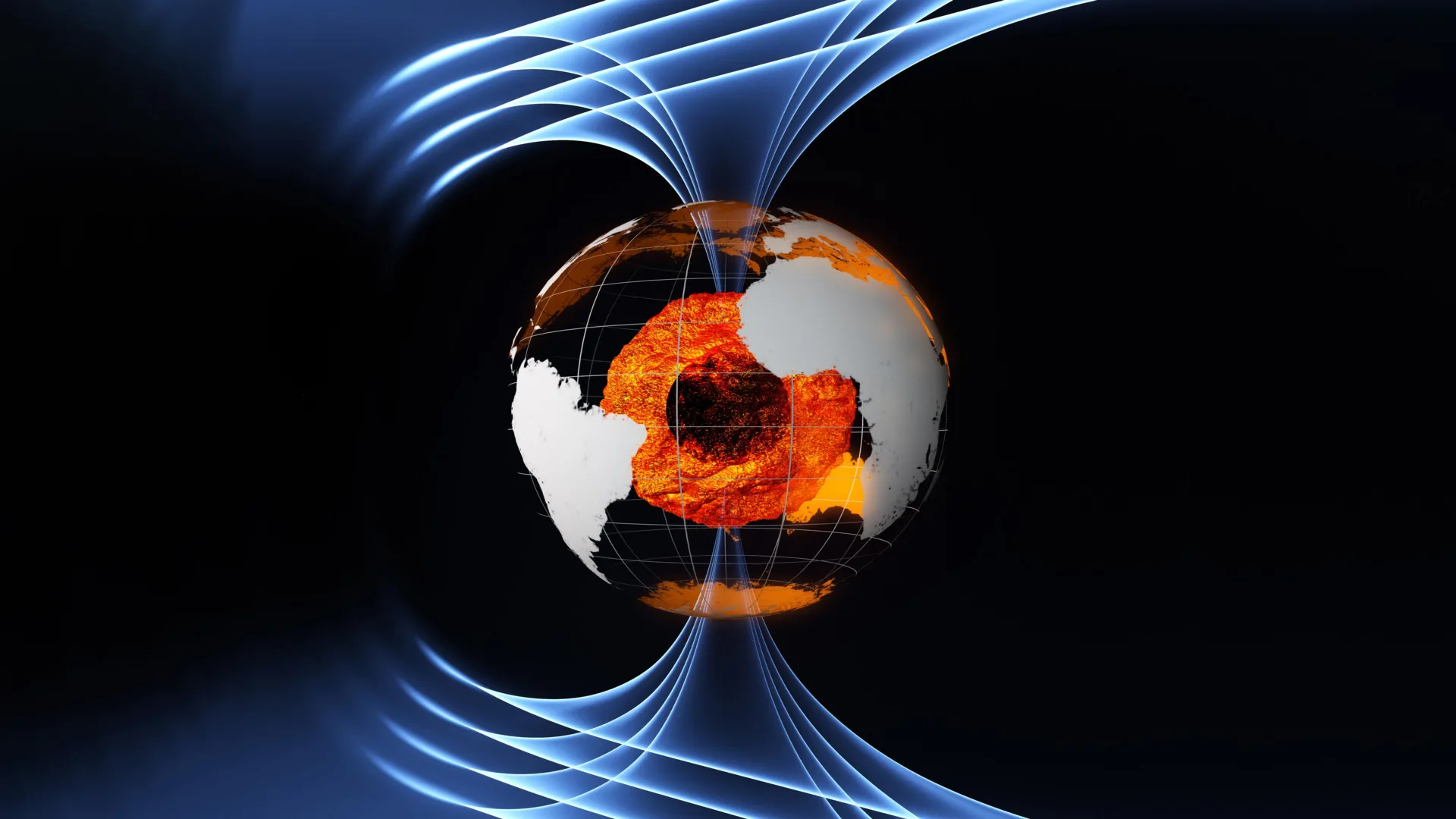
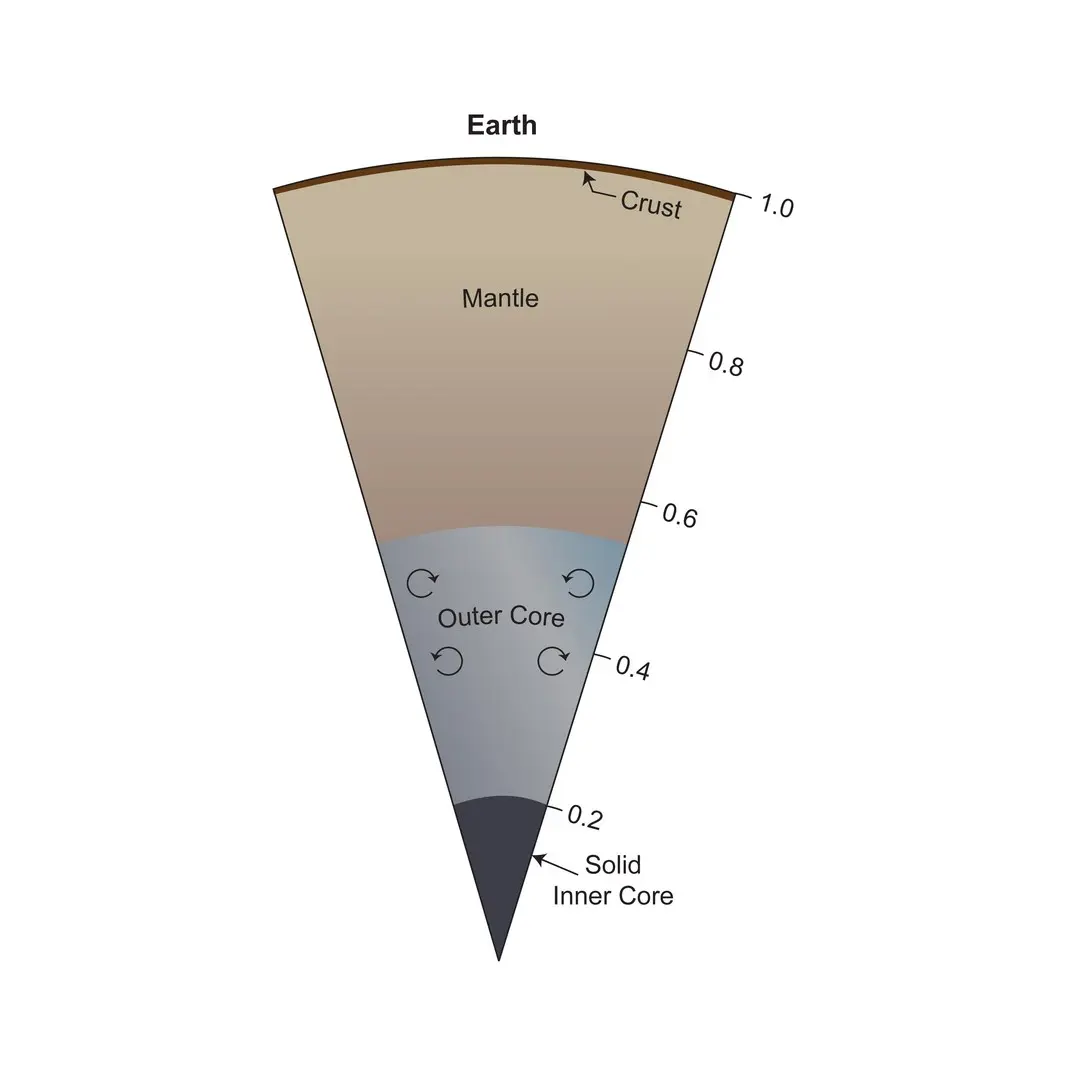
Earth has four layers. The crust we stand on is roughly 30 to 50 km thick. Below it sits the mantle, a 2,900 km shell of hot, slowly flowing silicate rock. Beneath that is the outer core: a 2,200 km deep ocean of liquid iron and nickel, somewhere between 4,000 and 6,000 degrees Celsius. And at the very centre, under impossible pressure, sits the solid inner core: a ball of iron roughly the size of the Moon, spinning independently of everything above it. The outer core's constant churning motion is what generates Earth's magnetic field. When that motion changes direction, something significant has happened deep in the engine that protects all life on the surface.
Depth of outer core (top)
approx. 2,900 km below surface
Depth of inner core (top)
approx. 5,100 km below surface
Temperature of outer core
4,000 to 6,000 degrees Celsius
Inner core diameter
approx. 2,440 km (similar to the Moon)
Inner core oscillation cycle
roughly 70 years per back-and-forth
Data span analysed (2026 study)
1997 to 2025 (28 years)
Satellites used
ESA Swarm (3) and CryoSat, plus ground stations
Inner core lag since 2008
approx. 0.1 degrees per year behind surface
The Inner Core (solid) The solid inner core has been slowing since around 2008 and is now rotating slightly slower than the rest of the planet. This appears to be part of a roughly 70-year oscillation. It was spinning faster in the 1970s, overtook the surface, and is now lagging behind. Scientists infer this from seismic doublets: pairs of near-identical earthquakes years apart whose wave patterns shift, revealing that the internal structure has moved.
The Outer Core (liquid) The liquid outer core normally flows westward in a pattern that has been stable for decades. The August 2026 study found a dramatic reversal: a strong eastward current appeared beneath the Pacific around 2010, was already slowing by 2020, and is now the dominant feature in that region. The study used 28 years of satellite magnetometer data to reconstruct how the flow changed. The researchers believe the two reversals, inner and outer, are connected.
"Earth's core may be far more variable and complex than once believed. This research raises intriguing questions about how our planet's deepest layers are dynamically connected.
"Lead researcher · Journal of Studies of Earth's Deep Interior · August 2026
Five things to know
Earth's magnetic field is generated by the liquid outer core churning around the solid inner core. Without it, solar wind would strip the atmosphere over millions of years.
The outer core reversal beneath the Pacific is the biggest change in core flow observed since satellite measurements began in the 1990s.
The inner core oscillation is roughly 70 years per cycle. The backward phase began around 2008 and is the current state.
A slower-spinning inner core fractionally lengthens Earth's day, by fractions of a millisecond, measurable by atomic clocks.
There is no surface danger. The magnetic field is not reversing, and this oscillation is not linked to eruptions or earthquakes.