Dark Energy May Be Dying: 2,884 Supernovae Say So
2,884 Dead Stars and a Wobbling Constant
The largest Type Ia supernova dataset ever assembled has returned a result that cosmologists did not expect: the force pushing the universe apart deviates from the standard model prediction by 2.5 to 3.1 sigma. That force is dark energy, and for 25 years physicists have assumed it is a fixed cosmological constant. The new data suggest it is not.
The dataset, called Supernovae Unite, combines the historic Pantheon+ catalogue (roughly 1,550 supernovae) with data from the Dark Energy Survey, adding more than 1,300 additional events and reprocessing the entire sample with consistent modern methods.
The result: 2,884 likely Type Ia supernovae spanning three decades of observations. Ryan Camilleri, a PhD candidate at the University of Queensland's School of Mathematics and Physics, led the effort with 23 co-authors including Professor Tamara Davis. "Our project sets a new global benchmark in supernova cosmology," Camilleri said. "We've rebuilt three decades of astronomical observations into a single, consistent framework."

The Standard Candles That Measure the Universe
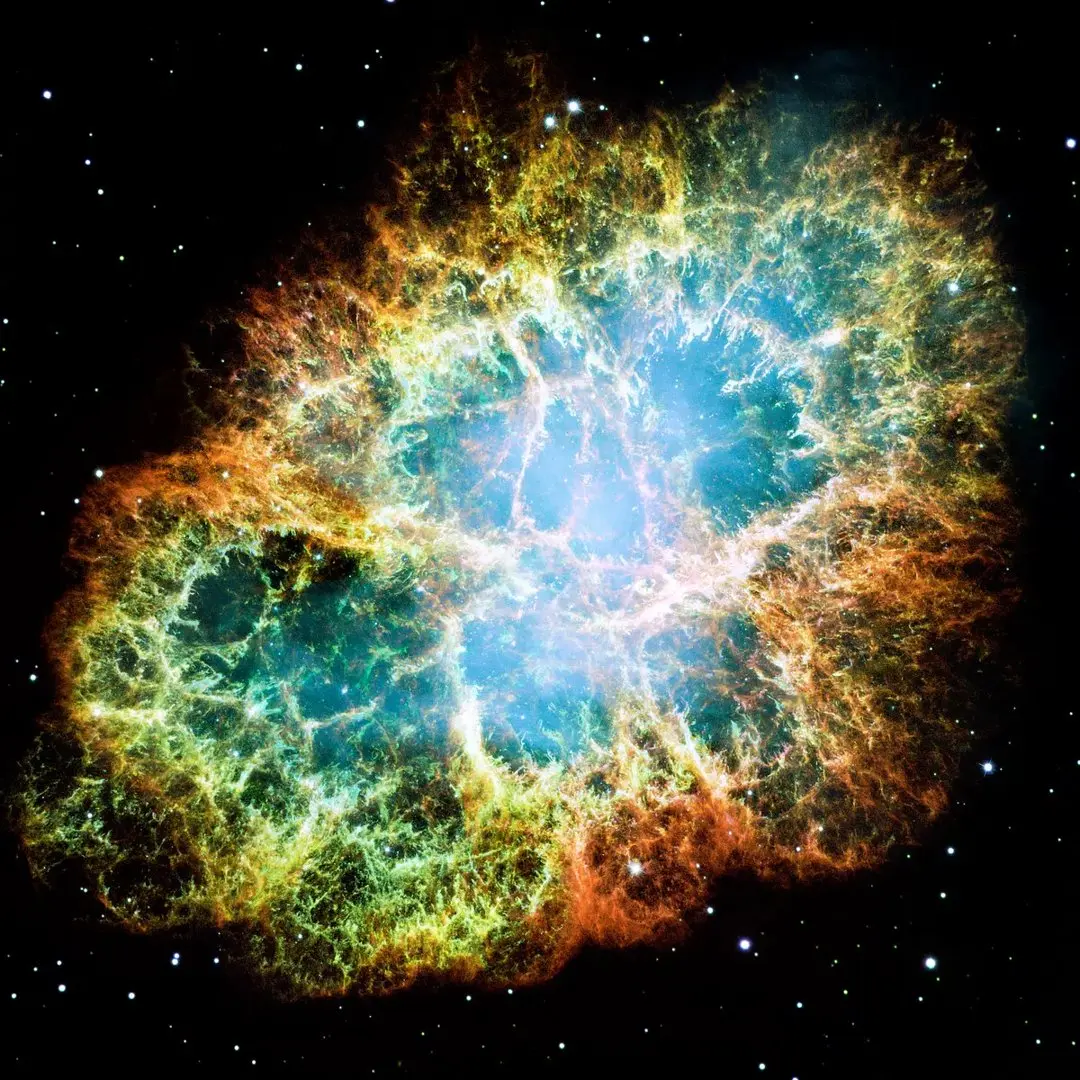
Type Ia supernovae are the rulers cosmologists use to measure cosmic distance. They occur when a white dwarf star in a binary system siphons mass from its companion until it crosses a critical threshold and explodes. Because that threshold is always the same, the explosion always reaches the same peak brightness, making each event a reliable "standard candle." An astronomer who observes one billions of light-years away can compare its apparent dimness against its known intrinsic brightness and calculate how far away it is, and therefore how fast the universe expanded between then and now.
The 1998 discovery that distant supernovae appeared dimmer than expected, implying the universe was accelerating its expansion, won the Nobel Prize in Physics in 2011.
That finding introduced dark energy as the agent responsible for the acceleration. The standard model, Lambda-CDM, treats dark energy as a cosmological constant: a fixed energy density of empty space that does not change over time. The Unite dataset challenges that assumption. After accounting for cosmic dust, host-galaxy stellar mass, and gravitational lensing across all 2,884 events, the sample fits a universe where dark energy is shifting over time, not holding steady.
Two Detectors, the Same Unexpected Answer
The Unite result does not stand alone. The Dark Energy Spectroscopic Instrument (DESI), a separate experiment that maps the universe's large-scale structure by tracking galaxy positions, found the same hint in its own surveys this year. DESI uses a completely different measurement method and a completely different class of observation. Professor Tamara Davis put the significance directly: "Two completely independent measurements have found hints of time variation in dark energy, challenging the standard model that dark energy does not change."
At 2.5 to 3.1 sigma, the deviation is well short of the five-sigma threshold physicists conventionally require to claim a discovery.
But sigma values this strong, across this many supernovae, with independent confirmation from a second instrument, are the kind of hint that rewrites careers when they clear five. Two independent instruments, built on different physics, pointing at the same anomaly is not coincidence. It is a signal.
""Instead of confirming the standard model of cosmology, which assumes dark energy is fixed and unchanging, we have more evidence that dark energy may change over time." Ryan Camilleri, PhD candidate, University of Queensland, lead author
"Steph1st of October 2026

What Changing Dark Energy Would Mean
If dark energy varies over time, then the cosmological constant is not the right description of it. That would require new physics. Candidates include quintessence (a scalar field whose energy density evolves as the universe ages) and other dynamical models. A fixed cosmological constant implies a universe that expands forever at a gently accelerating rate. A dark energy that grows stronger over time would eventually shred matter apart in what physicists call the Big Rip. A dark energy that weakens would allow gravity to eventually pull the universe back in.
Supernovae in Unite dataset
2,884
Prior Pantheon+ catalogue
~1,550
Sigma deviation from Lambda-CDM
2.5 to 3.1
Observations spanned
30 years
Independent confirmation
DESI surveys, 2026
What Happens Next
The Unite Hubble diagram and likelihood files will be made publicly available on acceptance of the paper, giving any team the same dataset to test alternative cosmological models. The Dark Energy Bedrock All-Sky Supernova program (DEBASS) is already detecting hundreds of additional nearby supernovae, filling a gap in the distance calibration. The Vera C. Rubin Observatory, scanning the entire sky every few nights over ten years, is expected to discover more than 20,000 new supernova host galaxies and permit a direct test of whether dark energy has been changing, or whether the current signal dissolves under larger statistics. Until then, 2,884 dead stars have done what good data always does: they have narrowed the options and made the universe slightly less comfortable to inhabit.