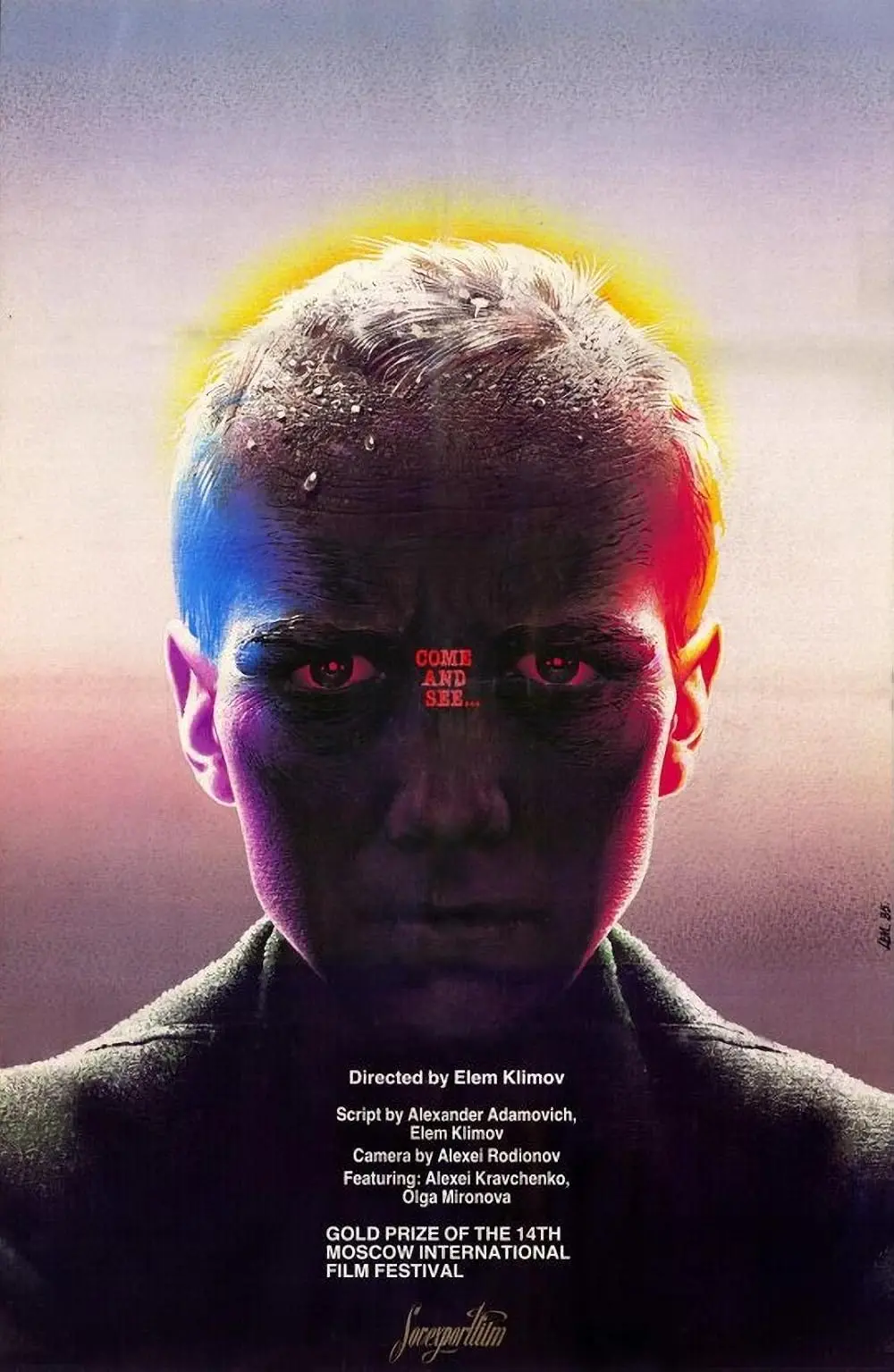
Come and See: Eight Years To Get The Script Approv
Come and See (1985)
Klimov fought Soviet censors for most of a decade, then made the most punishing war film ever produced and never directed again.
Runtime
146 minutes
Director
Elem Klimov
Box office
$20.9 million worldwide
Cinematography
Aleksey Rodionov
A War Film With No Combat
Belarus, 1943. A boy digs a rifle out of a sand dune so he can join the partisans, and the film follows him through a countryside being systematically destroyed by German punitive units. There is almost no fighting. What there is instead is aftermath, waiting, noise, and an escalating sense that the adult world has stopped functioning. Klimov shot much of it on a Steadicam moving with the boy's face, used live ammunition fired close to the actors, and cast Aleksei Kravchenko at fourteen, whose visible deterioration across the production is the film's central effect. The final village sequence, based on the Khatyn massacre and the six hundred and twenty eight Belarusian villages burned with their inhabitants, is filmed in real time and is close to unwatchable.
"Come and see.
"The title
Watching Come and See
Curiosity
/
Part
The script, written with Ales Adamovich from his own accounts of the occupation, was rejected repeatedly by Goskino until the fortieth anniversary of the Soviet victory made approval unavoidable.
Klimov used live rounds fired near the cast and put Kravchenko through conditions the crew described as hypnosis. He directed nothing else, saying he had lost interest in inventing anything after this.
Almost every film about atrocity since has had to decide whether to follow this model or reject it. Klimov refuses catharsis, refuses heroism, and refuses to let the camera leave a child's face, and the result is a film widely described as essential and rarely rewatched. The last shot, in which the boy fires at a photograph and then looks directly at the lens, is one of the few endings in cinema that indicts the person watching.