
Buy Your First Index Fund: Zero to Autopilot
The Fee Gap Is the Whole Argument
The average actively managed fund charges 0.54% per year. The best index funds charge 0.03%. On $100,000 after 30 years, that gap costs roughly $54,000 in lost compounding. The math is why Buffett spent decades telling ordinary investors to buy a low-cost index fund and leave it alone. The hard part is knowing which account to open first, which fund to pick, and how to automate it so it runs without you. This guide covers the full path, using verified figures from the IRS, Fidelity, Vanguard, and the SEC as of October 2026.
Step 1: Open the Right Account in the Right Order
The account type determines whether your gains are taxed each year or not at all. The order you fill them matters as much as the funds inside. First: contribute to your employer 401(k) up to the match. If the employer matches 4%, contribute at least 4%. That match is an immediate return before your fund does anything. Second: max a Roth IRA. Contributions come from after-tax dollars, so every dollar of growth and every retirement withdrawal is tax-free. The 2026 limit is $7,500 (under 50) or $8,600 (50 and over). The income phase-out for single filers begins at $150,000. Third: once both are maxed, use a taxable brokerage account. No special tax treatment, but no contribution limits and no withdrawal restrictions either.
401(k) employer match
Contribute at least enough to get the full match first
Roth IRA limit 2026 (under 50)
$7,500 per year
Roth IRA limit 2026 (50 and over)
$8,600 per year
Roth IRA phase-out (single)
Begins at $150,000 adjusted gross income
401(k) employee limit 2026
$23,500 (up from $23,000 in 2025)
Average active fund annual fee
0.54%
Best index fund annual fee
0.00 to 0.04%
Step 2: Pick One of These Five Funds
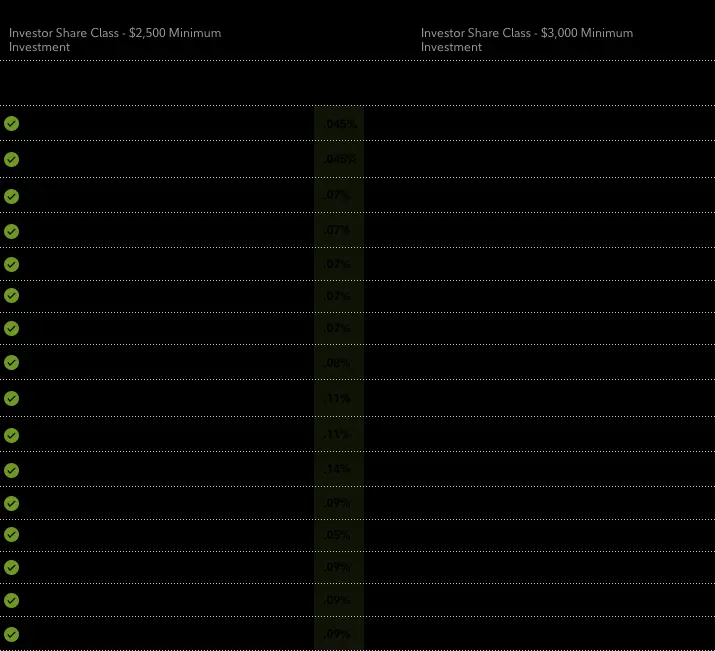
Every fund below tracks the entire U.S. market or the S&P 500. They are functionally near-identical over the long run. The differences are fee, minimum, and broker. Pick the one that fits your situation and stop looking. FZROX (Fidelity ZERO Total Market): 0.00% fee, no minimum. Only at Fidelity. Uses a proprietary index, so shares cannot transfer to another broker in-kind. FSKAX (Fidelity Total Market): 0.015% fee, no minimum. Standard index, transferable. VTSAX (Vanguard Total Stock Market): 0.04% fee, $3,000 minimum. The fund most cited in the financial independence community. VOO (Vanguard S&P 500 ETF): 0.03% fee, $1 minimum with fractional shares. Tracks only the 500 largest U.S. companies rather than the full market. SWTSX (Schwab Total Market): 0.03% fee, no minimum. Best if you use Schwab.
FZROX (Fidelity)
0.00% fee. Min $0. Fidelity-only, not transferable.
FSKAX (Fidelity)
0.015% fee. Min $0. Standard index, transferable.
VTSAX (Vanguard)
0.04% fee. Min $3,000. Total U.S. market.
VOO (Vanguard ETF)
0.03% fee. Min $1 fractional. S&P 500 only.
SWTSX (Schwab)
0.03% fee. Min $0. Best if you use Schwab.
Step 3: ETF or Mutual Fund?
The practical difference is smaller than most articles suggest. A mutual fund (FZROX, FSKAX, VTSAX, SWTSX) trades once per day at a closing price and accepts exact dollar amounts. Automating a $300 monthly contribution is trivial. An ETF (VOO) trades throughout the day like a stock, in whole or fractional shares. Most major brokers now support fractional ETF shares, so the gap has narrowed. For a taxable account, ETFs are slightly more tax-efficient. For an IRA, it makes no difference: gains are not taxed inside the account regardless. If you are at Fidelity or Schwab, use the mutual fund for easy automation. For maximum portability, use VOO or IVV (iShares S&P 500 ETF, also 0.03%).
Step 4: Open the Account and Fund It
Fidelity, Schwab, and Vanguard have no account minimums. You need your Social Security number, a government ID, and a bank account and routing number. The process takes about 15 minutes online. Go to fidelity.com, schwab.com, or vanguard.com and click Open an Account. Choose Roth IRA for most beginners, or individual brokerage if you have already maxed the IRA. Fill in your details, link your bank, and initiate an initial transfer. Once funded, search the ticker, enter a dollar amount, and confirm. Then set up a recurring monthly contribution. Every broker lets you schedule an automatic transfer from your bank into your fund. Set this up once. The most reliable predictor of long-run returns is not fund selection. It is adding money consistently through market highs and lows alike.
Do not sell during a downturn. Every significant market drop in modern history has recovered. An investor who sold during the 2008 or 2020 crash locked in the loss permanently. An investor who stayed the course more than tripled their money in the decade that followed each drop.
As of October 2026. IRA limits, income phase-outs, and fund fees can change annually. Confirm current figures at irs.gov before contributing.