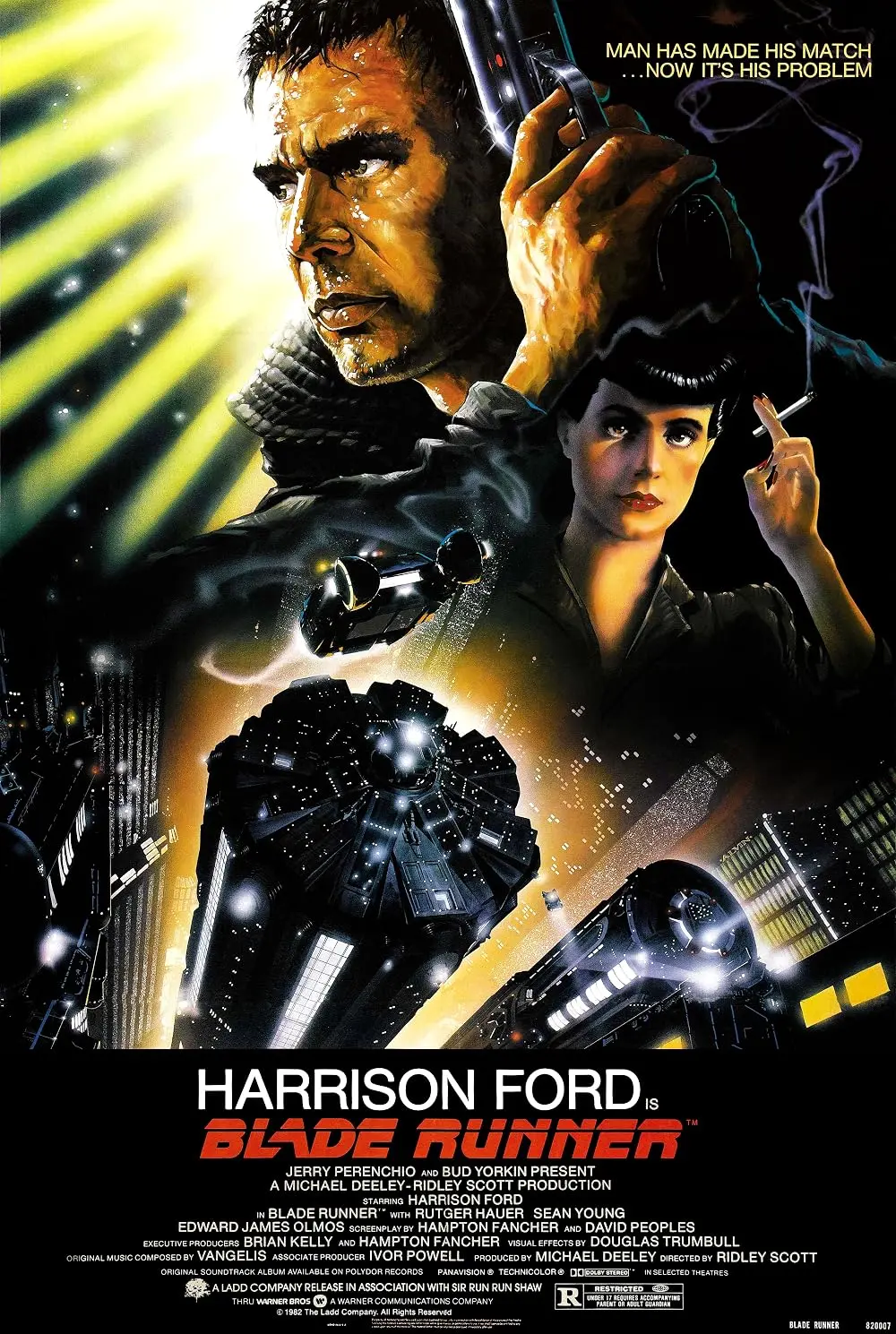
Blade Runner: A Flop With Seven Versions
Blade Runner (1982)
It lost money against E.T., was recut by the studio with a voiceover the star hated, and became the most influential design document in science fiction.
Runtime
112 minutes
Director
Ridley Scott
Budget
$28 million
Box office
$41.7 million worldwide
Cinematography
Jordan Cronenweth
The City Is The Argument
Los Angeles in 2019 is permanently raining, lit from below by advertising, and stacked so that the rich live above the weather. Syd Mead designed the vehicles, Lawrence Paull the sets and Jordan Cronenweth lit the whole thing through smoke and venetian blinds, and the combination created a look so complete that forty years of films, games and album covers have been borrowing it since. Underneath the design is a detective story with the moral arrow reversed: the hunter is a functionary, the fugitives want four more years of life, and the most humane speech in the film is delivered by the man the audience has been told to fear. The original release carried studio imposed narration and a borrowed happy ending, both later removed.
"All those moments will be lost in time, like tears in rain.
"Roy Batty · Blade Runner · 1982
Watching Blade Runner
Wonder
/
Reel
Rutger Hauer cut his final speech down himself the night before shooting and added the line about tears in rain, which was not in Hampton Fancher or David Peoples's script.
Philip K. Dick died three months before release, having seen only effects footage. He had been hostile to earlier drafts and enthusiastic about what he was finally shown.
There are seven known versions, including a workprint, the 1982 theatrical cut with narration, the 1992 Director's Cut and the 2007 Final Cut, which is the only one Scott fully controlled. The differences change the film's central question, because the unicorn in the later cuts implies something about Deckard that the original leaves alone. Almost every subsequent vision of an urban future is downstream of this one, usually without the moral ambiguity.