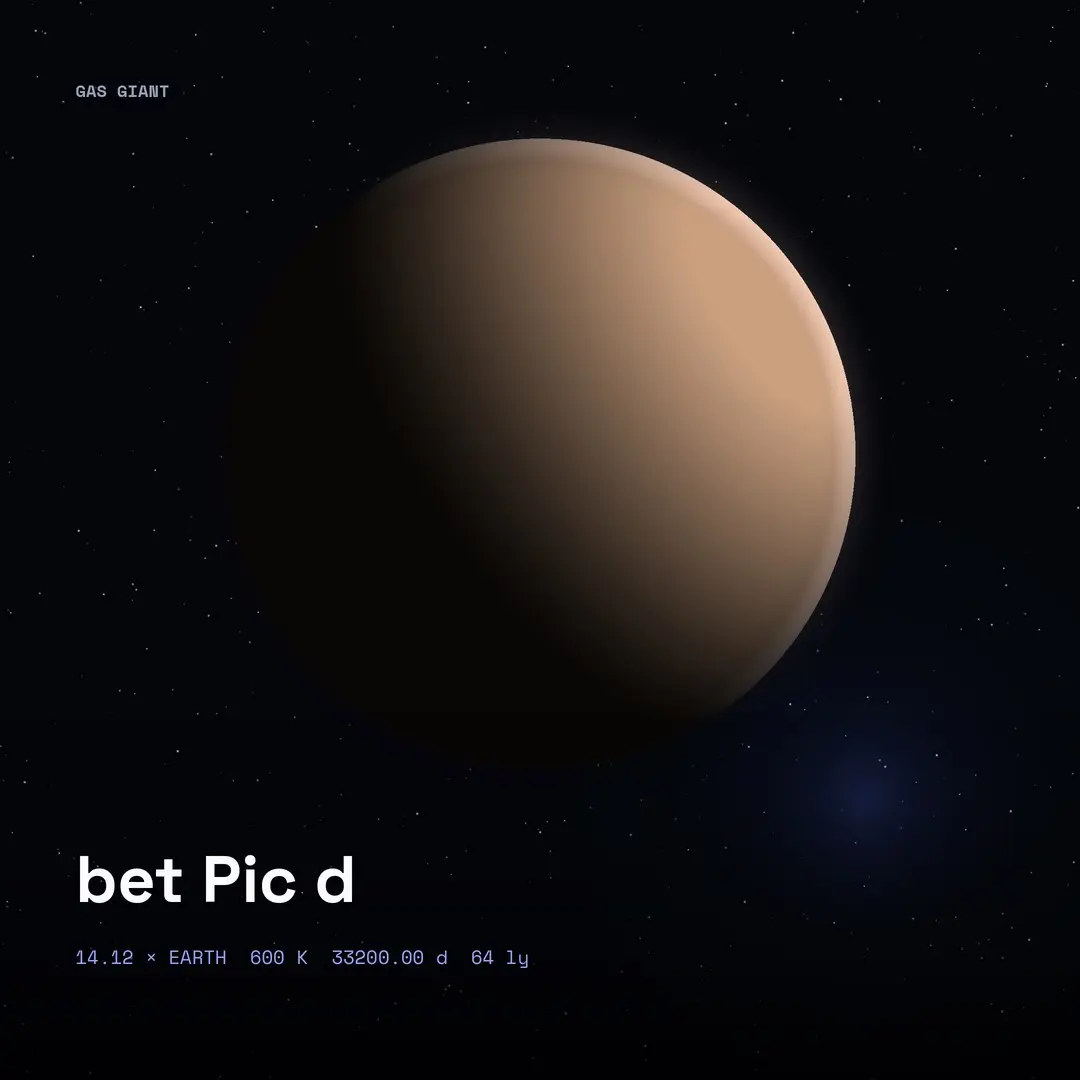
bet Pic d: Photographed, Not Inferred
Gas giant around bet Pic
It is 1.26 times Jupiter's radius, closest in size to Jupiter, and 762.8 times Earth's mass. A year there lasts 90.9 years, on an orbit 67.2 times Mercury's distance from the Sun. Its equilibrium temperature is 600 K, hotter than any desert.
Radius
14.12 Earth radii
Mass
762.8 Earth masses
Equilibrium temperature
600 K (measured)
One year
90.9 years
Orbit radius
26.0000 AU
Distance
64 light-years
What has been measured here and what has not
A radius from transit photometry. Yes.
A weight, not just a width. Yes.
A density, the one clue to composition. No.
How far out it orbits. Yes.
An observed temperature. Yes.
An eccentricity, so the orbit shape is known. Yes.
What the picture gives
A position, a brightness, and light that can be split into a spectrum.
Found by Paranal Observatory in 2026.
This is one of the rare planets that has actually been photographed. Fewer than a hundred of the thousands known were found this way, and they are mostly young giants far from their stars.
bet Pic has 3 known planets. Systems like this are the ones where architecture can be studied instead of guessed at.
Its orbit is noticeably elliptical, eccentricity 0.44, so the starlight it receives changes substantially over one year.
Fewer than a hundred planets have been photographed rather than inferred. Does \
seeing one directly change how real it feels to you?
