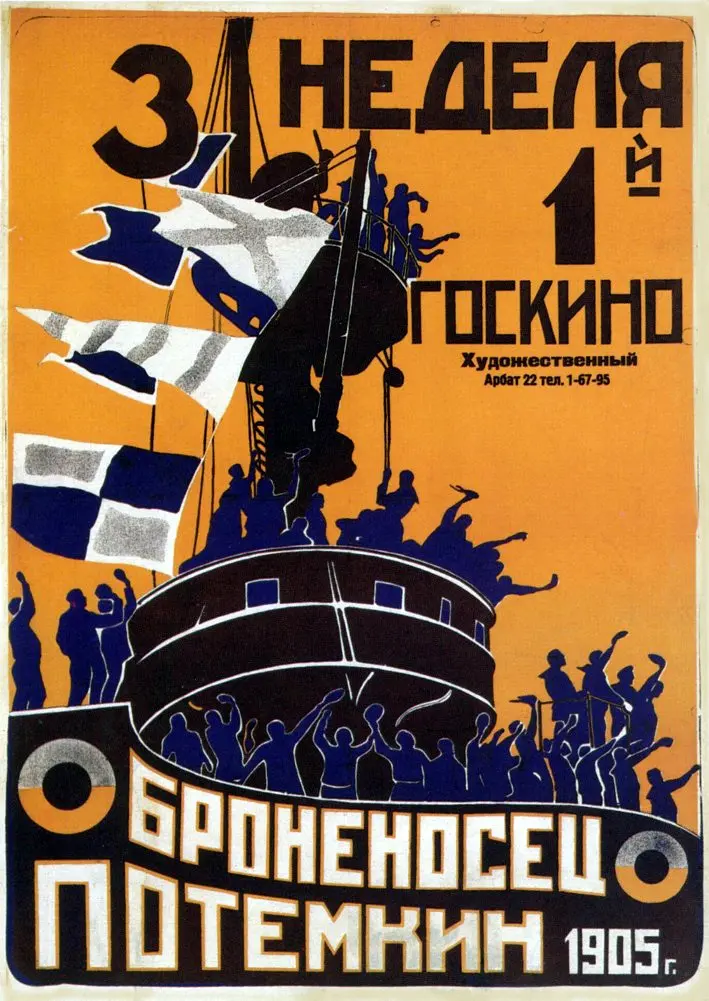
Battleship Potemkin: Six Minutes On A Staircase
Battleship Potemkin (1925)
A propaganda commission became the film that taught cinema how to cut, and one sequence that never happened.
Runtime
74 minutes
Director
Sergei Eisenstein
Box office
$46,653 worldwide
Cinematography
Eduard Tisse
Montage As Argument
Eisenstein was commissioned to mark the twentieth anniversary of the 1905 uprising and delivered a thesis about editing. His claim was that meaning does not live in the shot but in the collision between two shots, so a face plus a plate of maggoty meat is an argument, and a line of boots plus a child's body is a verdict. The famous Odessa Steps massacre is staged with that theory running at full power: the descent broken into fragments, the pram released, the boots advancing in rhythm, the stone lions cut together so that sleeping marble appears to wake and roar. No massacre happened on those steps in 1905. The sequence is so convincing that it is still described as history, which is both Eisenstein's greatest achievement and the reason the film is taught in ethics courses as well as film schools.
Watching Battleship Potemkin
Intensity
/
Scene
"Brothers! Who are you shooting at?
"Vakulinchuk to the firing squad · Battleship Potemkin · 1925
The stone lions are three separate statues at the Alupka palace, cut together so that a single lion appears to rise. It is the clearest demonstration of Eisenstein's theory in the film.
Banned outright in Britain until 1954 and censored across Europe, the film was studied closely by Joseph Goebbels, who wanted a National Socialist equivalent.
The Odessa Steps has been quoted so often that the quotations have their own lineage: Brian De Palma restages the pram in The Untouchables, Terry Gilliam sends it through Brazil, Woody Allen jokes about it in Bananas. The uncomfortable part is that the sequence is fiction. Eisenstein proved that assembling true looking fragments in the right order produces something an audience will remember as fact, a discovery that belongs as much to the history of propaganda as to the history of art.