August 2026: The Month Earth Crossed 1.5
16.96 Degrees: The Number Scientists Expected, and Hoped Would Not Arrive
The average surface air temperature across the planet in August 2026 was 16.96 degrees Celsius, according to ERA5 data published by the Copernicus Climate Change Service (C3S) on September 10. That made last month the joint hottest in recorded human history, tied with July 2023 at 16.95 degrees. The gap between the two months is 0.01 degrees, smaller than the margin of error. Copernicus treats them as equal. The figure that matters more is the anomaly: 1.65 degrees above the pre-industrial baseline of 1850 to 1900. That pushed August 2026 past the 1.5 degree threshold set by the Paris Agreement as the upper target for global warming. It is the first month to do so since November 2025, when the El Nino cycle was still feeding energy into the system. This time, El Nino is back. And so is the record.
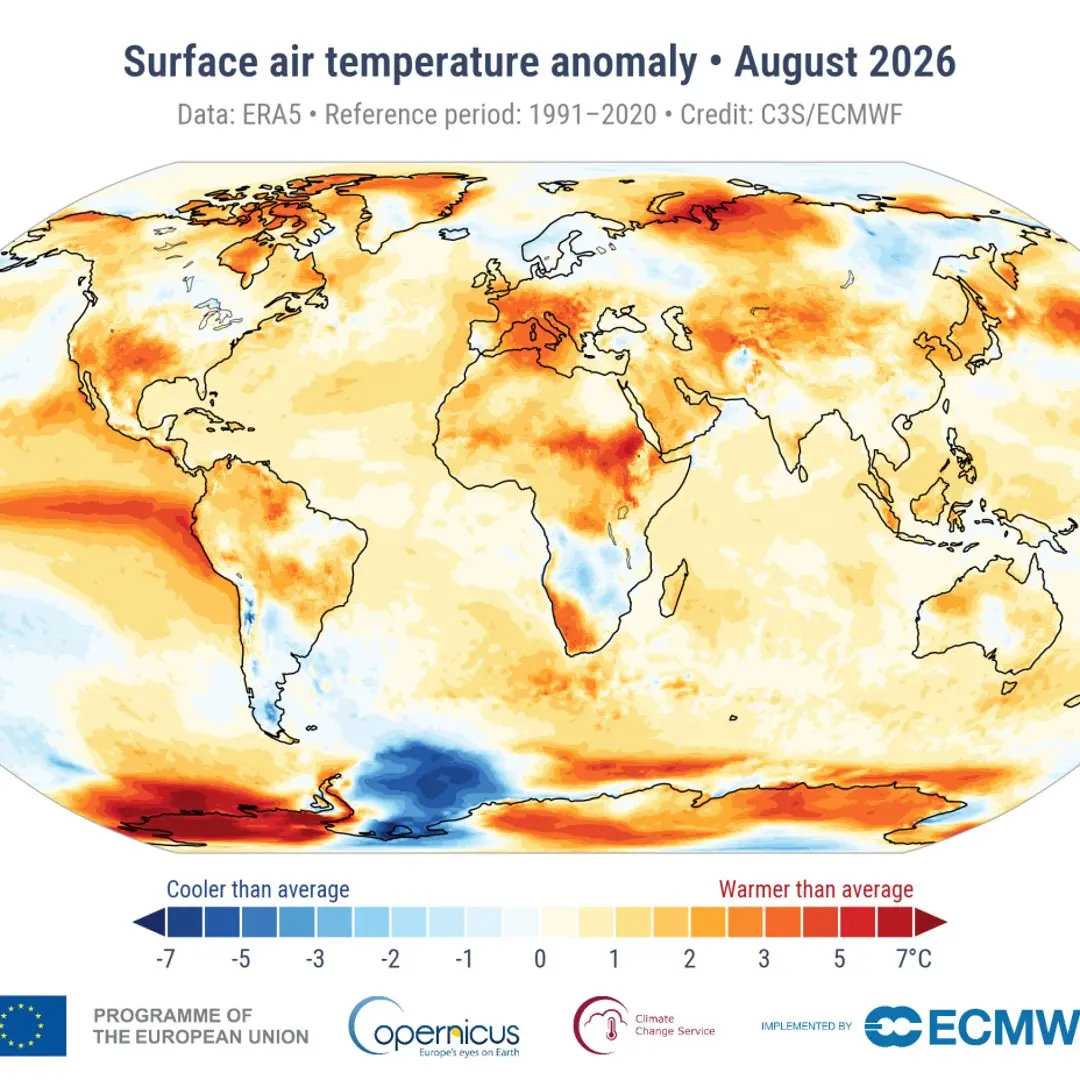
Surface air temperature anomaly for August 2026 relative to 1991 to 2020 average.
ERA5 dataset. Virtually every land mass ran warmer than average. The deeper red covers western France and England, where daily temperatures were more than 10 degrees Celsius above the seasonal norm.
The Numbers That Do Not Stand Alone
The previous August record was 16.82 degrees, a figure shared by August 2023 and August 2024. The new August record is 0.14 degrees above that. To understand what that means, consider that the entire range of average global surface temperatures between a cool year and a record year covers roughly 0.4 degrees. A jump of 0.14 degrees in one month's August average is not a rounding error. It is a structural shift. Sea surface temperatures told the same story. The average across extra-polar oceans (60 degrees south to 60 degrees north) reached 21.07 degrees in August, the highest on record for any month in the ERA5 dataset, tying the previous all-time record set in March 2024. On August 24 and 25, the daily average hit 21.11 degrees, a new single-day record. The boreal summer as a whole, June to August 2026, matched 2024 as the joint-warmest boreal summer in ERA5. For the year to date, January through August, 2026 is the second-warmest on record, behind 2024 and ahead of 2023.
Global average temperature, August 2026
16.96 degrees C
Above pre-industrial baseline (1850 to 1900)
plus 1.65 degrees C
Above 1991 to 2020 average
plus 0.85 degrees C
Previous August record (2023 and 2024)
16.82 degrees C
Extra-polar ocean surface temperature
21.07 degrees C (joint all-time record)
Last time monthly 1.5 degree threshold was crossed
November 2025
Western Europe's Worst Summer Since 2003 Is Now Its Worst Summer, Full Stop
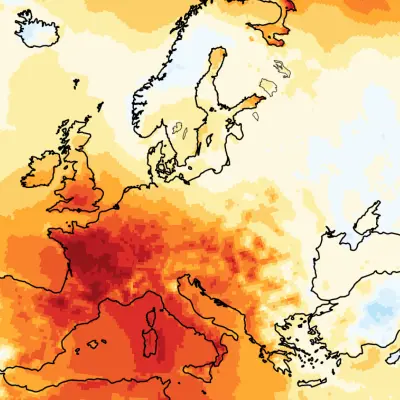
The Copernicus bulletin confirmed what residents of France, the United Kingdom, Spain and Portugal already knew: the summer of 2026 was western Europe's warmest on record, surpassing the catastrophic 2003 heatwave that killed an estimated 70,000 people across the continent. The 2003 record stood for 23 years. It is now gone. The August average land temperature across Europe reached 20.26 degrees Celsius, 1.10 degrees above the 1991 to 2020 average. Western France and England saw the sharpest departures: daily average temperatures ran more than 10 degrees above normal.
Rivers at Critical Levels
The hydrological consequences were measurable in real time. Copernicus and the European Flood Awareness System (EFAS) recorded exceptionally low river flows across the Rhine, the Danube, the Seine, the Loire, the Rhone, the Po, the Vistula, and the Glomma. Drought conditions were reported in France, the United Kingdom, Hungary, Romania and Serbia.
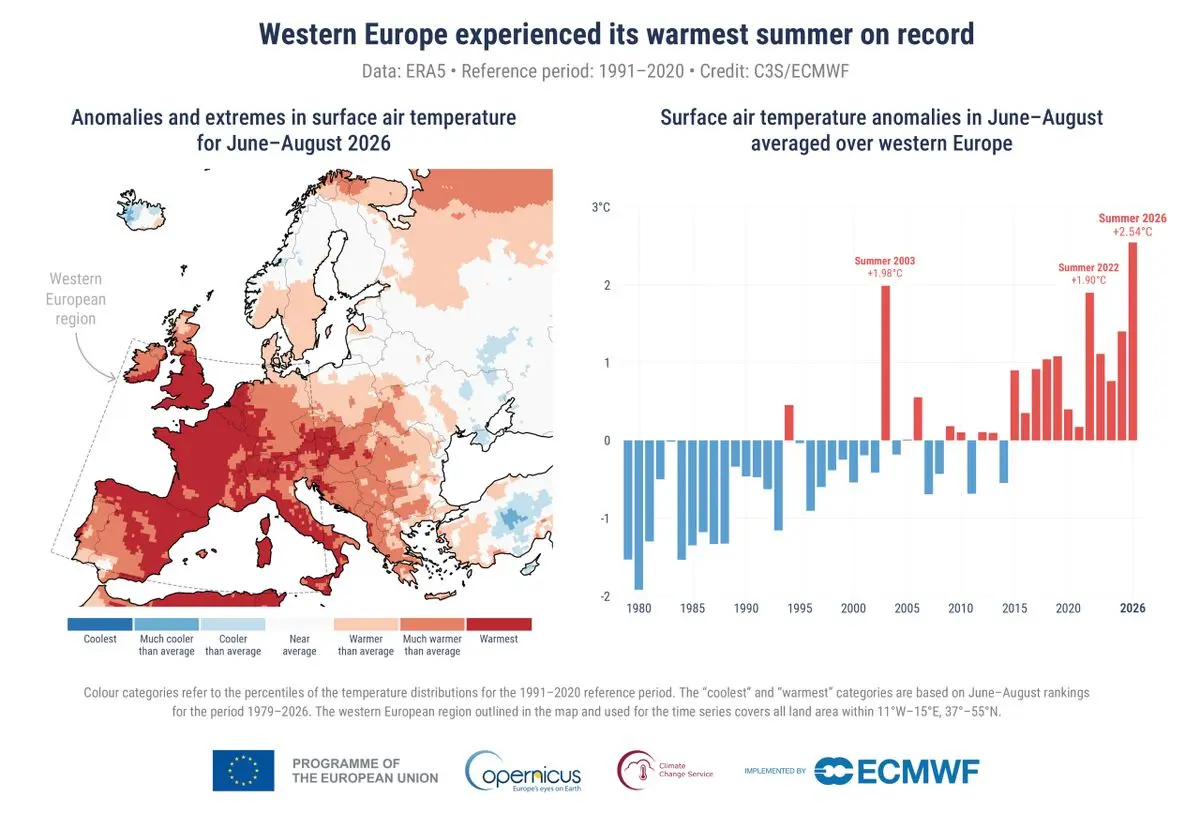
Western Europe summer temperature anomalies relative to the 1991 to 2020 average.
The chart shows 2026 surpassing the 2003 benchmark that had stood as the worst European summer in living memory.
""It is now time to stop acting surprised that our warming planet keeps getting warmer. This is occurring exactly as forecast by scientists literally decades ago." Andrew Dessler, climate scientist, Texas A&M University
"Steph1st of October 2026

What the 1.5 Degree Threshold Actually Means
A single month crossing 1.5 degrees does not constitute a Paris Agreement breach. The agreement's target refers to long-term global average warming, measured over decades, not individual months. Scientists have been clear about this distinction: monthly exceedances are a leading indicator, not the verdict. But the direction matters. In the twelve months to August 2026, the 12-month running average has been above 1.5 degrees for most of the past two years. The months that fell below the threshold in early 2026 were the exception. August's return confirmed the exception was temporary.
The El Nino Connection, and What Comes Next
Samantha Burgess, Strategic Lead for Climate at the European Centre for Medium-Range Weather Forecasts (ECMWF), said: "August 2026 was a remarkable month in the global climate record. These observations show how climate change is driving extremes across both the atmosphere and the oceans." El Nino conditions in the equatorial Pacific add heat to the atmosphere on top of background warming from fossil fuel emissions. The El Nino that faded in early 2026 left a cooler first half of the year. Its return, confirmed by equatorial Pacific sea surface temperatures, has restored the record-setting conditions. No La Nina reversal is projected. The forecast for the months ahead: above 1.5 degrees.