AU Mic c: 4-Planet System, 0.119 AU Out
Mini-neptune around AU Mic
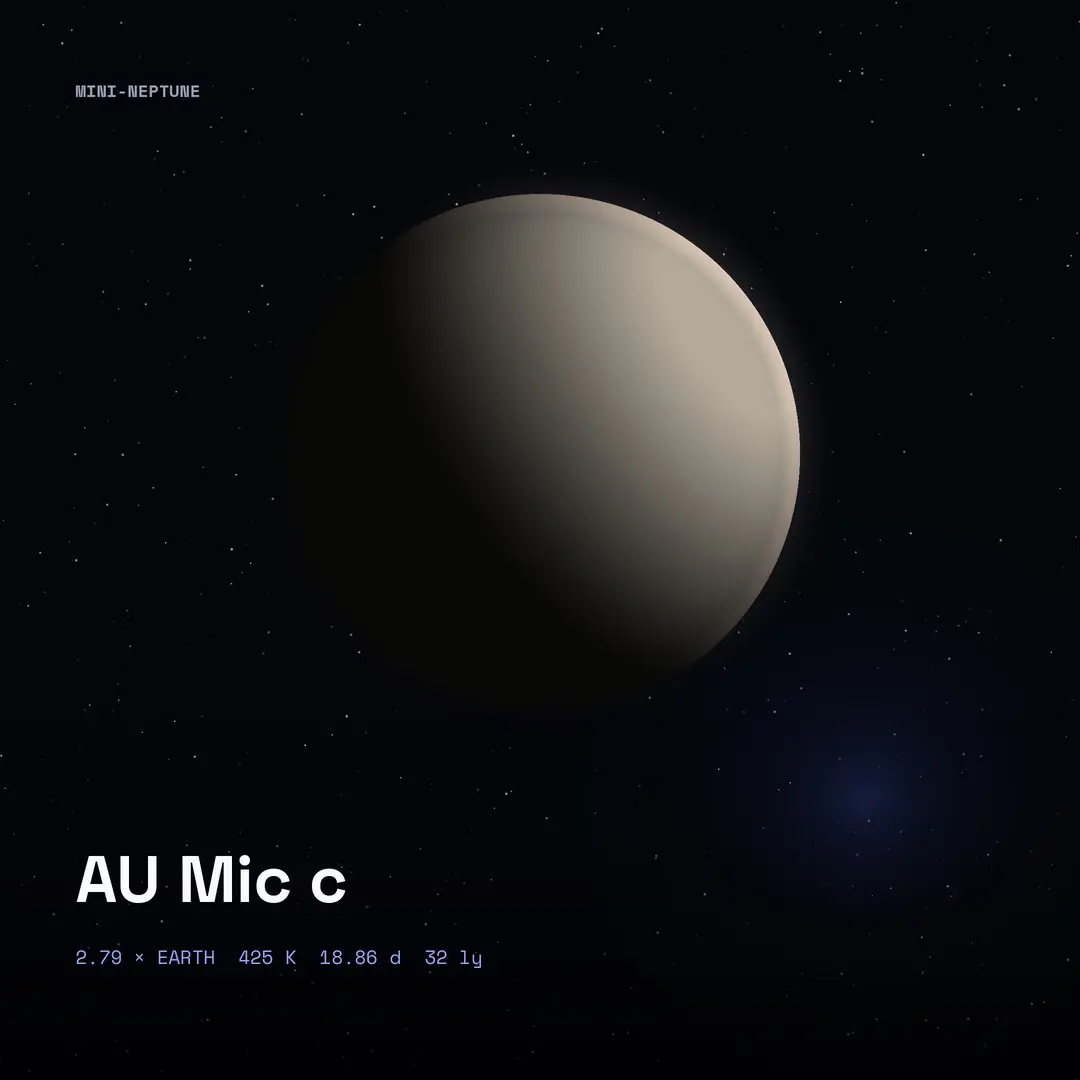
It is 2.79 times Earth's radius, closest in size to Neptune, and 14.5 times Earth's mass, at 3.90 g/cm3, less dense than Earth. A year there lasts 18.86 days, on an orbit 3 times closer to its star than Mercury is to the Sun. Its equilibrium temperature is 425 K, hotter than any desert. The host star AU Mic runs at 3540 K with 0.64 times the Sun's mass.
Radius
2.79 Earth radii
Mass
14.5 Earth masses
Equilibrium temperature
425 K (measured)
One year
18.86 days
Orbit radius
0.1190 AU
Host star
AU Mic at 3540 K
Distance
32 light-years
Starlight blocked
0.088% at each transit
What the transit gives
How deep the star dims fixes the planet's size relative to it.
Found by Transiting Exoplanet Survey Satellite (TESS) in 2021. TESS scans most of the sky in 27-day stretches, so it favours bright nearby stars and short orbits over the faint distant ones Kepler specialised in.
The size came from a crossing, the mass did not. That pairing is uncommon and it is what lets anyone say whether this is rock or gas.
AU Mic has 4 known planets. Multi-planet systems are where orbital dynamics can be measured rather than assumed.
