AU Mic b: 4-Planet System, 0.070 AU Out
Ice giant around AU Mic
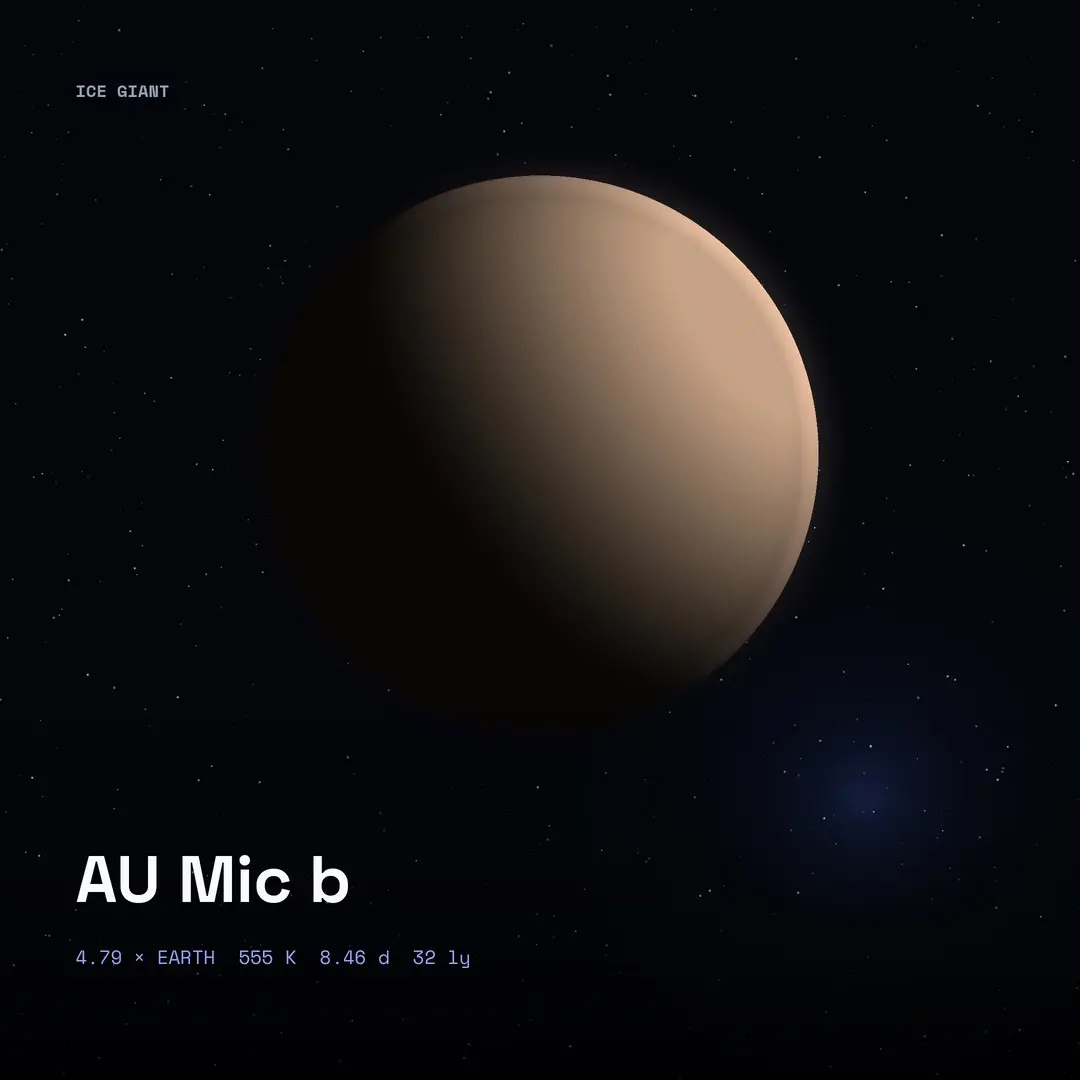
It is 4.79 times Earth's radius, closest in size to Uranus, and 9.0 times Earth's mass, at 0.49 g/cm3, less dense than Earth. A year there lasts 8.46 days, on an orbit 6 times closer to its star than Mercury is to the Sun. Its equilibrium temperature is 555 K, hotter than any desert. The host star AU Mic runs at 3540 K with 0.64 times the Sun's mass.
Radius
4.79 Earth radii
Mass
9.0 Earth masses
Equilibrium temperature
555 K (measured)
One year
8.46 days
Orbit radius
0.0700 AU
Host star
AU Mic at 3540 K
Distance
32 light-years
Starlight blocked
0.259% at each transit
What a crossing measures
The depth of the dip is the ratio of the two discs, so the radius follows.
AU Mic has 4 known planets. Planets in company tug on each other, and those tugs are measurable, which is how masses get pinned down without a wobble.
Found by Transiting Exoplanet Survey Satellite (TESS) in 2020. TESS scans most of the sky in 27-day stretches, so it favours bright nearby stars and short orbits over the faint distant ones Kepler specialised in.
Two independent measurements sit behind this page: a dip in starlight for the size, and something else entirely for the mass. Together they make a density.
