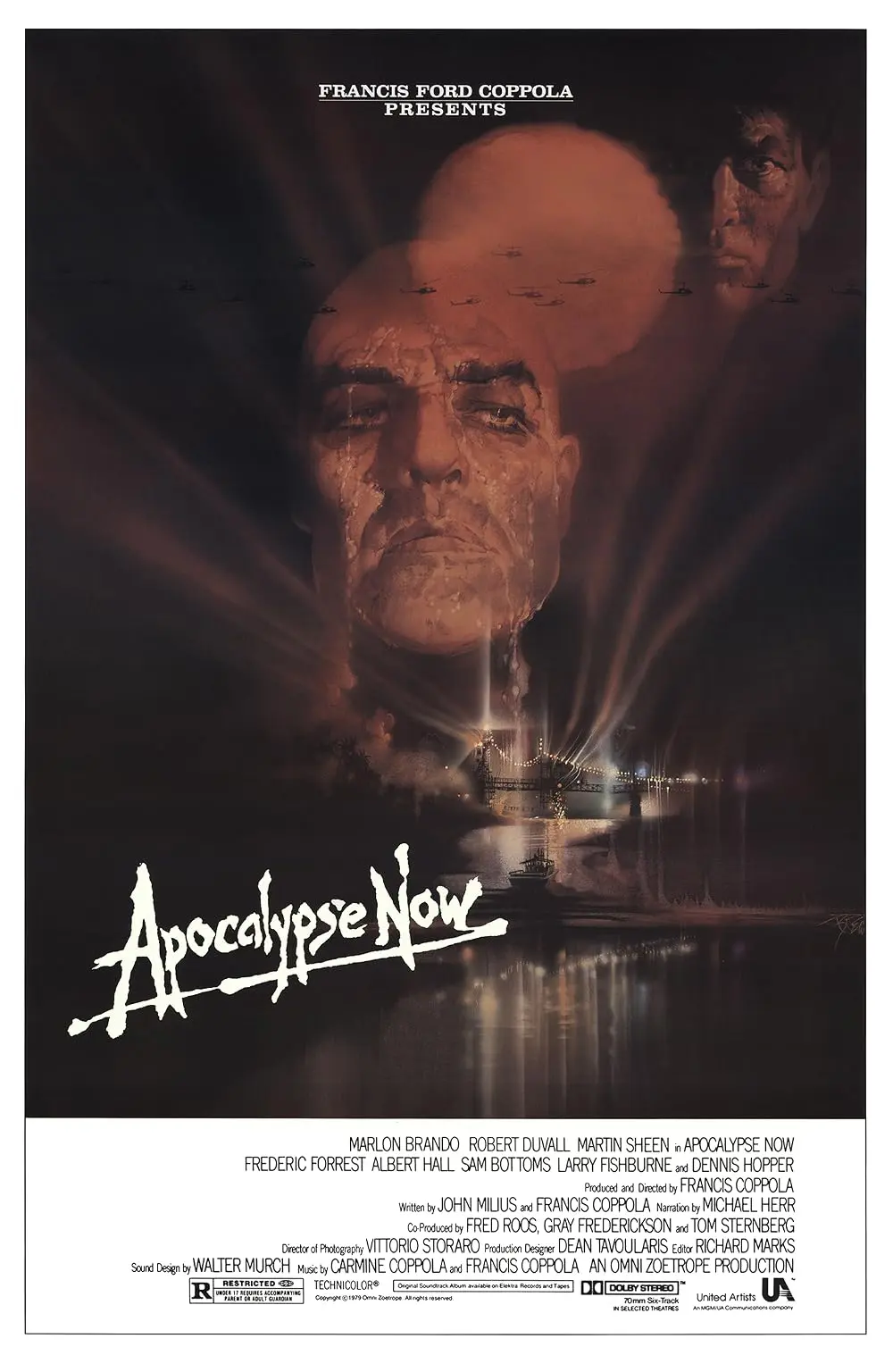
Apocalypse Now: Sixteen Months In The Philippines
Apocalypse Now (1979)
A typhoon destroyed the sets, the star had a heart attack, the government took the helicopters back, and Coppola lost his mind on schedule.
A Production That Became Its Subject
Coppola took Conrad's Heart of Darkness up the Nung River and financed much of it himself, and the shoot turned into the thing it was describing. A typhoon flattened the sets. Martin Sheen had a heart attack at thirty six and crawled to a road for help. The Philippine air force kept recalling the helicopters mid scene to fight an actual insurgency. Brando arrived weighing far more than the part allowed, having not read the book, so Coppola shot him in shadow and let him improvise. What came out of it is a war film with no campaign and no objective, structured as a boat trip through set pieces that get progressively less explicable, and photographed by Vittorio Storaro as though the jungle were lit from inside.
Runtime
147 minutes
Director
Francis Ford Coppola
Budget
$31.5 million
Box office
$92.2 million worldwide
Cinematography
Vittorio Storaro
Watching Apocalypse Now
Register
/
Chapter
"I love the smell of napalm in the morning.
"Lieutenant Colonel Kilgore · Apocalypse Now · 1979
It shared the Palme d'Or in 1979 with The Tin Drum while still technically unfinished, screened as a work in progress because Coppola could not settle the ending.
Eleanor Coppola filmed the production and its footage became Hearts of Darkness in 1991, including her husband saying on tape that the film was a disaster and he had no idea what he was doing.
There are now three official versions, the 1979 cut, Redux in 2001 and the Final Cut in 2019, and the argument about which is correct has never settled because the film was never resolved in the first place. Its subject is not Vietnam policy but the collapse of a chain of command into theatre, which is why it aged into the definitive American film about the war without ever describing the war accurately.