AMD Buys the Godmother of AI for $8.2 Billion
AMD just spent $8.2 billion to buy the woman who built ImageNet
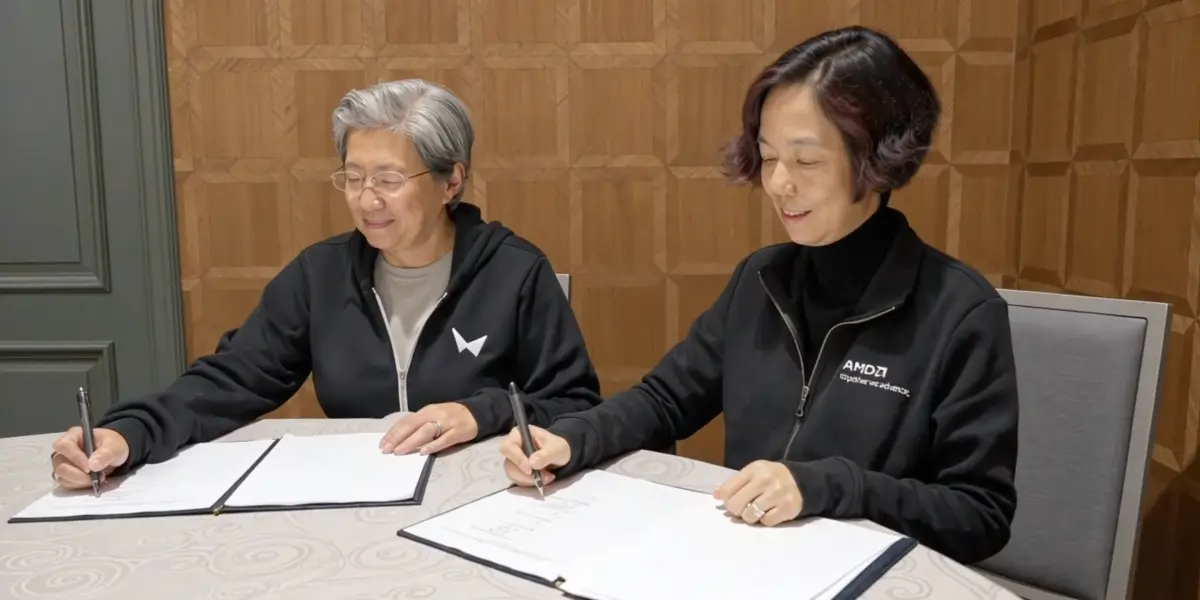
On September 28, 2026, AMD announced it would acquire World Labs, the San Francisco spatial-intelligence startup co-founded by Dr. Fei-Fei Li, in an all-stock deal worth $8.2 billion. Li, known as the godmother of AI, will join AMD as executive vice president and chief scientist, reporting directly to chair and CEO Dr. Lisa Su. The deal is expected to close by the end of 2026, subject to regulatory approval. Two years ago, World Labs did not exist. When it emerged from stealth in September 2024, its seed round valued the company at $1 billion. Eight months later, a $1 billion funding round in February 2026 put that valuation at $5 billion. AMD's $8.2 billion acquisition values it at 8.2x its founding price. That trajectory, from zero to an $8.2 billion exit inside 24 months, makes it one of the fastest startup journeys in AI history.
The woman behind ImageNet and why she matters
Li spent two decades as a Stanford computer science professor and built ImageNet: 14 million labeled photographs that became the training ground for modern computer vision. When its challenge launched in 2010, object-detection error rates fell from 25 percent to under 4 percent within five years. Every self-driving camera and medical imaging tool traces a direct line back to that dataset. In 2024, she co-founded World Labs with three other Stanford professors, betting the next frontier was space, not language. Their product, Marble (beta: November 2025), takes a text prompt, photograph, or video clip and generates a navigable, editable 3D environment. Not an image. A space you can move through.
From $230 million to $8.2 billion in 24 months
The seed round (September 2024) raised $230 million at a $1 billion valuation, backed by Andreessen Horowitz, NEA, and Radical Ventures, with Geoffrey Hinton, Jeff Dean, Reid Hoffman, and Eric Schmidt among the individuals. The February 2026 $1 billion round brought AMD and Nvidia in as investors, plus Autodesk at $200 million. Total raised before exit: $1.23 billion. AMD was not a cold buyer. Lisa Su called herself a long-time friend and early investor, and the two companies had run a joint training and inference optimisation program on AMD GPUs for over a year. The acquisition converted a partnership into ownership.
"Without having a focused hardware effort, AI is hobbled in efficiency. And scale. Dr. Fei-Fei Li, co-founder and CEO of World Labs, September 28, 2026
"Steph29th of September 2026

World Labs seed valuation (September 2024)
$1 billion
World Labs Series B valuation (February 2026)
$5 billion
AMD acquisition price (September 2026)
$8.2 billion
Valuation growth from founding to exit
8.2x in 24 months
Capital raised before acquisition
$1.23 billion
AMD's largest prior acquisition (Xilinx, 2022)
approx. $50 billion
AMD Instinct MI450 deal with Anthropic signed this year
$5 billion
Why AMD is paying $8.2 billion for a researcher, not a product
The deal is not about Marble. AMD makes no money building world models. The logic is about what AI workloads are becoming. Large language models are trained on text. World models are trained on video: physical reality, with gravity, cause and effect. Running them requires different memory patterns, different precision, different latency profiles than a transformer. By internalising Li and her team, AMD can shape its 2027 and 2028 chip roadmaps around those requirements before the silicon is designed. Nvidia sees the same opportunity: it partners with Wayve on self-driving applications and runs its own physical-AI stack under Isaac. The gap is that Nvidia has a partner. AMD now has the person who defined the field. Neither Google nor OpenAI has a hire at this level on its hardware side. For a company that spent years trailing Nvidia in data-centre GPUs, that is a statement as much as a strategy.