
AI Is Erasing the Entry-Level Job
The first-job gap just hit 19 percent, and it keeps widening
Workers aged 22 to 25 in highly AI-exposed occupations are now 19 percent less likely to be employed than peers in less-exposed fields. That is the headline finding of the August 2026 revision of Stanford Digital Economy Lab's "Canaries in the Coal Mine" paper. Twelve months earlier the gap was 15 percent. Before ChatGPT launched in late 2022, it did not exist. The study draws on ADP payroll records covering 4.6 million US workers across 730 occupations. Authors Erik Brynjolfsson, Bharat Chandar, and Ruyu Chen call their findings descriptive rather than causal. But they are unambiguous on direction: the gap is real, it is widening, and it falls almost entirely on people who are just starting out. Older workers in the same AI-exposed roles are largely unaffected.
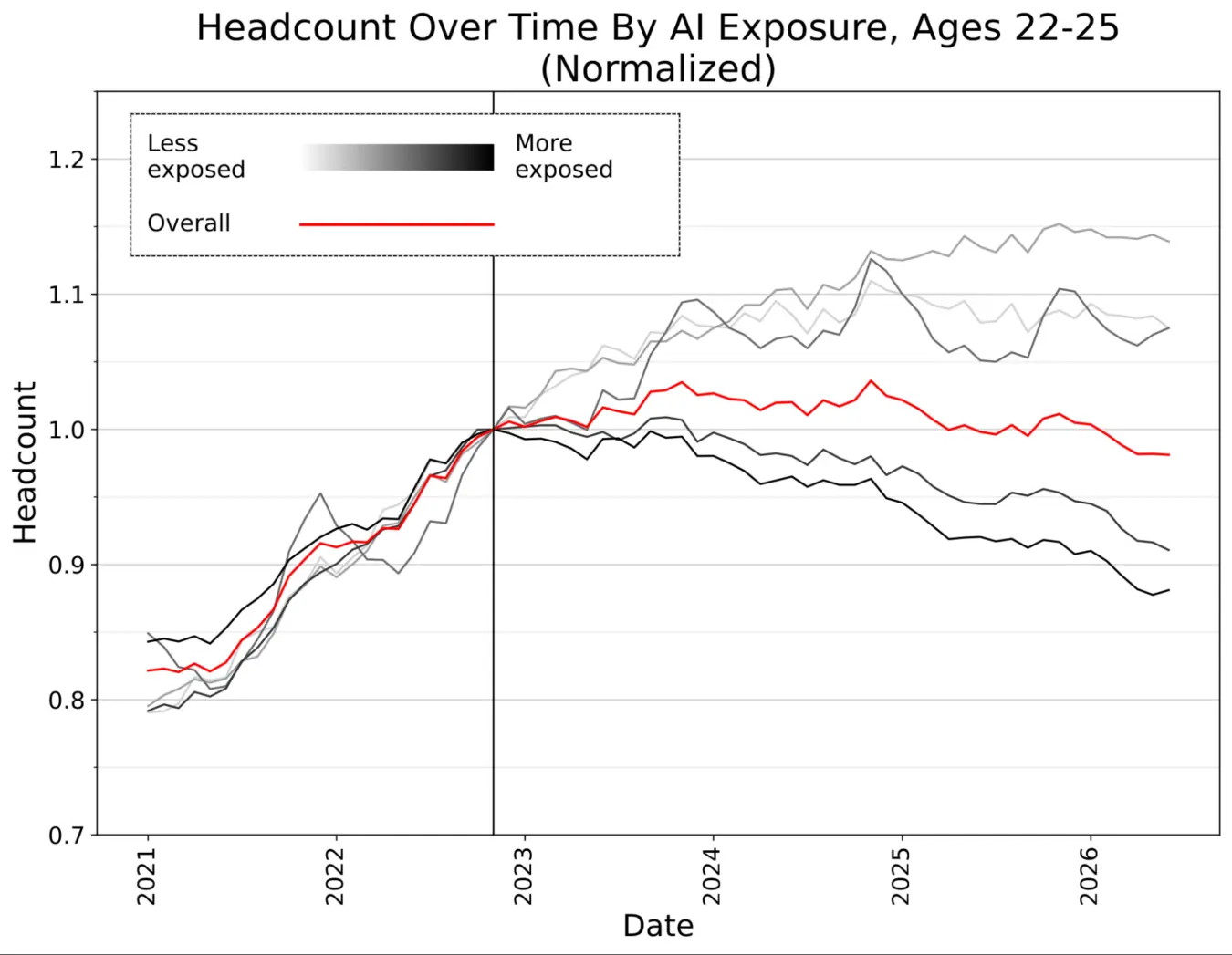
Credit: Stanford Digital Economy Lab. Source: Stanford DEL "Canaries" August 2026.
The chart tracks headcount since 2021, split by AI exposure. For all ages the most and least-exposed groups grow at similar rates after ChatGPT. For ages 22 to 25 they diverge sharply. The most-exposed lines fall 11 percent below their late-2022 baseline by June 2026. The least-exposed lines climb 10 percent above it. That 21-point spread is what the 19 percent headline is measuring. The mechanism is not layoffs. It is a collapse in hiring. Software developer roles for 22 to 25 year-olds are down about 20 percent from their 2022 peak. Customer service roles in the same age band are down 11 percent. Entry-level postings across the economy have fallen 35 percent since early 2023 while senior-level postings rose 15 percent over the same period.

Employment gap, ages 22-25, most vs least AI-exposed (June 2026)
19%
Same gap twelve months earlier (July 2025)
15%
Same gap before ChatGPT (late 2022)
0%
Employment change, ages 22-25 in most AI-exposed roles, since Nov 2022
-11%
Employment change, ages 22-25 in least AI-exposed roles, since Nov 2022
+10%
Entry-level job postings change since early 2023
-35%
Senior-level job postings change since early 2023
+15%
Recent graduate unemployment, ages 22-27 (NY Fed, Q2 2026)
5.6%
Same rate in 2019
3.6%
Recent graduate underemployment rate (NY Fed, Q2 2026)
42%
"It appears what younger workers know overlaps with what LLMs can replace. Erik Brynjolfsson, Director, Stanford Digital Economy Lab, August 2026
"Steph24th of September 2026

Remote work is the second mechanism
The New York Fed published its own analysis in June 2026 and found that the shift to distributed work explains 64 percent of the rise in unemployment among young college graduates. The logic: managers are reluctant to hire inexperienced workers they cannot supervise. Remote work makes the cost of a wrong entry-level hire higher, so companies are making fewer of them. AI reduces the routine cognitive tasks that entry-level hires would have done. Remote work reduces willingness to hire the people who would do them. The combination is structural. It will not reverse when interest rates fall. Finance and information services shed around 9,000 jobs a month since 2023, against 44,000 a month added pre-pandemic. Underemployment for recent graduates hit 42 percent in Q2 2026, the highest level since 2020.

What the market still wants
The Stanford study finds no evidence of broad economy-wide displacement. Healthcare, cybersecurity, and the skilled trades are still hiring. Construction needs 349,000 net new workers in 2026 alone, per Associated Builders and Contractors. Employers have not stopped wanting young people who understand AI tools. They have stopped wanting people who only do the tasks those tools now handle. The graduates landing jobs in AI-exposed fields are coming through referrals, internships, and portfolios rather than cold applications. Brynjolfsson's prescription: "We'll have to more explicitly train people, as opposed to hoping they will figure these things out on their own." The 2027 cohort will enter a market where the gap is wider still.