8 Running Injuries: Causes and Recovery Times
Most Running Injuries Come From One Mistake
Nearly half of all runners get injured in any given year. A systematic review in the British Journal of Sports Medicine puts the annual rate at 19 to 79 percent depending on the group. The knee is the single most injured region, accounting for 24.3 percent of all running injuries. The good news: almost all of the eight most common injuries share the same root cause and the same first fix. The root cause is load greater than the body can absorb. Tendons and bones adapt far more slowly than muscles. A runner who feels fit in four weeks may still have tendons and shin bones that need another two months. Most re-injuries happen because runners return to full mileage the moment pain stops, not when tissue has actually recovered.
Knee injuries
24.3% of all running injuries (BJSM systematic review)
Shin splints (MTSS)
Most common in novice runners: 15% of all injured
Median recovery (all injuries)
71 days, range 9 to 617 days
#1 root cause
Training load increase faster than tissue adaptation
Re-injury trigger
Returning to full load when pain stops, not when tissue heals
How to Read This Reference
Each entry below gives you four things: the cause, the tell-tale symptom that distinguishes it from other injuries, your first action, and a realistic recovery range. Ranges assume you act early. Ignored injuries at the lower end of the range can double or triple the timeline.
1. Runner's Knee (PFPS)
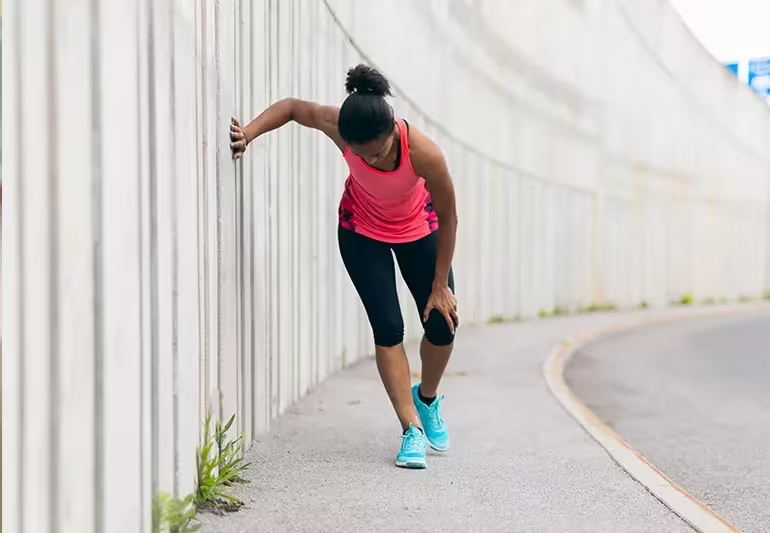
Cause: overuse and weak hip or quad muscles
Symptom
Dull ache around or behind the kneecap; worse on stairs, squatting, or long sitting
First action
Stop the run, ice 20 min, reduce weekly volume by 50%
Recovery
6 to 8 weeks mild; months if chronic or biomechanical issue untreated
2. IT Band Syndrome (ITBS)
Cause: weak glutes and hips; too much mileage too fast
Symptom
Sharp pain on the OUTER side of the knee, sometimes a click; side not front
First action
Rest 2 to 3 days, foam-roll the outer hip (not the band itself)
Recovery
2 to 6 weeks; longer if the hip weakness is not addressed with strength work
3. Shin Splints (MTSS)
Cause: rapid volume increase, hard surfaces, worn-out shoes
Symptom
Dull ache along the inner shin bone; tender to press; eases with warmup, returns after
First action
Cut mileage by half, ice 15 to 20 min, switch to soft surfaces
Recovery
2 to 4 weeks if caught early; 4 to 8 weeks if you pushed through it
Shin splints pushed hard enough become a tibial stress reaction or stress fracture. The pain pattern is identical at first. If shin pain does not ease within two to three weeks of rest, get imaging before resuming running.
4. Plantar Fasciitis
Cause: tight calves, high volume, worn shoes, poor foot mechanics
Symptom
Stabbing heel pain worst on first steps in the morning; eases mid-run, returns after
First action
Stretch calf and plantar fascia before standing; ice 20 min after any running
Recovery
3 to 6 months to full volume; one of the slowest-recovering running injuries
5. Achilles Tendinopathy
Cause: sudden mileage or speed increase; tendons need 8 to 12 weeks to adapt
Symptom
Pain and stiffness at the back of the ankle just above the heel; worst in the morning
First action
Stop speed work and hills; begin heavy slow calf raises (eccentric loading)
Recovery
6 to 12 weeks typical; chronic cases need 3 to 6 months of structured rehab
6. Stress Fracture
Cause: bone loaded faster than remodelling can keep up; risk raised by low vitamin D
Symptom
Localised point tenderness on one spot of bone; pain worsens during run, not just after
First action
Stop all impact immediately and see a doctor; imaging confirms the diagnosis
Recovery
Shin 6 weeks; fibula 8 weeks; metatarsals 11 to 12 weeks; femoral neck 15 weeks
7. Hamstring Strain
Cause: sprint or hill work without warmup; muscle fatigue late in long runs
Symptom
Sudden sharp pull at the back of the thigh, often with an audible pop; bruising possible
First action
RICE for 48 to 72 hours; no stretching in first 48h as it worsens micro-tears
Recovery
Grade 1 mild: 2 to 6 weeks; grade 2 partial: 6 to 12 weeks; grade 3 full: months
8. Hip Flexor Tendinopathy
Cause: high mileage, hill running, weak core failing to control hip drive
Symptom
Deep groin or front-of-hip ache; clicks or catches at the top of the stride
First action
Reduce hill work, strengthen core and glutes, avoid aggressive hip-flexor stretching
Recovery
4 to 8 weeks with load management and targeted strength work

The One Rule That Prevents Most of These
Every injury above is caused or worsened by the same error: adding load faster than the body can adapt. The 10 percent weekly mileage rule exists for this reason. It is not always sufficient on its own but it is the single most effective guardrail most runners ignore. Pain settling is not the same as the tissue being ready. A fully recovered runner does not just have no pain; they have rebuilt strength, mobility and tissue capacity at the injured site. Returning to full training before that point is the most reliable way to add another eight weeks to the timeline. Two practical clearance tests. First: 20 single-leg calf raises on the injured side without compensation. Second: a 20-minute easy run with no pain during and no soreness increase in the 24 hours after. Both passing on the same day is a reasonable signal. If in doubt, see a physio. As of October 2026.