55 Cancri e: A Lava World That Kept Its Air
The first rocky planet outside our system with an atmosphere
55 Cancri e orbits its star in under 18 hours at 0.015 AU. Its surface is a magma ocean. The expectation for a rock that close was either bare stone or a thin veil of vaporised rock, neither of which counts as an atmosphere in any useful sense. In May 2024 JWST measured its thermal emission with two instruments and found something else: a genuine volatile atmosphere, likely rich in carbon dioxide or carbon monoxide. The likely source is the magma itself, outgassing volatiles dissolved in the melt.
Radius
1.875 Earth radii, a super-Earth
Mass and density
7.99 Earth masses at 6.66 g/cm3
One year
17.7 hours
Orbit radius
0.015 AU, roughly a fortieth of Mercury's
Host star
55 Cancri at 5172 K, close to a solar twin
Distance
about 41 light-years
What the thermal emission settled
A bare rock with no atmosphere. Ruled out.
A thin veil of vaporised rock, the default expectation for a lava world. Ruled out.
A genuine volatile atmosphere, likely rich in carbon dioxide or carbon monoxide. This is what the data supports.
Nitrogen, water vapour and sulfur dioxide in the mix. Possible, not established.
Clouds of condensed lava droplets. Proposed to explain the variability, not confirmed.
Secondary means the atmosphere is not the hydrogen the planet formed with. That original envelope is long gone, stripped by the star. What is there now came out of the planet itself. Earth's air is secondary in exactly the same sense, which is why a molten super-Earth turns out to be a reasonable place to study how our own atmosphere got started.
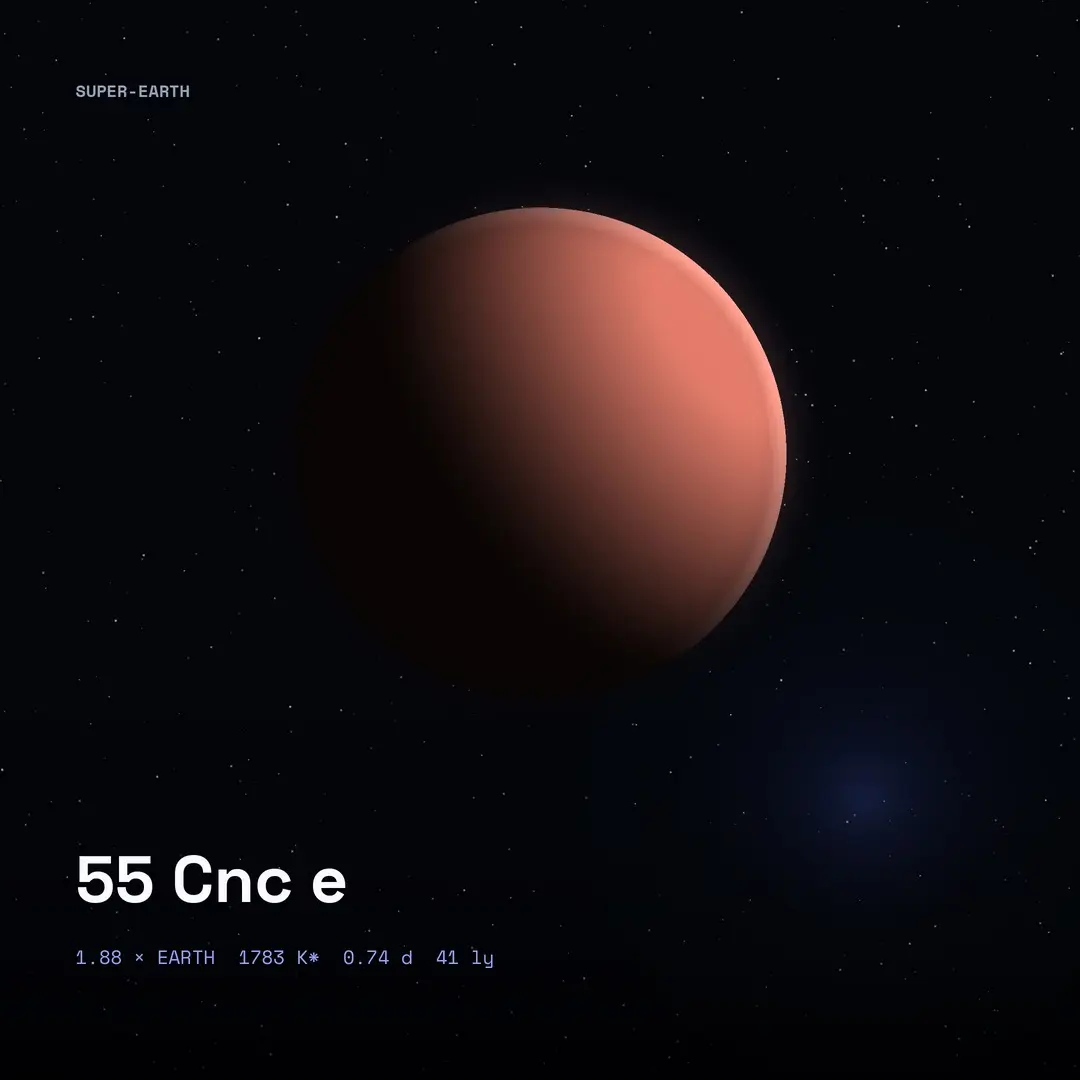
The archive lists no measured equilibrium temperature, so the 1783 K on the cover is derived from the star and the orbital distance and carries an asterisk. It is hot enough to melt every common silicate rock, which is the only part of the number that matters here.
The dayside brightness varies noticeably between observations, by amounts too large for a stable surface. Clouds of condensed rock, plumes from the magma ocean and shifting circulation have all been proposed. Nobody has settled which, and it makes every measurement here provisional.