130,000 Eyes: America's War Over Flock Cameras
130,000 Cameras and They're All Watching You
Ten years ago, automated license plate readers were specialist tools used by repo men and a handful of big-city police departments. Today there are 130,000 AI-powered ALPRs on American streets, operated by more than 5,000 law enforcement agencies. Every month they capture billions of license plates, plus each vehicle's make, model, colour, and physical alterations. The dominant vendor is Flock Safety, an Atlanta startup whose cameras are so ubiquitous that a single network can tell police everywhere you drove, every day, for months. That capability is now at the centre of one of the sharpest civil liberties fights in the country, and in at least 36 states, people are simply cutting the cameras down.
AI-powered ALPRs on American streets
130,000
Law enforcement agencies using Flock
5,000+
License plates captured per month
billions
Cities that have cancelled Flock contracts
100+
States with confirmed vandalism incidents
36
People registered for DeFlock's Week of Action
25,000+
False-alert rate (California 2024 police audit)
71%
How Bad Can Plate Data Actually Get
Flock's defenders call the cameras targeted and proportionate. The data tells a different story. A 2024 analysis by California police found that 71 percent of Flock alerts sent to officers turned out to be wrong plate reads. That error rate has led to real harm: one family was held at gunpoint after their car was misidentified. A Colorado officer used Flock data to accuse a woman of theft and refused to look at the exonerating evidence sitting alongside it. The misuse cases are harder to dismiss. Officers have used the system to stalk ex-girlfriends. A Texas sheriff's office ran a search to track a woman suspected of seeking an abortion, a use case Flock's own terms of service do not explicitly prohibit. A Kansas police department used the cameras to identify a journalist who wrote an op-ed critical of the department. Jay Stanley, Senior Policy Analyst at the ACLU's Speech, Privacy and Technology Project, put it plainly: "The potential for police fishing expeditions is unlimited." Th
"We don't own this data. We don't sell this data. Cities have control over how it is used.
"Garrett Langley · CEO · Flock Safety · August 2026
The Uprising: Rakes, Paint, and Reciprocating Saws
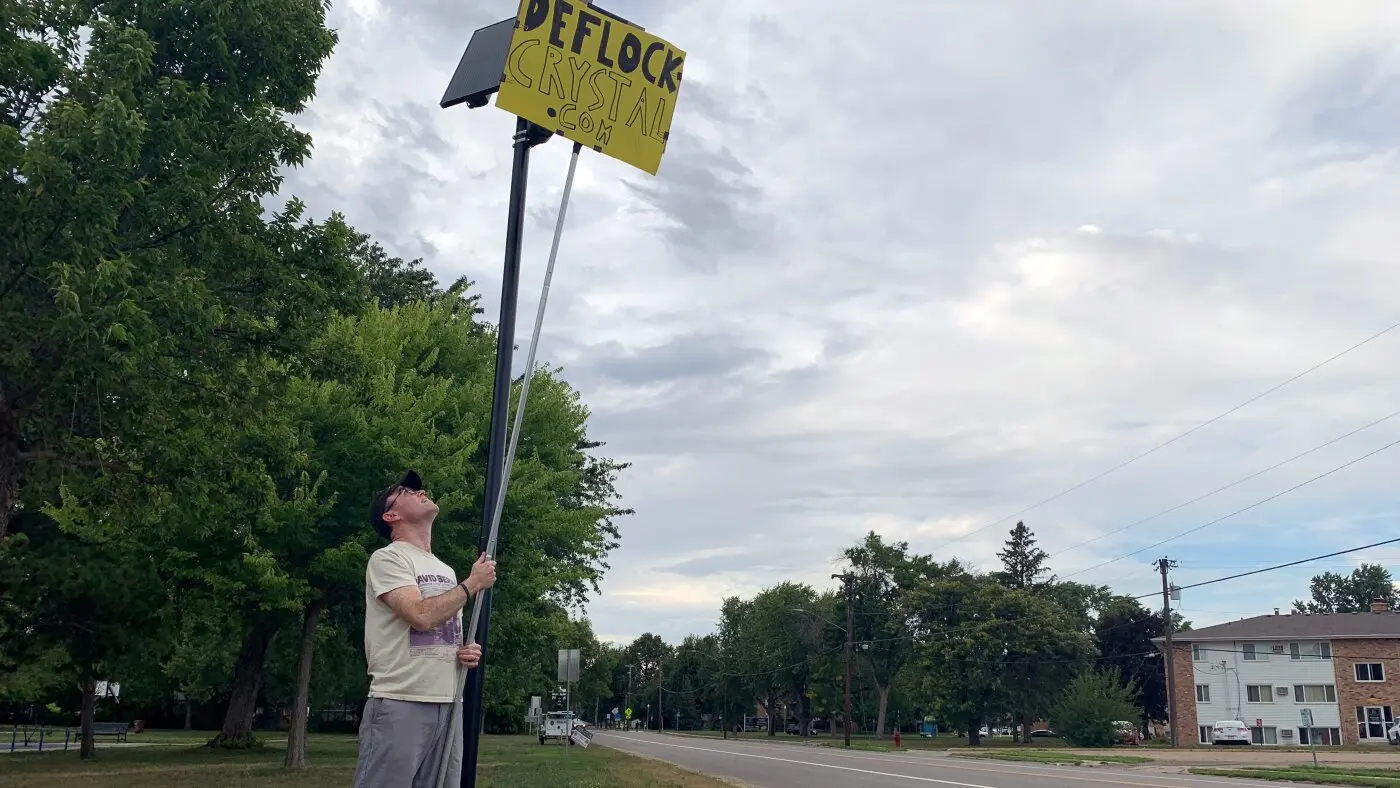
The backlash is no longer polite. NPR's review of local news reports found Flock cameras damaged in at least 36 states. The methods include painting the lenses, covering them with stickers, shooting them, driving vehicles into the poles, and sawing the poles clean through. Social media is full of instructional content, shot in the tongue-in-cheek register of a home-improvement tutorial. Not everyone is going that far. In Crystal, Minnesota, a resident named Brady O'Rourke walks to the busiest street near his house several times a week carrying a roof rake, a long pole normally used to knock snow off roofs, with a bright yellow sign taped to the end. He holds it in front of the camera lens. It is legal. It is stubborn. It has become an emblem of a movement that has grown faster than Flock's lawyers can keep up with. DeFlock, the advocacy group that maps every known plate reader location across the US, declared a National Week of Action this month. More than 25,000 people registered fo
Flock's August Fix and Why It Changed Nothing
On August 13, 2026, under pressure from the vandalism wave and a wave of negative press, Flock Safety announced a round of privacy reforms. The company said it would shorten its recommended data retention periods, build in new oversight tools, and cut off access to officers who appear to be misusing the system. Critics were not moved. "The changes are bull," said one activist who has been targeting the cameras. The problem, in the activists' view, is not that Flock lacks oversight features. It is that the infrastructure itself, a private company building a de facto national movement database for law enforcement, without warrants, without public votes, and without meaningful judicial oversight, should not exist in its current form. Clare Garvie, Deputy Director for Technology Law and Policy at the NYU Policing Project, has noted that the system gives law enforcement the ability to look at where any of us was at any given point, retroactively. That is not a feature. That is the product
What the Courts May Decide
The legal front is moving. In April 2026, the ACLU filed an amicus brief in a Fourth Circuit case arguing that mass ALPR use violates the Fourth Amendment's protection against unreasonable search and seizure. The brief argues that the aggregate picture built up by tracking every vehicle through every intersection constitutes a search, even if each individual plate scan does not. In May 2026, a bipartisan amendment to restrict federal funding for ALPR infrastructure gained enough support to pass committee, though it has not yet been signed into law. The ACLU has also released model legislation for states and cities to adopt data minimisation requirements, use restrictions, and warrant thresholds for historical queries. The cameras are not going anywhere fast. Flock's CEO Garrett Langley has warned that vandalism constitutes a felony and that activists are "being amped up to go do something" dangerous. But 100 cities have already voted with their contracts. And in 36 states, some resid